

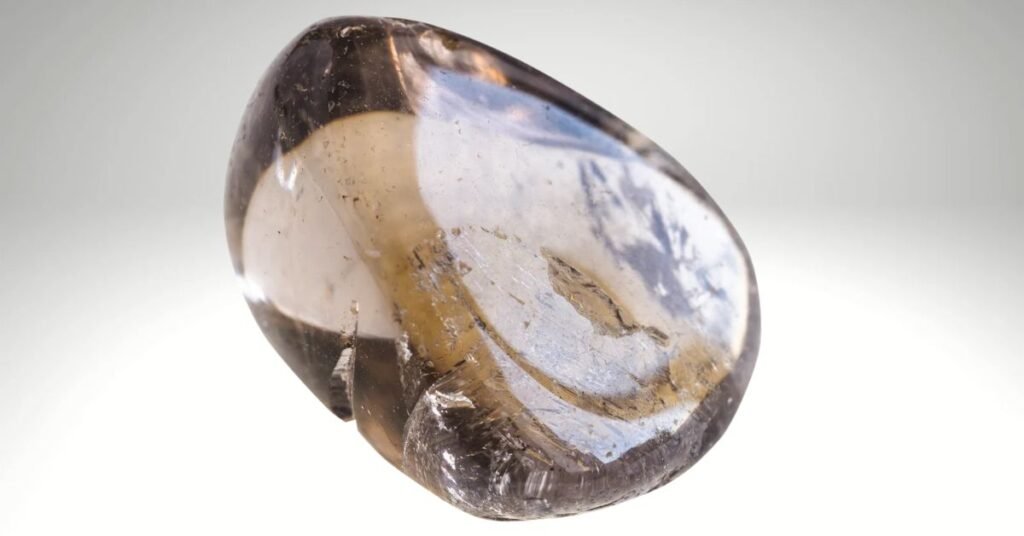
Smoky quartz is a translucent brown-to-gray variety of quartz, and the traditional smoky quartz meaning centers on grounding, protection, and letting go of what you no longer need to carry. It looks like clear quartz seen through a veil of woodsmoke, and that softened, earthy color is a large part of its appeal. Where clear quartz feels bright and expansive, smoky quartz feels steady and quiet, like the moment at the end of a long day when you finally set everything down.
It’s also one of the most misunderstood crystals. Its color really does come from radiation, which worries some people, and much of the very dark “smoky quartz” sold online has been darkened in a lab. This guide explains what smoky quartz is, where its color comes from, what it represents, how to use it, and how to choose a natural piece.
Table of Contents
What Is Smoky Quartz?
Smoky quartz is a color variety of quartz, the same mineral as clear quartz, amethyst, and citrine. Its color ranges from pale, almost transparent tan to deep chocolate brown and near-black. The darkest, almost opaque variety is sometimes called morion.
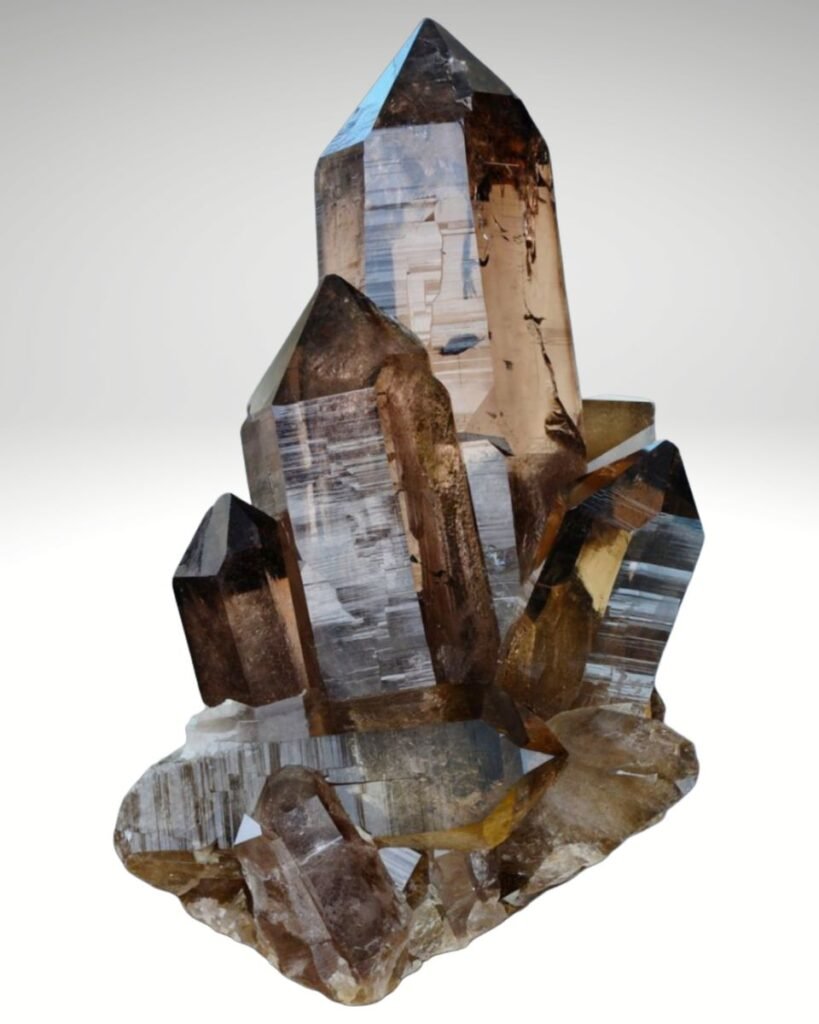
Like all quartz, smoky quartz measures 7 on the Mohs hardness scale, which makes it durable enough for everyday jewelry, worry stones, and display pieces. It often grows as long, six-sided points, and it’s one of the few crystals where natural points are widely available at reasonable prices.
According to Geology.com, Brazil supplies most of the smoky quartz used in jewelry today, with Madagascar as another important commercial source. Notable deposits also exist in Switzerland, Russia, Ukraine, Colorado, and New Hampshire.
Where Does Smoky Quartz Get Its Color?
This is the part most guides skip, and it’s genuinely fascinating.
Smoky quartz starts out as ordinary quartz with a tiny impurity: a few atoms of aluminum sitting where silicon atoms would normally be. Geology.com explains that the color appears when natural radiation, given off by the surrounding rock, activates “color centers” around those aluminum impurities. Over geologic time, that low-level radiation knocks electrons out of place, creating tiny defects that absorb light and produce the smoky brown tone.
Amethyst forms in a similar way, except its color centers form around iron instead of aluminum. That’s why amethyst and smoky quartz sometimes appear in the same crystal, and why both can lose color if they’re heated. In fact, much of the citrine on the market is heat-treated amethyst, as we explain in our guide to citrine meaning.
If you want a metaphor, it’s a good one: smoky quartz is clear quartz that has absorbed its surroundings for millions of years, slowly, quietly, and without breaking. That’s a fitting image for a stone associated with processing heavy energy and letting it settle.
Is Smoky Quartz Radioactive?
No. This is one of the most common questions about smoky quartz, and the answer is reassuring.
Smoky quartz was exposed to natural radiation while it formed, but the stone itself doesn’t give off radiation. The radiation changed the crystal’s structure, creating the color centers that absorb light, and then it was gone. A smoky quartz point on your nightstand is no more radioactive than a clear quartz point.
The same is true of smoky quartz that has been darkened in a lab. Gem labs color colorless quartz by exposing it to gamma rays, a process that doesn’t make the stone radioactive. A study of irradiated quartz published in the journal Materials Research describes how colorless quartz with aluminum impurities turns smoky under gamma rays, and notes that this treatment is routine in jewelry production (Materials Research). The treatment is safe, but it’s worth knowing about, because it affects how a stone looks and how it should be described.
How Can You Tell Natural Smoky Quartz From Treated Stones?
Natural smoky quartz is common and inexpensive, so lab treatment isn’t as widespread as it is for some stones. But very dark, uniformly black “smoky quartz” deserves a closer look. Here’s how the most common versions compare:
| Type | How it’s made | Typical look | What to know |
|---|---|---|---|
| Natural smoky quartz | Natural radiation acting on aluminum in quartz over geologic time | Light tan to deep brown, often with uneven color zones and lighter areas near the base of points | The classic stone; color is stable under normal indoor light |
| Morion | Natural, very dark smoky quartz | Near-black, nearly opaque | Genuine but less common; often priced higher |
| Irradiated quartz | Colorless quartz exposed to gamma rays in a lab | Very dark, often uniformly black, sometimes with a slightly gray, flat look | Safe to handle, but should be disclosed as treated |
| Heated smoky quartz | Dark natural stone heated to lighten it | Even, lighter brown or golden tone | Sometimes sold as “smoky citrine” or simply citrine |
| Glass | Man-made | Perfectly uniform color, sometimes with tiny round bubbles | Not quartz at all |
The simplest clues are color variation and price. Natural smoky quartz almost always shows some variation in tone, while lab-darkened points tend to be the same inky black from tip to base. If a large, jet-black point is surprisingly cheap, it’s worth asking the seller whether it has been irradiated.
A Short History of Smoky Quartz
Smoky quartz has a long and practical history. Gem lore holds that flat panes of smoky quartz were used in China as early as the 12th century as a kind of early sunglasses, cutting glare and, according to some accounts, helping judges keep their expressions unreadable in court.
In Scotland, smoky quartz from the Cairngorm Mountains is known as cairngorm, and Geology.com describes it as Scotland’s national gem. Cairngorm became closely tied to Highland dress, appearing in brooches, kilt pins, and the hilts of ceremonial daggers. The original Scottish deposits were largely worked out long ago, so most “cairngorm” jewelry today uses imported smoky quartz.
During the Victorian era, dark smoky quartz was used in mourning jewelry, a quiet way of carrying grief while still wearing something beautiful.
There’s an American chapter, too. In 1985, New Hampshire designated smoky quartz as its official state gem (New Hampshire General Court). The state’s granite is rich in quartz, and smoky crystals are still found in its hills.
Smoky Quartz Meaning: What Does It Represent Spiritually?
In modern crystal practice, smoky quartz carries a clear and consistent set of meanings.
Grounding. Smoky quartz is one of the most popular grounding stones, used to feel more present in the body and less caught up in racing thoughts. Our guide on how to ground yourself spiritually explains practices that pair well with it.
Letting go. Smoky quartz is traditionally associated with releasing: stress, old habits, resentment, or the mental clutter of a long day. Our article on detachment and inner freedom explores this idea in more depth.
Protection. Like black tourmaline, smoky quartz is used as a protective stone, though many people find it gentler and less intense. It’s a common choice for entryways and workspaces.
Steady calm. Smoky quartz is often used during demanding seasons of life, including grief. It appears in our guide to crystals for grief and loss as a steadying companion.
Chakra connection. Smoky quartz is most closely linked to the root chakra, the energy center associated with safety and stability, and sometimes to the solar plexus. Our chakra balancing guide explains how the root chakra supports the others.
A gentle note on expectations: there’s no scientific evidence that a crystal itself removes stress or negative energy. In a well-known experiment, people holding real quartz and people holding glass replicas reported the same sensations (Time). What smoky quartz reliably offers is a tangible cue to pause, breathe, and put something down.
How to Use Smoky Quartz to Let Go: A 5-Minute Practice
Smoky quartz is especially useful at transitions: the end of the workday, the drive home, or the moment before bed when your mind replays everything that happened. Here’s a simple practice built around that idea.
- Hold the stone. Sit comfortably and hold a smoky quartz point or palm stone in your hand. Notice its weight and temperature.
- Name what you’re carrying. Silently name two or three things from the day that are still weighing on you. Keep it brief, like items on a list.
- Exhale slowly. Take five slow breaths, making each exhale a little longer than the inhale. With each exhale, imagine setting one item down.
- Set the stone down. Place the stone on a shelf, windowsill, or table near the door. The physical act of putting it down marks the end of the day’s work.
- Choose one thing to carry forward. Before you move on, name one thing you want to keep from the day, such as a kind word, a small win, or a lesson.
This works because it pairs a physical action with a mental one. Over time, simply seeing the stone by the door can become a cue to shift gears.
Other Ways to Use Smoky Quartz Every Day
At your desk. Keep a smoky quartz point near your computer as a grounding anchor during busy workdays. It pairs well with tiger’s eye when you need both steadiness and confidence.
By the front door. Many people place smoky quartz near the entrance as a symbolic filter between the outside world and home. Our guide on how to use crystals to balance your home offers more placement ideas.
During meditation. Its earthy color and weight make smoky quartz a good stone for grounding meditations and body scans.
With other stones. Smoky quartz balances lighter, more “airy” stones. Pair it with moonstone or labradorite when you want intuition without feeling spacey, or with clear quartz to keep an intention both clear and grounded.
How Do You Cleanse and Care for Smoky Quartz?
Physical cleaning. Smoky quartz is durable. Warm, soapy water and a soft brush are all it needs. Dry it with a soft cloth.
Light and heat. Natural smoky quartz is stable under normal indoor light, but heat can fade it. Keep it away from fireplaces, radiators, and hot car dashboards, and avoid leaving it in strong, direct sun for long periods, especially lab-treated stones, which can be less color-stable.
Energetic cleansing. Almost every method works with smoky quartz: running water, smoke, sound, or resting it on a selenite plate. Because it’s so often used for letting go, many people cleanse it more frequently than other stones. Our guide on how to cleanse and charge your crystals covers the options.
Our Picks
Smoky quartz is affordable and widely available, so it’s an easy stone to begin with. Here are three good options.
A six-sided polished point is the classic way to keep smoky quartz on a desk, shelf, or windowsill, and it works well for the letting-go practice above:

- Stone size:approx 60-100mm(2.4 to 4 inches) long,approx 20-34mm(0.8 to 1.3 inches) Width.Average weight: 62-107 grams.–…
- Note: Since each stone is a unique natural creation please expect some slight variation in terms of color, texture and i…
- The chakras are the centers of energy,located on the midline of the body.Each of the 7 chakras represents a physical,emo…
A smooth palm or worry stone fits comfortably in your hand during grounding exercises or a stressful commute:

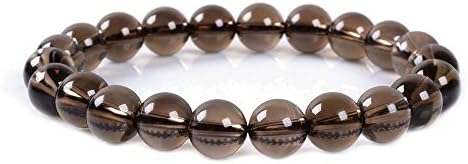
A bead bracelet keeps smoky quartz with you throughout the day as a quiet reminder to stay grounded. It comes in several stones, so make sure smoky quartz is selected when you order:
The Bottom Line
The smoky quartz meaning is about grounding and release: feeling steady in your body, protecting your energy, and setting down what you no longer need to carry. Its color comes from natural radiation acting on traces of aluminum over millions of years, but the stone itself is completely safe. Choose a natural piece with gentle color variation, keep it somewhere you’ll see it at the end of the day, and let it remind you that putting things down is part of moving forward.
Frequently Asked Questions
What does smoky quartz mean spiritually?
Spiritually, smoky quartz represents grounding, protection, and letting go. It’s traditionally used to release stress and mental clutter and to feel more present and stable. It’s most closely linked to the root chakra, the energy center associated with safety.
Is smoky quartz radioactive?
No. Smoky quartz gets its color from natural radiation that acted on the crystal while it formed, but the stone itself doesn’t emit radiation. Lab-irradiated smoky quartz isn’t radioactive either. Both are safe to wear and handle.
How can I tell if smoky quartz is real?
Natural smoky quartz usually shows some color variation, with lighter and darker zones. Very dark, perfectly uniform black points may be lab-irradiated colorless quartz. Glass imitations often have tiny round bubbles and completely even color.
Can smoky quartz go in water?
Yes. Smoky quartz is a durable form of quartz and can be washed with warm, soapy water or rinsed under running water. Dry it with a soft cloth afterward.
Does smoky quartz fade in the sun?
Natural smoky quartz is fairly stable, but long exposure to strong heat can lighten it, and lab-treated stones may fade more easily. Keep it away from heaters and hot cars, and avoid leaving it in direct sun for long periods.
What is the difference between smoky quartz and black tourmaline?
Both are popular protection stones, but they’re different minerals. Smoky quartz is translucent brown-to-gray quartz associated with grounding and letting go. Black tourmaline is an opaque black mineral traditionally used as a stronger protective shield.
This article is for general educational purposes and reflects traditional and spiritual uses of crystals. It is not a substitute for professional medical or mental health advice. If you are experiencing persistent stress, grief, or emotional distress, please consult a licensed healthcare provider.
References
- Geology.com. “Smoky Quartz.” King, H. M. https://geology.com/gemstones/smoky-quartz
- Materials Research (SciELO). Study of color formation in natural quartz after gamma irradiation and heat treatment. https://scielo.br/j/mr/a/NPJGPDBLyFb5Dxy9TttWVpv/abstract/?lang=en
- New Hampshire General Court. “RSA 3:15 State Gem.” https://gc.nh.gov/rsa/html/I/3/3-15.htm
- Time. “Do Crystals Work? What Science Says About Healing Crystals.” https://time.com/4969680/do-crystals-work/