

Citrine is the yellow to golden-orange variety of quartz, and its traditional meaning is warmth: optimism, confidence, creativity, and abundance. If amethyst is the stone people reach for when they want to slow down, citrine is the one they reach for when they want to light up. Its sunny color has earned it nicknames like “the merchant’s stone” and “the success stone,” and it’s one of the most popular crystals for anyone setting goals, starting something new, or simply wanting more joy in an ordinary day.
There’s also a fact about citrine that most crystal guides skip, and it matters if you’re buying one: real citrine is rare in nature. According to the Gemological Institute of America, most citrine on the market is amethyst that has been heated until its purple turns golden. This guide explains the citrine meaning and its history, how to tell natural citrine from heated amethyst, whether the difference matters for your practice, and the simple, honest ways to use citrine every day.
Table of Contents

What Is Citrine?
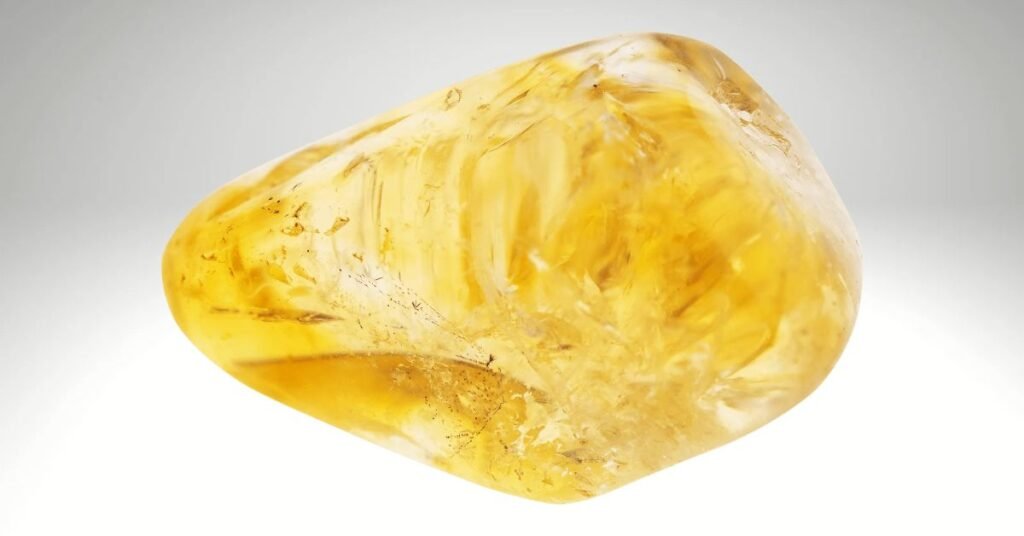
Citrine is silicon dioxide, the same mineral as clear quartz, amethyst, and rose quartz. Its color ranges from pale lemon yellow to deep honey and reddish orange. The name comes from the French citron, meaning lemon, a nod to its brightest shades.
Like all quartz, citrine measures 7 on the Mohs hardness scale, durable enough for rings and everyday carry. For centuries it was confused with topaz because of its similar golden color, and the two still share a role today: both are birthstones for November. Citrine earned that official spot in the United States in 1952, when Jewelers of America updated the modern birthstone list it first published in 1912 (National Jeweler).
Natural citrine forms when quartz containing trace elements, such as aluminum or iron, is exposed to natural radiation and specific temperatures deep in the Earth. Those conditions are uncommon, which is why naturally golden quartz is far rarer than its purple cousin.
What Does Citrine Mean Spiritually?
Across modern crystal traditions, citrine carries a remarkably consistent set of meanings, almost all of them tied to its sunlit color.
Abundance and prosperity. Citrine is best known as an abundance stone. Shopkeepers have long kept a piece near the cash register, which is where the nickname “merchant’s stone” comes from. The idea is less about attracting money magically and more about holding an attitude of openness and possibility. Our guide to crystals for abundance and prosperity covers that side of citrine in depth, alongside pyrite, green aventurine, and jade.
Joy and optimism. Citrine’s warm color is the most direct link to its emotional meaning. People use it as a reminder to notice what’s going well, especially during gray seasons or discouraging stretches.
Confidence and motivation. In chakra traditions, citrine is linked to the solar plexus chakra, the energy center associated with personal power, willpower, and self-esteem. If chakra work is part of your practice, our complete guide to chakra balancing explains how the solar plexus fits with the other six.
Creativity and fresh starts. Because it’s associated with energy and momentum, citrine is a popular stone for new projects, new jobs, and new homes.
Why Is Most Citrine Actually Heat-Treated Amethyst?
Here’s the part of the citrine story that changes how you shop for it.
Naturally yellow quartz is scarce, but amethyst is plentiful, especially in Brazil and Uruguay. Gem cutters long ago learned that heating amethyst to roughly 480 to 930 °F (about 250 to 500 °C), typically for up to a few hours, turns its purple color yellow, orange, or reddish brown. The result is chemically still quartz, and it’s now the main source of the citrine sold worldwide. GIA states plainly that “most citrine is the result of heating” (GIA FAQ), and a technical review by the Gemmological Association of Great Britain notes that, strictly speaking, heated amethyst isn’t citrine at all (Gem-A).
This isn’t a scandal; heat treatment is common and accepted throughout the gem trade, and heated citrine is stable and beautiful. The problem is labeling. Many crystal shops sell heated amethyst as “natural citrine,” often at natural-citrine prices, and many buyers have no idea their golden cluster spent time in a kiln.
Does Heat-Treated Citrine Still “Work”?
That depends on what you believe a crystal does, and it’s a question only you can answer. Here’s an honest way to think about it. There’s no scientific evidence that any crystal emits energy that changes your mood or finances; in a well-known 2001 experiment by psychologist Christopher French, people holding real quartz and people holding glass replicas reported the same sensations (Time). What a crystal reliably offers is a focus for attention and ritual, and research suggests deliberate rituals can genuinely help people manage emotions (Norton & Gino, PubMed).
Seen that way, a heated citrine can serve as a cue for optimism just as well as a natural one. If you follow traditions that hold a stone’s natural formation matters, you may prefer natural citrine, and that’s a valid choice too. What matters most is knowing what you’re buying and paying a fair price for it.
How Can You Tell If Citrine Is Natural or Heated?
Only a gem lab can say for certain, but a few visual clues will get you most of the way.
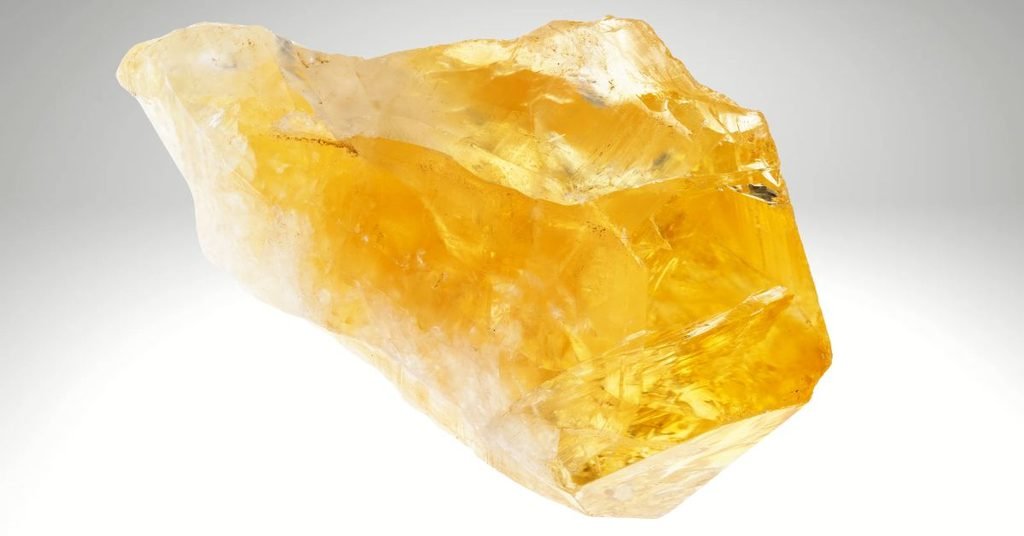
Look at where the color sits. Heated amethyst clusters and geode pieces usually show their strongest, darkest orange right at the crystal tips, fading to pale yellow or white near the base. Natural citrine tends to have its color spread more evenly through the crystal, as Gem-A’s comparison notes.
Notice the shade. Natural citrine is most often a soft, pale yellow to champagne or light honey, sometimes with a faint smoky tint. Intense burnt orange or reddish brown, especially on clusters, almost always points to heat treatment.
Check the shape. Citrine “geode” clusters with dozens of small, dark-tipped points on a white base are nearly always heated amethyst, because that’s how amethyst grows. Natural citrine more often appears as single points or tumbled stones.
Read the label and ask the seller. Honest sellers say “heat-treated” or “natural.” A low price on a large, deep-orange “natural citrine” cluster is a strong warning sign.
Know the other lookalikes. “Lemon quartz” is usually quartz that has been irradiated and heated to a greenish yellow. “Madeira citrine” is a trade name for deep reddish-brown to orange stones, often heated. Yellow glass and dyed quartz also appear in cheap jewelry. If you’d like a simple side-by-side, here’s how they compare:
| Type | Typical color | Where the color sits | What it is |
|---|---|---|---|
| Natural citrine | Pale yellow to champagne or honey | Fairly even throughout | Naturally colored quartz; rare |
| Heated amethyst (sold as citrine) | Deep orange to reddish brown | Strongest at the tips; white or pale base | Amethyst that was heated |
| Lemon quartz | Bright greenish yellow | Even | Usually irradiated and heated quartz |
| Glass or dyed stone | Very uniform, often “too perfect” | Even, sometimes with bubbles or dye in cracks | Not natural citrine |
What Are the Benefits of Citrine?
With realistic expectations in place, here’s where citrine earns its place in a wellness practice.
A Daily Cue for Optimism
Citrine’s most practical benefit is as a reminder. Keep a tumbled stone somewhere you’ll see it each morning, and use that glance as a prompt to name one thing you’re looking forward to. Small, repeated moments like this shape the tone of a day more than any single grand intention.
Motivation for Goals and New Projects
Many people keep citrine on their desk when they’re starting something: a business, a fitness goal, a creative project. Pair it with a written goal and the stone becomes a physical bookmark for that commitment. Our guide to the best crystals for focus explains when an energizing stone like citrine fits better than a calming one like amethyst.
A Confidence Anchor
Holding a citrine palm stone before a presentation, an interview, or a hard conversation gives your hands something to do and your mind a single point to return to. A few slow breaths with the stone in hand is a simple pre-performance ritual.
Warmth in Your Home
Citrine’s golden color brightens any room, and it’s a natural choice for kitchens, home offices, and entryways. In feng shui practice, it’s often placed in the wealth area of a home or office; our crystals for abundance guide shows where that is. If you’ve just moved, our guide to crystals for a new home suggests how citrine fits into a housewarming ritual.
How Do You Use Citrine Every Day?
The most effective ways to use citrine are simple enough to repeat daily.
In my own practice, I keep citrine where I work and study. For me, it’s a stone for mental clarity: when I sit down to a demanding task, its warm golden color is a small cue to clear my head and give my full attention to what’s in front of me.
Set a morning intention. Hold the stone for three breaths as part of your morning routine and name one goal or one thing you’re grateful for. Our morning meditation routine is easy to pair with this.
Keep it on your desk. A citrine point or small cluster near your workspace works as a visual cue to come back to your priorities.
Carry it. A tumbled stone in your pocket or bag is easy to reach for before a meeting or a difficult moment.
Wear it. A citrine pendant or bracelet keeps the intention close all day. Our guide to choosing healing crystal bracelets explains what to look for.
Use it in a grid. Citrine is a classic stone for abundance and new-beginnings grids, often with clear quartz at the center. Our crystal grid layouts guide walks through simple designs.
Keep it out of the bedroom, or test it first. Because citrine is considered an energizing stone, many people find it better suited to daytime spaces. If you want a crystal for sleep, amethyst is the more traditional choice; see our guide on how to use crystals for sleep.
Which Shape of Citrine Should You Choose?
| Shape | Best for | Keep in mind |
|---|---|---|
| Tumbled stone | Pocket carry, morning ritual, gifts | The easiest way to find natural citrine at a fair price |
| Natural point | Desk focal point, grids | Check whether it’s natural or heated |
| Cluster or geode piece | Home office, entryway, shelf display | Almost always heated amethyst; buy it for its beauty, labeled honestly |
| Palm stone | Confidence ritual, anxious moments | Smooth shape fits the hand naturally |
| Jewelry | All-day intention reminder | Avoid steam cleaning and harsh chemicals |
If you’re unsure, start with a tumbled stone. It’s affordable, versatile, and the shape in which natural citrine is most commonly sold. For a broader look at forms, see our guide to crystal shapes and what each is for.
Does Citrine Need Cleansing?
You’ll often read that citrine is “self-cleansing” and never needs to be cleared. That’s a modern crystal-community belief rather than an ancient tradition, and many practitioners cleanse it anyway, simply because cleansing is part of the ritual that keeps a stone meaningful. There’s no harm in it.
Energetic cleansing. Moonlight, sound from a singing bowl, or the smoke of sage or palo santo all work well. Our step-by-step guide on how to cleanse and charge your crystals covers every method.
Physical cleaning. GIA recommends warm, soapy water for citrine and warns against steam cleaning, sudden temperature changes, and harsh chemicals (GIA).
Sunlight. GIA also notes that prolonged, intense light can fade some citrine. “Charging” citrine in the sun is a popular idea because of its sunny color, but a short session is plenty, and a sunny windowsill is not a good permanent home for it.
How Does Citrine Compare With Other Popular Crystals?
| Crystal | Its focus | Choose it if… |
|---|---|---|
| Citrine | Optimism, motivation, abundance | You want energy and momentum |
| Clear quartz | Clarity, intention, versatility | You want one stone for many purposes (our clear quartz guide) |
| Amethyst | Calm, sleep, spiritual clarity | You want to slow down rather than speed up (our amethyst guide) |
| Rose quartz | Self-compassion, emotional warmth | You’re being hard on yourself (our rose quartz guide) |
Citrine and clear quartz make a popular pair for goal-setting: citrine for motivation, clear quartz for a clear intention. Citrine and amethyst balance each other well, too, with one for daytime energy and one for evening calm. That pairing is fitting, since so much citrine began its life as amethyst. For a fuller starter list, see our 7 essential crystals for beginners.
Products Worth Considering
If you’re new to citrine, a small set of tumbled stones is the easiest place to start: one for your pocket, one for your desk, and one for your morning ritual. Tumbled stones are also the form in which paler, more natural-looking citrine most often turns up, so take a moment with the listing photos to see the color:

- Set of 3 citrine stones gemstones crystals.
- Size of stones: approx 0.35 x 0.6 x 0.35 inches , Quantity: 3 Pcs.
- Please Note: the color, size, and shape of each natural stone may be slightly different from the images shown.
For a desk, shelf, or entryway, a cluster brings warm golden light into a room. Like most citrine clusters, this one shows the deep orange tips typical of heat-treated amethyst, so think of it as a beautiful decorative piece and an everyday cue for optimism rather than a rare natural specimen:

- Enhance your home decor with these stunning citrine crystal clusters, each unique in size and shape. Amplify wealth and …
- Citrine stones are known for their ability to promote abundance and prosperity in your life. Bring abundance and energy …
- These large yellow crystals are perfect for meditation, healing practices, and energy work. Enhance manifestation and cr…
A beaded citrine bracelet keeps your intention close all day, and it’s an easy, low-cost way to see whether you enjoy wearing the stone before investing in fine jewelry:

For a November birthday, or any fresh start worth marking, a sterling silver tree-of-life pendant set with the November birthstone pairs citrine’s symbolism of growth with a piece that can be worn every day:

If you’d like something more lasting, a 14K gold teardrop pendant in the November birthstone makes a thoughtful gift for a birthday, a graduation, or a new beginning:

The Bottom Line
The citrine meaning has always been about light: optimism, confidence, creativity, and the openness that lets good things in. It’s also a stone with a secret, since most of the citrine you’ll find began as amethyst before a kiln turned it gold. That doesn’t make it less beautiful or less useful as a daily reminder to look up and keep going. Know what you’re buying, pay a fair price, keep it out of strong sun, and give it a place where it can remind you, every morning, of what you’re working toward.
Frequently Asked Questions
What does citrine mean spiritually?
Spiritually, citrine represents optimism, abundance, confidence, and creativity. It’s linked to the solar plexus chakra, the energy center associated with personal power, and it’s often called the “merchant’s stone” because shopkeepers traditionally kept it near the register.
Is most citrine fake?
Most citrine isn’t fake, but most of it isn’t naturally yellow either. According to GIA, most citrine on the market is amethyst that has been heat-treated to turn it golden. It’s still real quartz; it just started out purple. Natural citrine is rare and usually paler yellow.
How can I tell if my citrine is natural?
Natural citrine is usually pale yellow to honey colored, with color spread fairly evenly through the stone. Heated amethyst tends to be deep orange with the darkest color at the crystal tips and a white base. Only a gem lab can confirm it with certainty.
Where should I put citrine in my home?
Citrine works best in daytime spaces: a desk or home office, a kitchen, an entryway, or a business. Many people keep it out of the bedroom because it’s considered an energizing stone. Avoid sunny windowsills, since prolonged strong light can fade some citrine.
Does citrine need to be cleansed?
Citrine is often described as self-cleansing, but that’s a modern belief rather than an old tradition. Cleansing it with moonlight, sound, or smoke is harmless and can be a meaningful part of your ritual. For physical cleaning, use warm, soapy water and avoid steam.
What is the birthstone for November?
November has two birthstones: topaz and citrine. Citrine was added to the official U.S. birthstone list in 1952, when Jewelers of America updated the list first published in 1912.
This article is for general educational purposes and reflects traditional and spiritual uses of crystals. It is not a substitute for professional medical, mental health, or financial advice. If you are experiencing persistent low mood, anxiety, or emotional distress, please consult a licensed healthcare provider.
References
- Gemological Institute of America (GIA). “Citrine Description.” https://www.gia.edu/citrine-description
- Gemological Institute of America (GIA). “Is citrine treated?” FAQ. https://my.gia.edu/FAQ/gia-faq-treated-citrine
- Gemological Institute of America (GIA). “Citrine Care and Cleaning.” https://gia.edu/citrine-care-cleaning
- Hibou, J. “Understanding and Testing for Rare Natural Citrine.” Gemmological Association of Great Britain (Gem-A), 2022. https://gem-a.com/?p=7252
- National Jeweler. “4605 Rocks on How the Modern Birthstone List Came to Be.” https://nationaljeweler.com/articles/diamonds-gems/supply/4605-rocks-on-how-the-modern-birthstone-list-came-to-be
- Time. “Do Crystals Work? What Science Says About Healing Crystals.” https://time.com/4969680/do-crystals-work/
- Norton, M. I., & Gino, F. “Rituals alleviate grieving for loved ones, lovers, and lotteries.” Journal of Experimental Psychology: General, 2014. PubMed. https://pubmed.ncbi.nlm.nih.gov/23398180/