

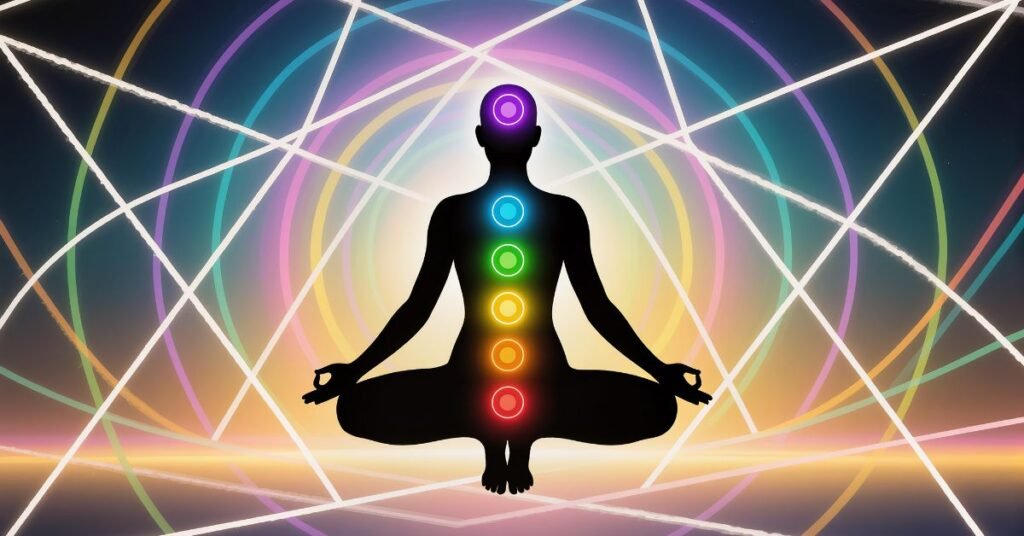
Chakra balancing for beginners starts with a simple idea: the body has seven main energy centers, running from the base of the spine to the crown of the head, and each one is linked to a different part of your emotional and spiritual life. When you “balance” your chakras, you’re really doing a structured check-in with yourself, moving your attention through the body, one center at a time, and asking what each area of your life needs.
This guide explains what chakras are, where the familiar seven-chakra system actually comes from (the answer is more recent than most people think), what each chakra represents, and a practical 10-minute routine you can start today. It’s written for people who are curious but want an honest, grounded introduction rather than a wall of mystical claims.
What Are Chakras?
A chakra is an energy center in the subtle body described in Hindu and Buddhist tantric traditions. The Sanskrit word chakra means “wheel,” and chakras are often pictured as spinning wheels or lotus flowers along the central channel of the body. In these traditions, they’re points where breath, attention, and life force (prana) meet, and they’re worked with through meditation, breath control, mantra, and visualization.
In modern wellness practice, the chakras have become a map for self-awareness. Each center is associated with a theme, such as safety, creativity, confidence, love, expression, intuition, or connection, which gives you a simple framework for noticing where you feel steady and where you feel stuck.
Where Does the 7-Chakra System Come From?
Most beginners are surprised to learn that the version of the chakras found in most books and apps, seven chakras, each with its own rainbow color, gland, and personality trait, is a fairly modern blend of Indian and Western ideas.
Historian Kurt Leland, who traced this history in detail, found that traditional Indian systems varied widely, listing anywhere from four to forty-nine chakras depending on the text and lineage (Leland, Quest, 2017). The seven-chakra model that dominates today drew heavily on one sixteenth-century Bengali text, introduced to English readers in 1919 when Sir John Woodroffe, writing as Arthur Avalon, published The Serpent Power.
The rest of the familiar package was added in the West during the twentieth century. According to Leland, the rainbow color sequence was attached to the chakras gradually by Western color healers between the 1920s and 1950s; links to the endocrine glands appeared in 1928; and the pairing of each chakra with specific psychological qualities was popularized in 1977.
None of this makes the modern system “fake.” It simply means today’s chakra map is a living tradition that has grown and changed, and you’re free to use it as a practical framework rather than a fixed doctrine. It also explains why different books disagree about colors, crystals, and details: there was never one original version.
Is There Scientific Evidence for Chakras?
There’s no anatomical evidence that chakras exist as physical structures, and chakra balancing is not a treatment for any medical or mental health condition. What does have research behind it are the practices traditionally used to work with the chakras.
Slow, controlled breathing is the clearest example. A systematic review published in Frontiers in Human Neuroscience found that slow breathing techniques were associated with increased relaxation and calm and with reduced anxiety and arousal (Zaccaro et al., 2018, PubMed). Meditation, mindful body awareness, and gentle movement have similar support.
The most useful way to approach chakra balancing, then, is as a structured mindfulness practice. The chakra map tells you where to place your attention and what to reflect on; the breath, posture, and awareness do the work.
What Are the 7 Chakras?
Here’s a quick reference, using the modern Western associations most beginners will encounter.
| Chakra | Sanskrit name | Location | Theme | Modern color | Common crystals |
|---|---|---|---|---|---|
| Root | Muladhara | Base of the spine | Safety, stability | Red | Black tourmaline, red jasper |
| Sacral | Svadhisthana | Lower belly | Creativity, pleasure | Orange | Carnelian, orange calcite |
| Solar plexus | Manipura | Upper abdomen | Confidence, will | Yellow | Citrine, tiger’s eye |
| Heart | Anahata | Center of the chest | Love, compassion | Green / pink | Rose quartz, green aventurine |
| Throat | Vishuddha | Throat | Expression, honesty | Blue | Blue lace agate, sodalite |
| Third eye | Ajna | Between the brows | Intuition, insight | Indigo | Amethyst, lapis lazuli |
| Crown | Sahasrara | Top of the head | Connection, meaning | Violet / white | Clear quartz, selenite |
Root Chakra (Muladhara)
The root chakra is associated with safety, stability, and your basic sense of belonging in the world. When people describe feeling “ungrounded,” scattered, or constantly on edge, this is the center chakra practice points to.
Simple practice: Stand barefoot on the ground, feel the weight of your body through your feet, and take ten slow breaths. Our guide on how to ground yourself spiritually offers more techniques, and black tourmaline is the classic root chakra stone.

Sacral Chakra (Svadhisthana)
The sacral chakra is linked to creativity, pleasure, and emotional flow. Its theme is allowing yourself to enjoy things, to play, and to feel your emotions rather than holding them at a distance.
Simple practice: Spend ten minutes on something creative with no goal: sketching, cooking, dancing to one song. Notice whether you judge yourself while you do it.
Solar Plexus Chakra (Manipura)
The solar plexus chakra represents confidence, willpower, and personal agency. It’s the center associated with following through on decisions and trusting your own judgment.
Simple practice: Each morning, choose one small commitment you’ll keep that day, and notice how it feels to keep it. Citrine and tiger’s eye are common stones here; our guide to the best crystals for focus explains how they’re used.

Heart Chakra (Anahata)
The heart chakra is the bridge between the lower and upper centers and is associated with love, compassion, forgiveness, and self-acceptance.
Simple practice: Place a hand over your chest, take three slow breaths, and silently offer yourself one kind sentence. Rose quartz is the heart chakra stone most people start with, and our guide to the best crystals for love covers others.

Throat Chakra (Vishuddha)
The throat chakra relates to communication, honesty, and expressing your truth, including the ability to listen.
Simple practice: Journal for five minutes about something you’ve been holding back from saying, then read it aloud to yourself. Our collection of throat chakra affirmations is a good companion to this practice.

Third Eye Chakra (Ajna)
The third eye chakra is associated with intuition, imagination, and insight: seeing a situation clearly, beyond the noise.
Simple practice: Sit quietly with your eyes closed, bring your attention to the space between your brows, and watch your thoughts without following them for three minutes. Amethyst is the traditional third eye stone.

Crown Chakra (Sahasrara)
The crown chakra represents connection to something larger than yourself, whether you understand that as spirit, nature, community, or meaning.
Simple practice: End your day with one minute of silence and a single question: “What mattered today?” If you’re noticing bigger shifts in how you see the world, our guide to spiritual awakening signs may resonate.
How Do You Know If a Chakra Is Out of Balance?
In chakra tradition, an “imbalanced” or “blocked” chakra shows up as difficulty in that center’s area of life. It’s best to treat these as reflective prompts, not diagnoses:
Root: Do I feel safe and settled, or anxious and scattered?
Sacral: Am I allowing myself enjoyment and creativity, or am I numb or rigid?
Solar plexus: Do I trust my own decisions, or do I feel powerless or overly controlling?
Heart: Am I able to give and receive care, or am I closed off or harsh with myself?
Throat: Do I say what I mean, or do I swallow my words?
Third eye: Can I see my situation clearly, or am I stuck in overthinking?
Crown: Do I feel connected to meaning, or disconnected and adrift?
If one question lands harder than the others, that’s the center to give extra attention in your practice this week. One important note: physical symptoms such as chest pain, digestive problems, headaches, or persistent anxiety are not chakra signals and deserve a visit to a healthcare professional.
A 10-Minute Chakra Balancing Routine for Beginners
This routine moves your attention through all seven centers, from root to crown. You can do it seated or lying down.
- Settle (1 minute). Sit comfortably, close your eyes, and take five slow breaths, making each exhale a little longer than the inhale.
- Root (1 minute). Bring attention to the base of your spine and the points where your body touches the floor. Feel supported.
- Sacral (1 minute). Move attention to your lower belly. Let it soften and rise with each breath.
- Solar plexus (1 minute). Bring attention to your upper abdomen. Imagine a steady warmth there.
- Heart (1 minute). Rest a hand on your chest and breathe into it. Offer yourself one kind word.
- Throat (1 minute). Notice your throat and jaw. Let them relax. Hum softly for a few breaths if you like.
- Third eye (1 minute). Bring attention to the space between your brows. Simply observe your thoughts.
- Crown (1 minute). Imagine the top of your head opening to the sky. Feel the space above you.
- Integrate (2 minutes). Sense your whole body at once, from the ground to the crown. Notice which area felt easiest and which felt hardest, and take that awareness into your day.
If you’re new to meditation, our guides to starting a daily meditation practice, breathwork for beginners, and the body scan meditation script all pair naturally with this routine.
How Do You Use Crystals for Chakra Balancing?
Crystals are one of the most popular tools for chakra work because they give each center a physical anchor. The simplest method is to lie down and place one stone on or near each chakra point, from a grounding stone at the base of the spine to a clear stone just above the head, and then follow the routine above.
You don’t need a full set to begin. One stone for the chakra you most want to work on is enough. If you’d like to compare complete kits, our guide to the best chakra crystal sets reviews what to look for, and our crystal grid layouts guide shows how to arrange chakra stones in a simple grid. Before you start, see our guide on how to cleanse and charge your crystals, since several popular chakra stones, like selenite and lepidolite, shouldn’t get wet.
What Mistakes Do Beginners Make With Chakra Balancing?
Treating it as a diagnosis. Chakra reflection is a self-awareness tool. It can’t tell you what’s physically or medically wrong.
Trying to “fix” every chakra at once. Pick one center to focus on for a week. Depth beats breadth.
Worrying about the “correct” colors or stones. As the history above shows, there was never a single original system. Use the associations that resonate with you.
Skipping the lower chakras. Many people rush to the third eye and crown. Traditions consistently emphasize starting from a stable, grounded base.
Expecting dramatic sensations. Some people feel warmth or tingling; many feel nothing in particular. The benefit comes from regular, attentive practice, not from special experiences.
The Bottom Line
Chakra balancing for beginners doesn’t require believing in invisible wheels or memorizing elaborate charts. The modern seven-chakra system is a blend of ancient tantric ideas and twentieth-century Western additions, and it works best as a practical map: seven places to bring your attention, seven questions to ask about your life, and a structure for breath and stillness that research genuinely supports. Start with ten minutes, choose one center to focus on, and let the practice grow from there.
Frequently Asked Questions
What is the easiest way to balance your chakras?
The easiest method is a short guided routine that moves your attention from the base of the spine to the crown, spending about a minute breathing slowly into each area. Pairing it with one crystal for the chakra you most want to work on adds a simple physical anchor.
Which chakra should beginners start with?
Most traditions recommend starting with the root chakra, which is associated with safety and stability. A grounded, settled base makes it easier to work with the other centers.
Are the chakra colors traditional?
Not entirely. According to historian Kurt Leland, the rainbow color sequence was attached to the chakras by Western color healers between the 1920s and 1950s. Traditional Indian texts described different colors and varying numbers of chakras.
Can crystals balance your chakras?
There’s no scientific evidence that crystals change the chakras directly. In practice, placing stones on each chakra point gives your attention a physical focus during meditation, which can make the routine easier to follow.
How long does chakra balancing take?
A complete routine can take as little as ten minutes. Many people practice daily or a few times a week, and focus on a single chakra for a week at a time when they want to go deeper.
Is chakra balancing a replacement for therapy or medical care?
No. Chakra balancing is a mindfulness and self-reflection practice. Physical symptoms or persistent emotional distress should always be discussed with a qualified healthcare professional.
This article is for general educational purposes and reflects traditional and spiritual practices. It is not a substitute for professional medical or mental health advice. If you are experiencing physical symptoms or persistent emotional distress, please consult a licensed healthcare provider.
References
- Leland, K. “The Rainbow Body: How the Western Chakra System Came to Be.” Quest 105.2, Theosophical Society in America, 2017. https://www.theosophical.org/publications/quest-magazine/the-rainbow-body-how-the-western-chakra-system-came-to-be
- Zaccaro, A., et al. “How Breath-Control Can Change Your Life: A Systematic Review on Psycho-Physiological Correlates of Slow Breathing.” Frontiers in Human Neuroscience, 2018. PubMed. https://pubmed.ncbi.nlm.nih.gov/30245619/
- Avalon, A. (Sir John Woodroffe). The Serpent Power. London: Luzac & Co., 1919.
6 thoughts on “Chakra Balancing for Beginners: A Grounded Guide to the 7 Chakras”