

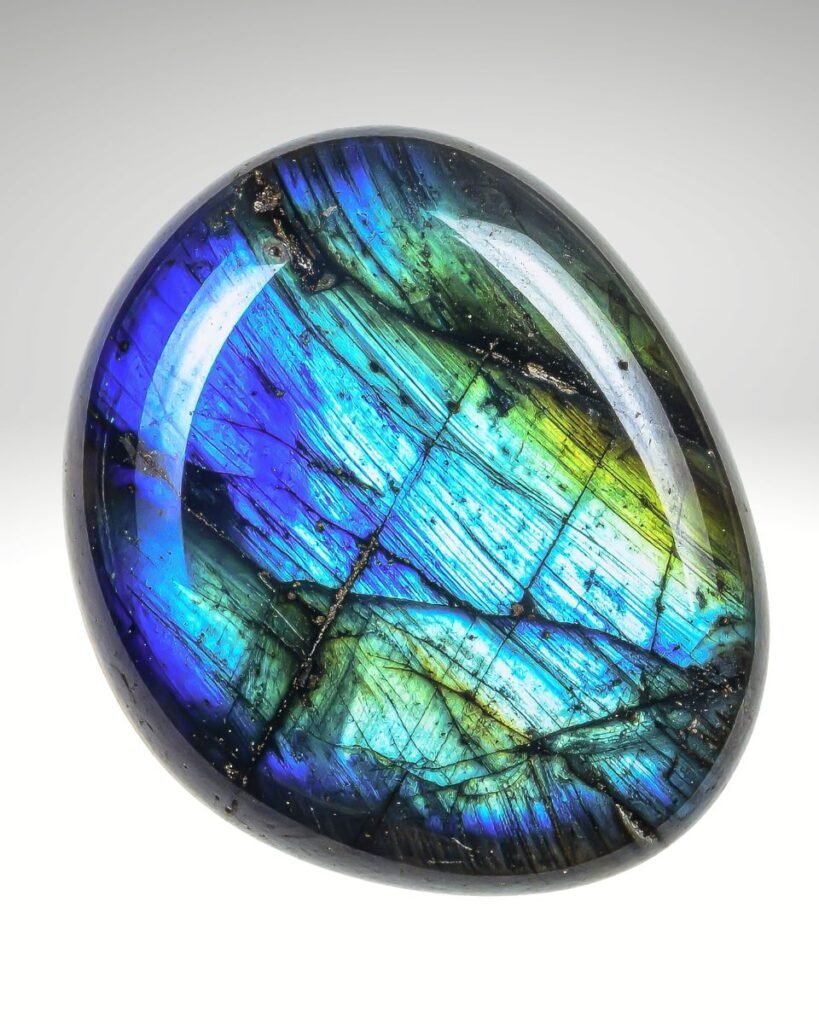
Labradorite is a gray-green feldspar that bursts into flashes of blue, green, gold, and sometimes violet when light hits it at just the right angle, and the traditional labradorite meaning centers on intuition, protection, and transformation. It’s the stone of the in-between moment: the instant a dull-looking rock turns, catches the light, and reveals something no one expected. That quality has made labradorite a favorite for anyone working through change or learning to trust their own perception.
Its flash also has one of the most fascinating explanations in the mineral world. Labradorite’s colors aren’t pigment at all. They’re produced by light bouncing between layers so thin they can only be seen with an electron microscope. This guide covers what labradorite is, where its color comes from, what it represents, how to use it, and how to choose a piece with a flash you’ll love.
Table of Contents
What Is Labradorite?
Labradorite is a calcium-rich member of the plagioclase feldspar family, one of the most common mineral groups in Earth’s crust. Most labradorite looks like an ordinary gray or dark stone until you tilt it. Then a sheet of color seems to switch on beneath the surface.
The stone is named for Labrador, Canada. According to Geology.com, it was first documented on the Isle of Paul near Nain, where a Moravian missionary found it in 1770. Labradorite is so famous for its color play that the effect is named after it: labradorescence. Geology.com notes that labradorite is the only mineral in the plagioclase series to show strong labradorescence, although many labradorite specimens don’t show it at all.
Labradorite measures about 6 to 6.5 on the Mohs hardness scale, the same range as moonstone. It also has two directions of perfect cleavage, natural planes along which a hard knock can split the stone. That makes it lovely for pendants, earrings, and display pieces, but a less durable choice for rings that take daily bumps.
You may have seen labradorite without realizing it. Rock rich in labradorite is quarried and sold as “labradorite granite” or “blue granite” for countertops, tiles, and window sills, so some kitchens carry a quiet shimmer of it.
What Causes Labradorite’s Flash?
Labradorescence is a form of iridescence, the same family of optical effects you see in soap bubbles, oil on water, and the shimmering wings of some butterflies.
Here’s what’s happening. As labradorite cools slowly deep underground, two slightly different feldspar compositions separate into extremely thin, stacked layers, one richer in calcium and one richer in sodium. Mineralogists call this layered structure the Bøggild intergrowth, after the Danish mineralogist Ove Balthasar Bøggild, who studied it in the 1920s. Researchers at the University of Wisconsin–Madison used electron microscopy and atom probe tomography to map these layers in detail in a 2021 study (Minerals).
When light enters the stone, it reflects off these layers. Light waves bouncing from neighboring layers either reinforce one another or cancel out, depending on the wavelength. The color you see depends on the spacing of the layers: thinner spacing returns blues, thicker spacing returns golds and oranges. As Geology.com explains, the color isn’t reflected from the surface at all. It comes from inside the stone.
That’s also why the flash is directional. Because the layers run in one direction, the color appears only when your eye, the light, and the layers line up. Turn the stone a few degrees and the flash vanishes, leaving plain gray. It’s a beautiful metaphor for intuition: the insight is there the whole time, but you have to look from the right angle to see it.
Where Does Labradorite Come From?
Labradorite has a story on nearly every continent, but a few sources stand out.
Labrador, Canada. The original locality is still the stone’s spiritual home. There’s an Inuit legend, noted by Memorial University geologist Andrew Kerr in a presentation to the European Geosciences Union, that the northern lights were once imprisoned in the rocks of the Labrador coast (EGU). In some tellings, a warrior struck the rocks with his spear and freed most of the lights into the sky, while some stayed trapped in the stone. It’s easy to see why: a good piece of labradorite looks a lot like the aurora.
Finland (spectrolite). Finland produces labradorite with an unusually full rainbow of colors, sold under the trade name spectrolite. It has a remarkable discovery story. The deposit at Ylämaa in southeastern Finland was found in 1940 by Pekka Laitakari, the son of geologist Aarne Laitakari, while fortifications were being built there during World War II. Quarrying for spectrolite began after the war.
Madagascar. Today, much of the labradorite sold in crystal shops comes from Madagascar, which produces gray to black material with strong blue, green, and gold flashes. Madagascar also produces the transparent labradorite sold as rainbow moonstone.
Is Rainbow Moonstone a Type of Labradorite?
Yes. As we explain in our guide to moonstone meaning, the stone sold as “rainbow moonstone” is mineralogically a transparent, light-bodied variety of labradorite rather than true moonstone, which is orthoclase feldspar. The colorful glow in rainbow moonstone comes from the same layered structure that creates the flash in gray labradorite.
So if you love rainbow moonstone, you already love labradorite. The difference is mostly in the body color: dark gray for classic labradorite, milky white for rainbow moonstone.
Labradorite Meaning: What Does It Represent Spiritually?
In modern crystal practice, labradorite carries a set of meanings that grow naturally from its hidden, shifting color.
Intuition and insight. Labradorite is best known as a stone of intuition. Its flash, which appears only from the right angle, has made it a symbol of seeing what others miss and trusting quiet inner signals.
Transformation. Labradorite is often called a stone of transformation, a companion for career changes, spiritual growth, and periods when you feel you’re becoming someone new.
Protection. Many practitioners use labradorite as a shielding stone, especially for sensitive people who absorb the moods around them. Our guide to the best crystals for empaths covers how it fits alongside other protective stones, and our article on how to protect yourself from negative energy offers practical habits to pair with it.
Spiritual awareness. Labradorite is linked to the third eye and throat chakras, and some traditions also connect it to the crown chakra. Our chakra balancing guide explains how these energy centers relate to one another.
Meditation. Its moving color gives the eyes something calm to rest on, which is why labradorite appears in our guide to the best crystals for meditation.
A gentle note on expectations: there’s no scientific evidence that a crystal itself produces intuition or protection. In a well-known experiment, people holding real quartz and people holding glass replicas reported the same sensations (Time). What labradorite reliably offers is a striking visual reminder to slow down, change your angle, and pay attention.
How to Use Labradorite Every Day
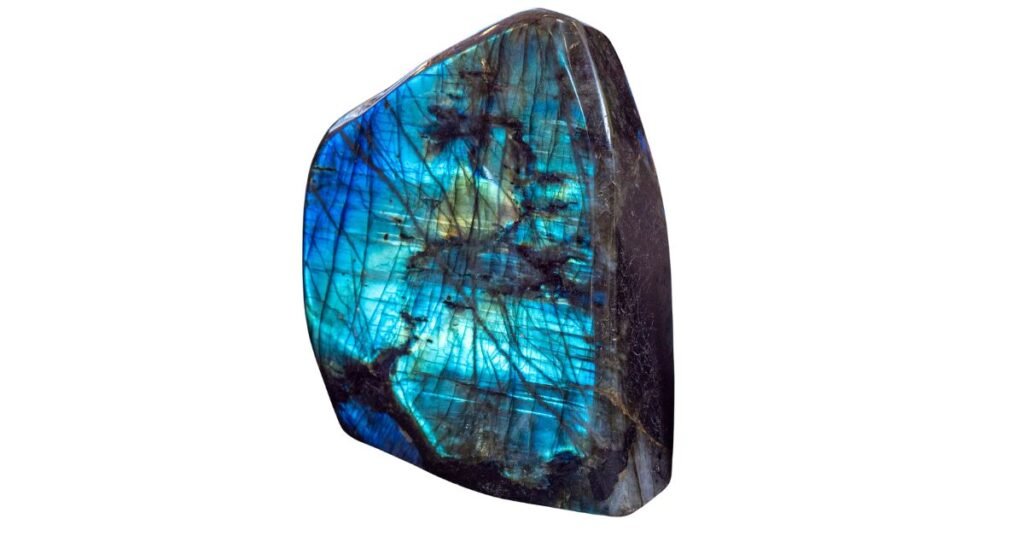
As a meditation focus. Hold a palm stone or freeform piece in soft light and slowly tilt it until the flash appears. Rest your attention on the color for a few breaths, then let it go and return. This simple “find the flash” practice works well for people whose minds wander during still meditation.
During decisions. Keep labradorite on your desk while you weigh a choice. When you notice it, ask yourself whether you’ve looked at the problem from more than one angle, which is exactly what the stone asks of the light.
For sensitive days. Wear a labradorite pendant or carry a tumbled stone on days with crowded rooms, difficult meetings, or emotionally heavy conversations.
In your home. A polished sphere or freeform piece near a window shows off the flash as daylight changes. Our guide on how to use crystals to balance your home offers placement ideas.
Alongside other stones. Labradorite pairs well with stones that balance its mystical quality:
- With moonstone, its feldspar cousin, for intuition and new beginnings.
- With clear quartz to keep an intention clear and focused.
- With tiger’s eye when insight needs to become action.
- With black tourmaline for a stronger protective pairing.
How Do You Choose a Good Labradorite?
Because the flash depends on the angle of the internal layers, two stones that look identical in a photo can look very different in your hand. A few simple checks help.
| What to check | What to look for | Why it matters |
|---|---|---|
| Face-up flash | Color visible when you look straight down at the stone | Geology.com notes that skilled cutters orient the base parallel to the color layers; poorly cut stones flash only at an awkward tilt |
| Coverage | Flash across most of the surface, not a small patch | Broad coverage looks more dramatic and is valued more highly |
| Color range | Blue and green are most common; gold, orange, and violet are rarer | A full rainbow, as in spectrolite, is the most prized |
| Body color | Gray to near-black for classic labradorite; white for rainbow moonstone | Darker bodies make the flash stand out more |
| Natural features | Small dark needles, lines, and uneven areas | These are normal; a perfectly uniform glassy shimmer may suggest an imitation |
The most reliable test is simple: tilt the stone slowly under a single light source. Real labradorite switches from gray to color and back again as you turn it. Glass imitations and dyed stones tend to show the same color from every angle.
How Do You Cleanse and Care for Labradorite?
Physical cleaning. Wash labradorite with warm, soapy water and a soft cloth, then dry it well. Like moonstone and other feldspars, it shouldn’t go in ultrasonic or steam cleaners, and harsh chemicals can dull the polish.
Storage. At Mohs 6 to 6.5, labradorite can be scratched by quartz, amethyst, and citrine. Keep it in a soft pouch or its own compartment.
Energetic cleansing. Gentle methods are best. Rest it on a selenite plate for a few hours, pass it through incense or sage smoke, or use sound from a singing bowl. Skip long soaks and salt water. Our guide on how to cleanse and charge your crystals compares the options.
Sunlight. Sunlight won’t harm labradorite’s color, which comes from structure rather than pigment, but sudden temperature changes can stress any stone with cleavage, so don’t move it straight from a hot windowsill into cold water.
Products Worth Considering
Labradorite is one stone where seeing it in person matters, so choose sellers with clear photos of the actual flash. Here are three good places to begin.
A palm stone is the best way to practice the “find the flash” meditation, since you can tilt it slowly in your hand:

- Labradorite Palm Stone: Labradorite is an important feldspar gemstone. It often displays a beautiful iridescent play of …
- High Quality: Palm stone is carved from Natural Labradorite Stone. This is a beautiful pocket stone that they fit perfec…
- Stone Size: approx:1.5″-2.5″ (Color shades and sizes can vary on all natural stones, please allow for slight variations….
A pendant keeps labradorite close during busy or emotionally demanding days, and it’s protected from the knocks that can chip rings:

For a desk or shelf, a larger polished sphere on a stand catches changing light throughout the day, and its curved surface lets the flash roll across the stone as you walk past:

- Size: 100-110mm/3.9-4.3″ diameter. Stand: Approx 3″ diameter base, 1.4″ tall, comes with Crystal Sphere Stand. Each piec…
- Labradorite Crystal: Labradorite is thought to be a powerful stone allowing one to find guidance towards their true purp…
- Home Decor: Crystal ball are exactly suitable for home decor,study,healing,figurine,living room ,kitchen,collecting,feng…
The Bottom Line
The labradorite meaning is about insight that appears when you change your angle: intuition, protection for sensitive people, and quiet support through transformation. Its flash comes from layers of feldspar thinner than a wavelength of light, the same physics that colors butterfly wings and soap bubbles, and its history runs from Inuit legend to a wartime discovery in Finland. Choose a piece with a strong face-up flash, care for it gently, and let it remind you that what looks ordinary at first glance can hold a whole sky of color.
Frequently Asked Questions
What does labradorite mean spiritually?
Spiritually, labradorite represents intuition, transformation, and protection. Its hidden flash of color makes it a symbol of insight that appears when you change your perspective, and it’s traditionally linked to the third eye and throat chakras.
What causes the colors in labradorite?
Labradorite’s colors come from light reflecting between extremely thin internal layers of slightly different feldspar compositions. The spacing of the layers determines which colors appear. This effect is called labradorescence, and it comes from inside the stone rather than its surface.
Why does labradorite only show color at certain angles?
The internal layers that create the color all run in one direction, so the flash appears only when the light, the layers, and your eye line up. Well-cut stones are oriented so the color shows when you look straight down at them.
Is rainbow moonstone the same as labradorite?
Rainbow moonstone is a transparent, white-bodied variety of labradorite. It isn’t true moonstone, which is orthoclase feldspar. Both stones show a moving glow, but rainbow moonstone’s colorful flash comes from the same layered structure as gray labradorite.
Can labradorite get wet?
Yes, briefly. Wash it with warm, soapy water and dry it right away. Avoid long soaks, salt water, harsh chemicals, and ultrasonic or steam cleaners, since labradorite is softer than quartz and has natural cleavage planes.
What is spectrolite?
Spectrolite is a trade name for labradorite from Finland that shows an unusually full range of colors, often including red, violet, gold, green, and blue in a single stone. It was discovered at Ylämaa in southeastern Finland in 1940.
This article is for general educational purposes and reflects traditional and spiritual uses of crystals. It is not a substitute for professional medical or mental health advice. If you are experiencing persistent anxiety or emotional distress, please consult a licensed healthcare provider.
References
- Geology.com. “Labradorite.” King, H. M. https://geology.com/gemstones/labradorite
- University of Wisconsin–Madison, Department of Geoscience. “Revisiting the Bøggild Intergrowth in Iridescent Labradorite Feldspars: Ordering, Kinetics, and Phase Equilibria.” Minerals, 2021. https://www.mdpi.com/2075-163x/11/7/727
- Kerr, A. “Labradorite gemstones and related ornamental stones from the type area on the coast of Nunatsiavut (Labrador), Canada.” EGU General Assembly, 2020. https://meetingorganizer.copernicus.org/EGU2020/EGU2020-13222.html
- Time. “Do Crystals Work? What Science Says About Healing Crystals.” https://time.com/4969680/do-crystals-work/