

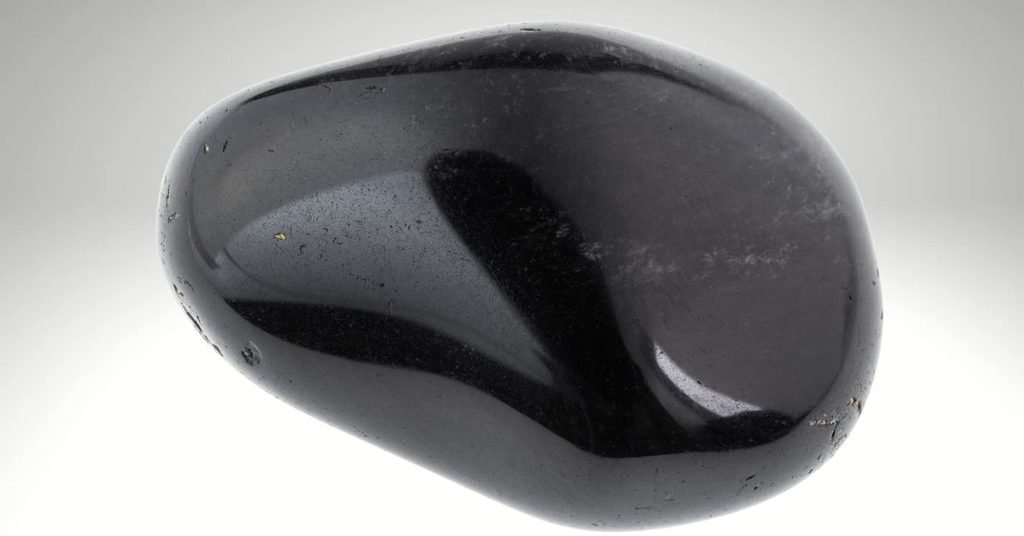
Black obsidian is a natural volcanic glass, formed when lava cools so quickly that crystals don’t have time to grow, and the traditional black obsidian meaning centers on protection, grounding, and seeing the truth clearly. Its glossy, mirror-like surface has made it a symbol of honest reflection for thousands of years, and its strong, dark presence has made it one of the most popular protection stones in modern crystal practice.
Obsidian also has a practical side that most guides skip. Broken obsidian forms edges sharp enough that surgeons have experimented with obsidian scalpels. That doesn’t make it dangerous to own, but it does mean it’s worth knowing how to choose and handle it well. This guide covers what obsidian is, what it represents, its remarkable history, how to use it, and how to keep it safe in your home.
Table of Contents
What Is Black Obsidian?
Obsidian is a volcanic glass. According to Geology.com, it forms when silica-rich lava cools so rapidly that its atoms can’t arrange themselves into an orderly crystal structure. Chemically, it’s similar to granite, but instead of grains of quartz and feldspar, it’s a smooth, glassy solid.
That makes obsidian technically a mineraloid rather than a crystal. It has no crystal structure at all, which is why it breaks in smooth, curved, shell-like surfaces called conchoidal fractures, the same way thick window glass does. Most crystal shops still sell it alongside crystals, and in everyday crystal practice it’s treated as one.
Obsidian measures about 5 to 6 on the Mohs hardness scale, softer than quartz. It’s usually jet black, but iron and other trace elements and tiny inclusions can create brown, gray, and banded varieties.
Interestingly, obsidian is a geologically young stone. Geology.com notes that obsidian older than a few million years is rare, because over time the glass slowly begins to crystallize and loses its glassy character.
Why Is Obsidian So Sharp?
When obsidian breaks, the fracture can taper down to an edge just a few molecules thick. Because the glass has no grains or crystal boundaries to interrupt that edge, it can be far finer than a honed steel blade.
This isn’t just folklore. In a 1982 paper in The Western Journal of Medicine, physician Bruce Buck described obsidian blades used in experimental surgery, reporting that a prismatic glass blade is far sharper than a honed steel edge and that skin incisions made with obsidian healed well (Western Journal of Medicine via PubMed Central). Obsidian scalpels are still used occasionally in specialized procedures today, although steel remains the standard because obsidian is brittle.
That same sharpness is why ancient peoples around the world prized obsidian for arrowheads, knives, and spear points. It’s also why it matters how you buy and handle it, which we’ll cover below.
A Short History of Obsidian
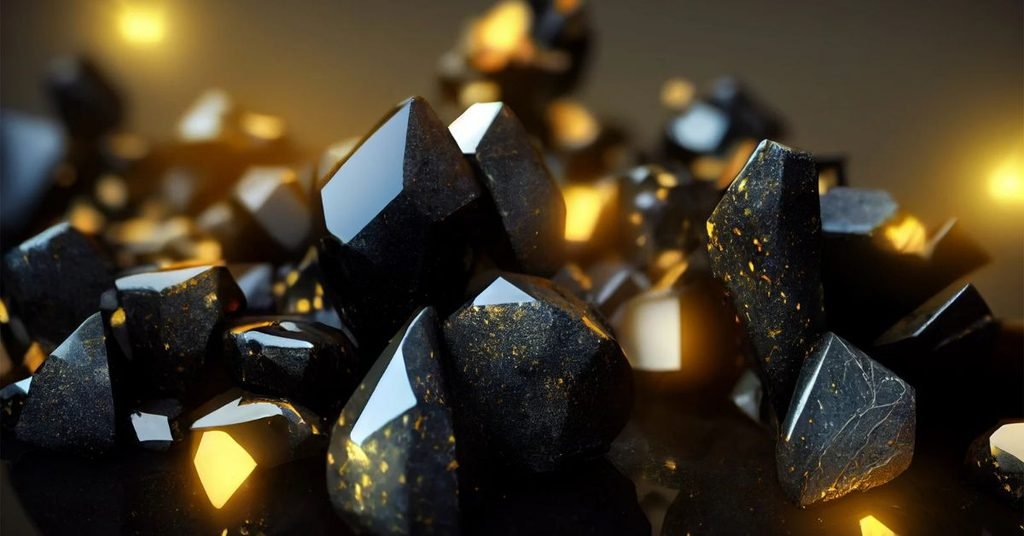
Obsidian has been part of human life for a very long time.
Across North America. Native peoples quarried obsidian from many sources in the American West. Obsidian Cliff in Yellowstone National Park, designated a National Historic Landmark in 1996, is one of the best known. The National Park Service notes that many tribes with ancestral ties to Yellowstone regard Obsidian Cliff as a spiritually significant place, with oral histories describing ancestral collection of the stone. Obsidian from Yellowstone has been found as far away as the Hopewell mound sites of Ohio, evidence of trade routes that crossed the continent. Glass Buttes in central Oregon is another famous source, still visited by rockhounds today.
In Mesoamerica. The Aztecs and other Mesoamerican cultures used obsidian for blades, tools, and polished mirrors. The Aztec god Tezcatlipoca was known as “Smoking Mirror,” a reference to dark obsidian mirrors.
In Elizabethan England. One of the most famous obsidian objects in the world is a polished black mirror associated with John Dee, an adviser to Queen Elizabeth I who used it in his attempts to communicate with spirits. In 2021, researchers led by Stuart Campbell of the University of Manchester used X-ray fluorescence to trace the mirror’s obsidian to Pachuca, Mexico, confirming that it was an Aztec object brought to Europe after the Spanish conquest (Antiquity). The mirror is on display at the British Museum.
That history of mirrors and reflection is a large part of why obsidian is associated with truth and self-awareness today.
Black Obsidian Meaning: What Does It Represent Spiritually?
Protection. Black obsidian is one of the most widely used protection stones, often described as a shield against negativity and draining environments. Our guide on how to protect yourself from negative energy covers practical habits to pair with it, and our home protection guide explains where protective stones are traditionally placed.
Truth and self-reflection. Because of its mirror-like surface and long history as a reflective stone, obsidian is associated with seeing yourself honestly, including the parts that are uncomfortable to look at. It’s a popular companion for journaling and inner work, such as the prompts in our shadow work journal guide.
Grounding. Formed from molten rock, obsidian is strongly associated with the earth and with feeling steady and present. It’s linked to the root chakra, the energy center associated with safety and stability. Our chakra balancing guide explains how the root chakra supports the rest.
Release. Like smoky quartz, obsidian is used to help let go of old patterns, though many people find obsidian more intense. If you’re new to dark protective stones, smoky quartz is often the gentler place to start.
A gentle note on expectations: there’s no scientific evidence that a stone itself blocks negative energy or reveals hidden truths. In a well-known experiment, people holding real quartz and people holding glass replicas reported the same sensations (Time). What obsidian reliably offers is a striking, weighty reminder of an intention to protect your peace and look at things honestly.
What Are the Different Types of Obsidian?
| Variety | Look | What causes it | Traditional focus |
|---|---|---|---|
| Black obsidian | Glossy, jet black | Pure volcanic glass with fine dark particles | Protection, grounding, truth |
| Snowflake obsidian | Black with white or gray “snowflake” spots | Small clusters of cristobalite crystals forming in the glass | Balance, calm perspective in hard times |
| Mahogany obsidian | Black with reddish-brown swirls | Iron (hematite) inclusions | Strength, grounded vitality |
| Rainbow obsidian | Black that shows colorful bands in strong light | Tiny aligned mineral inclusions | Joy and lightness during heavy seasons |
| Gold or silver sheen obsidian | Black with a metallic shimmer | Tiny gas bubbles aligned in the glass | Insight, self-reflection |
| Apache tears | Small, rounded, translucent black nodules | Obsidian pebbles weathered out of the host rock | Comfort in grief |
Snowflake obsidian is a good example of obsidian’s “young” nature: those white spots are the glass slowly beginning to crystallize.
How Do You Tell Real Obsidian From Glass?
Because obsidian is natural glass, man-made glass is the most common imitation. Bright blue, green, purple, or red “obsidian” is almost always manufactured glass, sometimes sold as “Andara glass” or “blue obsidian.” Real obsidian comes in black, brown, gray, and the banded or spotted varieties in the table above.
A few clues help:
- Light test. Hold a thin edge of black obsidian up to a strong light. Many pieces show a faint smoky brown or gray translucency at the edge.
- Natural features. Real obsidian often has tiny flow lines, bubbles stretched into lines, or small inclusions. Perfectly flawless, uniform color may suggest glass.
- Price and color. If a vivid, unusual color is cheap and widely available, it’s probably glass.
How Do You Handle Obsidian Safely?
Obsidian is completely safe to own and use, but a little common sense goes a long way with a stone that can form a razor edge.
Choose polished or tumbled pieces for everyday use. Tumbled stones, palm stones, spheres, and smooth carvings have no sharp edges. Raw chunks and knapped arrowheads are beautiful, but they can have edges sharp enough to cut skin.
Keep raw pieces away from children and pets. Display rough obsidian on a high shelf or in a closed case.
Handle with care. Obsidian is brittle. A drop onto tile or stone can chip it or break it into sharp shards. Don’t toss it into a bag with keys or other stones.
Clean up breaks carefully. If a piece breaks, pick up the larger shards with a cloth or gloves, sweep the area well, and wrap the pieces in paper before discarding them.
Don’t knap it at home without proper protection. Flintknapping, the art of shaping stone tools, is a wonderful hobby, but it requires eye protection, gloves, and leather padding because it sends sharp flakes flying.
How to Use Black Obsidian Every Day
By the front door. Place a polished obsidian sphere or tower near your entryway as a symbolic boundary between the outside world and your home.
At your desk. Keep a smooth obsidian stone on your workspace during stressful projects or difficult conversations. Pair it with tiger’s eye when you need confidence along with protection.
During journaling. Set a piece beside your journal during reflective writing as a reminder to be honest with yourself.
In grounding meditation. Hold a palm stone during a short grounding practice. Its weight and cool surface make it a natural anchor for attention. Our guide on how to ground yourself spiritually offers practices to try.
With gentler stones. Obsidian’s intensity pairs well with softer stones. Combine it with labradorite for protection with intuition, or with rose quartz to balance protection with self-compassion.
How Do You Cleanse and Care for Obsidian?
Physical cleaning. Wash obsidian with warm, soapy water and a soft cloth. Avoid sudden temperature changes, which can stress any glass.
Storage. At Mohs 5 to 6, obsidian scratches more easily than quartz. Keep it separate from harder stones, and wrap raw pieces so their edges don’t chip.
Energetic cleansing. Because obsidian is so often used for protection, many people cleanse it often. Running water, smoke, sound, or resting it on a selenite plate all work well. Our guide on how to cleanse and charge your crystals covers the options in detail.
Recommended Products
For most people, polished obsidian is the most practical choice: safe to handle, easy to clean, and just as striking as raw stone. Here are three good starting points.
A polished sphere makes a calm, protective centerpiece for an entryway or shelf, with no sharp edges to worry about:
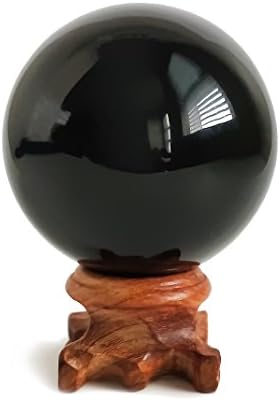
- Black crystal ball made of obsidian for energy work, scrying, Feng Shui, meditation, and grounding emotional energy.
- Obsidian sphere channels grounding energy, ideal for meditation, spiritual protection, and creating a balanced environme…
- Genuine obsidian crystal sphere helps in grounding energy, protecting against negativity, and promoting mental clarity.
A smooth palm or worry stone is ideal for grounding meditation and fits easily in your pocket:

- 【PORTABLE & EASY TO USE CRYSTAL STONE】 – You can keep the black polished stone in your pocket or handbag. When feeling a…
- 【Black Obsidian Crystal】: Shield of Protection. Black Obsidian possesses potent purifying properties, dispelling negativ…
- 【OCCASIONS FOR USING THE HEALING CRYSTAL】 – This Black Obsidian Crystal Stone is ideal for meditation to help relieve an…
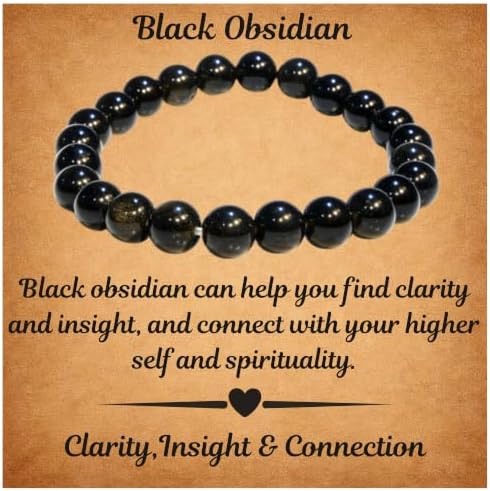
A bead bracelet keeps obsidian with you throughout the day as a reminder to protect your energy. It comes in several stones, so make sure black obsidian is selected when you order:
The Bottom Line
The black obsidian meaning is about protection, grounding, and honest reflection. This volcanic glass formed too fast to crystallize, can break to an edge finer than steel, and has served as a tool, a trade good, and a mirror for thousands of years, from Yellowstone to the Aztec world to the court of Elizabeth I. Choose polished pieces for everyday use, handle raw stones with care, and let obsidian remind you to guard your peace and look at your life with clear, honest eyes.
Frequently Asked Questions
What does black obsidian mean spiritually?
Spiritually, black obsidian represents protection, grounding, and truth. Its mirror-like surface makes it a symbol of honest self-reflection, and it’s traditionally used to shield against negativity. It’s linked to the root chakra, the energy center associated with safety and stability.
Is obsidian a crystal?
Technically, no. Obsidian is a natural volcanic glass that formed when lava cooled too quickly for crystals to grow, so it has no crystal structure. It’s classified as a mineraloid, but it’s sold and used alongside crystals in most crystal practices.
Is obsidian dangerous to handle?
Polished and tumbled obsidian is safe to handle. Raw obsidian and knapped pieces can have extremely sharp edges, so handle them carefully and keep them away from children and pets. If obsidian breaks, clean up the shards with a cloth or gloves.
How can I tell if obsidian is real?
Real black obsidian often shows a faint smoky translucency at thin edges and may have flow lines or tiny inclusions. Bright blue, green, purple, or red “obsidian” is almost always man-made glass. Perfectly uniform color and very low prices for unusual colors are warning signs.
What is the difference between black obsidian and black tourmaline?
Both are popular protection stones, but they’re very different materials. Black obsidian is a glossy volcanic glass with no crystal structure. Black tourmaline is a crystalline mineral with ridged, matte surfaces. Many people use both together for protection.
Can obsidian go in water?
Yes. Obsidian can be washed with warm, soapy water and rinsed under running water. Dry it with a soft cloth and avoid sudden temperature changes, such as moving it from hot sun into cold water.
This article is for general educational purposes and reflects traditional and spiritual uses of crystals. It is not a substitute for professional medical or mental health advice. If you are experiencing persistent anxiety or emotional distress, please consult a licensed healthcare provider.
References
- Geology.com. “Obsidian.” King, H. M. https://geology.com/rocks/obsidian.shtml
- Buck, B. A. “Ancient Technology in Contemporary Surgery.” The Western Journal of Medicine, 1982. https://pmc.ncbi.nlm.nih.gov/articles/PMC1273673
- National Park Service. Obsidian in Greater Yellowstone archeology. https://www.nps.gov/articles/archeology-obsidian-mvp-yellowstone-stones.htm
- Campbell, S., Healey, E., Kuzmin, Y., & Glascock, M. D. “The mirror, the magus and more: reflections on John Dee’s obsidian mirror.” Antiquity, 2021. https://cambridge.org/core/services/aop-cambridge-core/content/view/S0003598X21001320
- Time. “Do Crystals Work? What Science Says About Healing Crystals.” https://time.com/4969680/do-crystals-work/