

Learning how to set boundaries without feeling guilty starts with a surprising idea: you don’t have to make the guilt disappear before you act. A boundary is simply a clear statement of what you will and won’t do, and guilt is often just the echo of an old habit of putting everyone else first. When you learn to notice that feeling, name it, and test whether it’s telling you the truth, it loses most of its power to steer your choices.
If you’re the person who says yes before you’ve even checked your calendar, this guide is for you. It explains why boundaries trigger guilt in the first place, offers a simple mindful method for handling that guilt in the moment, gives you kind and clear words for common situations, and shows how to take care of yourself after you’ve said no. None of it requires you to become colder. It asks you to become more honest, with yourself first.
Table of Contents
What Is a Healthy Boundary?
A healthy boundary is a limit you set on your own time, energy, body, attention, or emotional space, and then act on. It describes your behavior, not someone else’s. “I don’t take work calls after 7 p.m.” is a boundary. “You need to stop calling me” is a demand, because it tries to control another person.
That distinction matters for guilt. In a Q&A for the Mayo Clinic News Network, psychologist Joel Streed describes a simple “law of relationships”: you can’t control what other people think, feel, or do, but you are responsible for your own thoughts, feelings, and actions. A boundary lives entirely on your side of that line. You decide what you’ll do; the other person decides how to respond.
Healthy boundaries are also flexible. You might happily stay late for a colleague during a crisis week and still protect your evenings the rest of the year. Rigid walls and endless openness both cause problems; a boundary is the thoughtful middle ground.
Why Do Boundaries Make Us Feel Guilty?
If boundaries are healthy, why does saying no feel so awful? A few patterns tend to work together.
Guilt is designed for real wrongdoing. Psychologists describe guilt as a “moral emotion” whose job is to flag when we’ve harmed someone so we can repair it. In her Psychology Today column, psychotherapist Sharon Martin points out the problem: when guilt fires over something that isn’t wrong, like setting a reasonable limit, it can keep us from acting in our own interest.
We learned that our worth comes from being useful. Many people grew up in homes or workplaces where approval came from being agreeable and available. Over time, “no” starts to feel like a risk to belonging itself. The Mayo Clinic guidance links unhealthy boundaries to exactly this belief that you can’t say no, often rooted in past experiences where refusing a request seemed to upset someone.
We take responsibility for other people’s feelings. If a friend is disappointed, it can feel as if we caused the disappointment and must fix it. But disappointment isn’t damage. Someone can feel let down by your choice without you having wronged them.
People-pleasing has a real emotional cost. Psychologist Julie Exline, writing in Psychology Today, describes how people pleasers often carry excessive guilt and anxiety when they can’t meet every request, alongside a strong fear of disapproval. The “yes” buys short-term relief and long-term exhaustion.
Is It Guilt or Just Discomfort? A Two-Question Check
This is the step most advice skips. Before you argue with your guilt, check whether it’s actually guilt.
Research on moral emotions draws a useful line between guilt and shame. In an influential review in the Annual Review of Psychology, June Price Tangney and colleagues describe guilt as focused on a specific behavior (“I did a bad thing”) and shame as focused on the whole self (“I am bad”). Guilt tends to motivate repair. Shame tends to make people want to hide or shrink.

When you set a boundary and feel terrible, ask yourself two questions:
- What exactly did I do, and whom did it harm? Try to name the specific action and the specific harm. “I said I can’t host Thanksgiving this year, and my sister has to make other plans” is an inconvenience, not an injury.
- If a close friend did the same thing, would I think they’d done something wrong? Most of us would tell a friend that declining to host, leaving a party early, or not answering work email on Sunday is completely reasonable.
If you can name a real harm, the guilt may be useful: maybe you broke a promise or spoke harshly, and a sincere repair is in order. But if the honest answer is “I didn’t hurt anyone, I just disappointed them,” what you’re feeling is the discomfort of a new habit wearing guilt’s clothing. You don’t need to obey it. You only need to let it pass.
I’ve had to practice this distinction in two very different roles. As an army officer, I sometimes have to give orders that people would rather not hear. An order can be unwelcome without being wrong, and when it’s fair and necessary, the discomfort it causes isn’t a harm I need to repair. Being a father to my daughters has taught me the same lesson more personally. Disciplining them, and accepting that there are limits to what I can do for them, doesn’t mean I’ve let them down. Those limits are part of caring for them, and I’ve learned not to carry guilt on the days I can’t do everything.
| What you feel | What it usually means | What helps |
|---|---|---|
| Guilt over a specific harm | You broke a promise or acted unkindly | Apologize, repair, and adjust |
| “Guilt” with no harm you can name | Discomfort from breaking an old people-pleasing pattern | Notice it, name it, and keep the boundary |
| Shame (“I’m a bad person”) | A global judgment about your worth | Self-compassion and support, not more self-criticism |
| Fear of the other person’s reaction | Anticipating disapproval or conflict | Prepare your words; remember their reaction is theirs |
How to Set Boundaries Without Feeling Guilty: Five Mindful Steps
These steps work for small boundaries (declining a favor) and larger ones (changing a pattern with a family member).
1. Pause Before You Answer
Most boundary problems start with an automatic yes. Give yourself a buffer: “Let me check and get back to you” is a complete sentence. Then take three slow breaths before deciding anything. If breathing practices help you settle, our guide to breathwork for beginners covers simple techniques you can use right in the moment.
2. Check In With Your Body
Your body often knows your limit before your mind admits it. Notice a tight jaw, a sinking stomach, or a heavy feeling in your chest when you imagine saying yes. A short body scan meditation is a good way to build this awareness over time, so you can recognize your “no” signals faster.
3. Name the Feeling
When the guilt rises, label it silently: “This is guilt,” or “This is fear of disappointing her.” It sounds almost too simple, but it has research behind it. In a brain-imaging study published in Psychological Science, Matthew Lieberman and colleagues at UCLA found that putting feelings into words, which researchers call affect labeling, reduced activity in the amygdala, a brain region involved in emotional reactions. Naming the feeling creates a little distance between you and it.
4. Say It Briefly and Kindly
Long explanations invite negotiation and feed the sense that you need permission. A good boundary is short, warm, and clear. You can acknowledge the other person’s feelings without taking responsibility for them: “I know you were hoping I could help, and I can’t take this on right now.”
5. Let the Feeling Pass Without Reversing Your Decision
The guilt may peak right after you say no. This is the moment many people take it back. Instead, treat the feeling like a wave: notice it rise, stay with your breath, and let it fall on its own. Each time you hold a reasonable boundary through the discomfort, the next one gets easier.
What Can You Say? Kind Scripts for Common Situations
Having words ready makes it far easier to follow through. Adjust these to sound like you.
| Situation | What you might say |
|---|---|
| A friend asks for a favor you can’t fit in | “I’d love to help, but I’m at capacity this week. I hope it goes well.” |
| Your manager adds a task to a full plate | “I can take this on. Which of my current projects should move to make room?” |
| A family member makes a comment you don’t want to discuss | “I’m not going to talk about that today. Can we talk about something else?” |
| Someone keeps calling late at night | “I’m turning my phone off at 9 now. Let’s talk tomorrow morning.” |
| You need to leave a gathering early | “I’ve had a lovely time. I’m heading out now to get some rest.” |
| Someone pushes back after you’ve said no | “I understand you’re disappointed. My answer is still no.” |
Notice what’s missing: long apologies, detailed excuses, and promises you don’t intend to keep. “No, thank you” doesn’t need a defense.
How Do You Handle the Guilt Afterward?
The hardest part often comes later, lying awake replaying the conversation. This is where self-compassion does its quiet work.
Psychologist Kristin Neff, a pioneer of self-compassion research, describes three parts: mindfulness (noticing your pain without exaggerating it), common humanity (remembering that everyone struggles), and self-kindness (treating yourself as you’d treat a friend). Her work isn’t just theory. In a randomized controlled trial, Neff and Christopher Germer found that people who completed an eight-week Mindful Self-Compassion program reported larger gains in self-compassion, mindfulness, and well-being than a waitlist group, and those gains held at follow-up.
Try this short practice, adapted from that approach, when the guilt returns:
Place a hand on your heart and say three things, silently or aloud.
“This is hard right now” (mindfulness).
“Lots of people feel this way when they start saying no” (common humanity).
“May I be kind to myself as I learn this” (self-kindness).
If the feelings feel heavier, writing helps. Journaling gives the guilt somewhere to go besides your thoughts, and our shadow work journal prompts can help you explore where your fear of disappointing others first took root.

Start Small: A Seven-Day Boundary Practice
Boundaries are a skill, and skills grow with low-stakes practice. Here’s a gentle week to build the muscle.
Day 1: Notice. Count how many times you say yes when you mean maybe or no. Don’t change anything yet.
Day 2: Pause. Use “Let me check and get back to you” at least once.
Day 3: Small no. Decline one easy request, such as a sales call, an optional meeting, or an extra errand.
Day 4: Name it. When discomfort comes up, label it out loud or in a journal.
Day 5: Protect one hour. Choose an hour of the day that belongs to you and guard it.
Day 6: Medium no. Decline something that matters a little more, using a script from above.
Day 7: Reflect. Ask what actually happened after each no. Most people discover the feared fallout rarely arrives.
If restlessness makes quiet reflection hard, our guide on how to meditate when you can’t sit still offers movement-based alternatives.
Do Boundaries Have a Spiritual Side?
Many spiritual traditions see clear limits as an expression of care rather than a failure of it. You can’t offer genuine kindness from an empty cup, and resentment builds quickly when every yes is reluctant.
In energy and chakra traditions, speaking your truth is associated with the throat chakra. If that framework resonates with you, our throat chakra affirmations can support you in finding your voice. Sensitive people who absorb others’ moods often find boundaries especially important; our guide to the best crystals for empaths and our article on how to protect yourself from negative energy explore that side. And if you notice you’re clinging to other people’s approval, the teaching of detachment as a path to inner freedom offers a deeper perspective: you can love people fully without needing them to agree with every choice you make.
When Is It Time to Get Support?
Some boundaries are harder than others. If you’re dealing with a relationship that involves control, intimidation, or repeated disrespect of your limits, a licensed therapist can help you plan safely. The same goes for guilt that feels constant, overwhelming, or tied to old pain you’d rather not face alone. Asking for help is itself a boundary: it says your well-being matters enough to invest in.
Gentle Tools That Help
You don’t need anything to set a boundary, but a few supportive tools can make the practice easier to stick with.
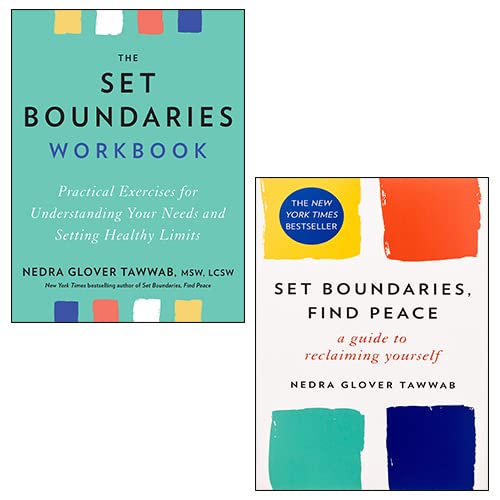
If you’d like a structured guide, therapist Nedra Glover Tawwab’s Set Boundaries, Find Peace is one of the most widely read books on the subject, and its companion workbook turns the ideas into practical exercises. This set includes both:
A daily self-care journal gives the guilt somewhere to land. Short prompts for self-compassion and reflection make it easier to notice patterns, like which requests consistently leave you drained:

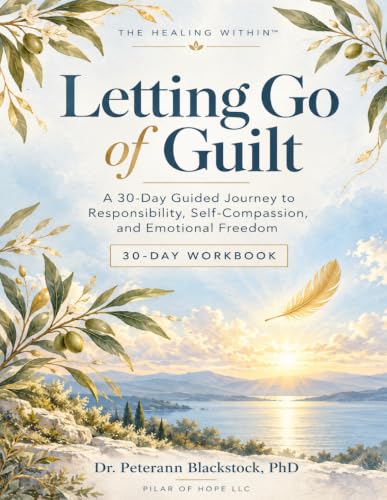
If guilt is the part that keeps pulling you back into yes, a 30-day guided journal focused on letting go of guilt pairs naturally with the seven-day practice above:
The Bottom Line
Learning how to set boundaries without feeling guilty is less about silencing guilt and more about understanding it. Real guilt points to real harm and asks for repair. Most boundary “guilt” is something else: the discomfort of breaking an old habit of over-giving. Pause before you answer, notice what your body is telling you, name the feeling, say your boundary briefly and kindly, and then treat yourself with the same compassion you’d offer a friend. With practice, your no becomes calmer, and your yes becomes more sincere.
Frequently Asked Questions
Why do I feel guilty when I set a boundary?
Guilt is meant to signal that you’ve harmed someone, but it often fires when you simply disappoint someone or break an old people-pleasing habit. If you can’t name a specific harm you caused, the feeling is usually discomfort with a new behavior rather than evidence that you did something wrong.
Is setting boundaries selfish?
No. A boundary describes what you will and won’t do, and it doesn’t control anyone else. Healthy boundaries protect your energy so you can show up for people sincerely instead of with resentment, which usually makes relationships stronger.
How do I say no without explaining myself?
Keep it short and kind: “Thanks for thinking of me, but I can’t this time.” You don’t owe a detailed reason. Long explanations often invite negotiation and reinforce the feeling that you need permission to decline.
What if someone gets upset when I set a boundary?
Their feelings are real, but they’re theirs to manage. You can acknowledge them (“I understand you’re disappointed”) without changing your answer. If someone repeatedly ignores or punishes your boundaries, that’s important information about the relationship.
Will the guilt ever go away?
For most people it fades with practice. Each time you hold a reasonable boundary and see that the relationship survives, your nervous system learns that saying no is safe. Self-compassion practices can speed that process.
How can mindfulness help with setting boundaries?
Mindfulness helps you pause before an automatic yes, notice body signals that reveal your limits, and observe guilt without obeying it. Even naming a feeling silently, such as “this is guilt,” can reduce its intensity.
This article is for general educational purposes and is not a substitute for professional mental health advice. If you are experiencing persistent guilt, anxiety, or distress, or if you feel unsafe in a relationship, please reach out to a licensed mental health professional.
References
- Streed, J. “Mayo Clinic Q and A: Setting boundaries for your well-being.” Mayo Clinic News Network, 2024. https://newsnetwork.mayoclinic.org/discussion/mayo-clinic-q-and-a-setting-boundaries-for-your-well-being/
- Martin, S. “6 Ways to Set Boundaries Without Guilt.” Psychology Today, 2022. https://psychologytoday.com/us/blog/conquering-codependency/202208/6-ways-set-boundaries-without-guilt
- Exline, J. J. “People Pleasing: Short-Term Benefits and Long-Term Costs.” Psychology Today, 2014. https://www.psychologytoday.com/us/blog/light-and-shadow/201409/people-pleasing-short-term-benefits-and-long-term-costs
- Tangney, J. P., Stuewig, J., & Mashek, D. J. “Moral emotions and moral behavior.” Annual Review of Psychology, 2007. PubMed. https://pubmed.ncbi.nlm.nih.gov/16953797/
- Lieberman, M. D., et al. “Putting feelings into words: Affect labeling disrupts amygdala activity in response to affective stimuli.” Psychological Science, 2007. PubMed. https://pubmed.ncbi.nlm.nih.gov/17576282/
- Neff, K. D., & Germer, C. K. “A pilot study and randomized controlled trial of the Mindful Self-Compassion program.” Journal of Clinical Psychology, 2013. PubMed. https://pubmed.ncbi.nlm.nih.gov/23070875/