

Feng shui for small apartments comes down to one idea: when every square foot has to do several jobs, the way you arrange it matters more, not less. Feng shui is the traditional Chinese practice of arranging a space so that energy, called chi, can move through it smoothly, and a small home simply has less room for that energy to get stuck. The good news is that most feng shui is about placement, light, and clutter rather than renovation, which makes it a natural fit for renters.
This guide is written for people who can’t knock down a wall, repaint, or drill into the plaster without risking their security deposit. You’ll find deposit-safe versions of the classic feng shui fixes, a simple way to zone a studio, and honest workarounds for the layout problems you can’t change, like a bed that has to face the door or a front door that opens straight into the kitchen. Along the way, we’ll look at what research on home environments says about why these changes tend to feel so good.
Table of Contents
Why Does Feng Shui Matter More in a Small Space?
In a large house, a cluttered corner or an awkward layout is easy to ignore. In a small apartment, you see everything at once. Your bed, your desk, your kitchen, and your laundry pile may all be in view from a single spot, and that constant visual input adds up.
Research on attention helps explain why. In a study published in the Journal of Neuroscience, Princeton researchers Stephanie McMains and Sabine Kastner found that multiple objects in your field of view compete for neural representation in the visual cortex, which limits how much the brain can process at once (PubMed). In everyday terms, a crowded room asks your brain to keep sorting through more than it needs to.
Home clutter also seems to affect stress. In a well-known UCLA study, psychologists Darby Saxbe and Rena Repetti analyzed how 60 dual-income spouses described their homes. Women who used more “stressful” words, like cluttered or unfinished, showed flatter daily cortisol patterns, a profile associated with poorer health, and more depressed mood over the course of the day (PubMed).
Feng shui reached many of the same conclusions centuries earlier through a different language. It’s a useful way to think about a small home: not as a set of superstitions, but as a practical framework for making a tight space feel calm, open, and supportive.
Feng Shui for Small Apartments: What Are the Core Principles?
If you’re new to feng shui, our feng shui for beginners guide covers the full foundation. For a small apartment, four principles do most of the work.
Clear pathways. Chi is said to move the way people do. If you have to squeeze past a chair to reach the window, energy gets stuck there too. Aim for one clear, comfortable path through every part of your home.
The commanding position. Your bed, desk, and sofa should let you see the front door without being directly in line with it. This placement is believed to support a sense of safety and control, and it’s often the single most noticeable change in a small space.
Balance of the five elements. Wood, fire, earth, metal, and water are represented through color, material, and shape. A small apartment can easily tip too far in one direction, such as all white walls and metal furniture, so a few plants, a wooden tray, or a warm throw can restore balance. Our guide to feng shui colors for each room shows which colors represent each element.
Light and air. Natural light and fresh air are considered the most powerful sources of positive chi. Open the blinds during the day, open a window when you can, and add lamps to dark corners.
How Do You Feng Shui an Apartment Without Breaking Your Lease?
This is where most feng shui advice falls short for renters. Here’s how to translate the classic recommendations into deposit-safe versions:
| Classic feng shui fix | Deposit-safe alternative |
|---|---|
| Paint walls in element colors | Use textiles: rugs, throws, pillow covers, curtains, and removable wallpaper on one small wall if your lease allows it |
| Hang a mirror to expand space | Lean a full-length mirror against the wall or hang one over a door |
| Install a wall to separate the bed | Use a folding screen, an open bookshelf, or a curtain on a tension rod |
| Add overhead lighting | Add floor lamps, table lamps, and plug-in wall sconces |
| Hang art at eye level | Use removable adhesive hooks or a picture ledge on a dresser |
| Fix a “sharp corner” on a column | Soften it with a trailing plant or a tall floor plant in front |
| Change a front door’s color | Add a welcoming doormat, a plant, or a wreath on an over-door hook |
Before using any adhesive products, read your lease and test them in an inconspicuous spot. Removing hooks slowly and pulling the tab straight down helps protect the paint.
How Do You Zone a Studio Apartment?
In a studio, your entire home is one room, so the bagua, feng shui’s energy map, can be applied in two ways. You can lay it over the whole apartment, with the bottom edge of the map lined up with your front door. Or you can treat each functional zone, such as sleeping, working, and eating, as its own small area. Many people find the second method easier in practice. Our beginners guide explains how to use the bagua map step by step.
Whichever method you choose, the goal is to give each activity its own clearly defined space:
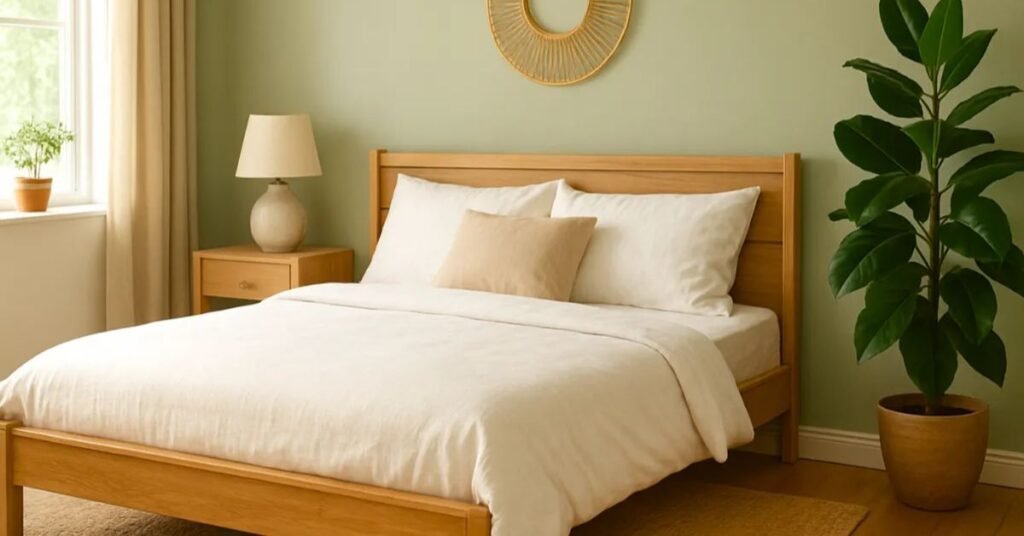
Define the sleep zone. Place your bed as far from the front door as the layout allows, ideally in the commanding position. A folding screen, a bookcase used as a divider, or a ceiling-mounted curtain on a tension rod can give the bed a sense of enclosure. For more detail, see our feng shui bedroom layout guide.
Define the work zone. If you work from home, keep your desk out of view of your bed if possible. Facing the room instead of a blank wall is considered better for focus. At the end of the day, close your laptop and put work materials away, so the zone “closes” too.
Define the living and eating zone. A rug is the simplest tool for defining space. Placing a sofa and coffee table on one rug and a dining table on another makes two clear areas, even if they’re only a few feet apart.
Anchor the entry. Even a tiny apartment benefits from a “foyer.” A small rug, a hook for keys, and a light near the door create a moment of arrival and keep the entry from becoming a dumping ground.
What If You Can’t Change the Layout?
Small apartments often come with fixed problems. Feng shui has traditional “cures” for most of them, and many can be adapted for renters.
The bed has to face the door. If the only place for your bed puts your feet directly in line with the door, place a solid footboard, a bench, or a trunk at the foot of the bed to create a buffer. If you can’t see the door from bed, a small mirror positioned so you can see it is a traditional fix.
The front door opens onto a wall. This is said to block chi as it enters. Hang a calming piece of art on that wall at eye level using removable hooks, or lean a mirror there to create a sense of depth. Good lighting at the entry also helps.
The front door lines up with a window or back door. Feng shui says energy can rush straight through and out. Place a plant, a rug, or a piece of furniture along the path to slow it down, and hang a faceted crystal or wind chime between them if you like that tradition.
The kitchen is visible from everywhere. Keep counters clear, close cabinet doors, and hide small appliances when you aren’t using them. A plant or a bowl of fruit on the counter makes the space feel intentional.
The bathroom door opens into the main room. Keep the bathroom door closed and the toilet lid down, a classic feng shui practice for keeping energy from draining away. A small plant or a full-length mirror on the outside of the door can lighten the area.
There’s very little natural light. Layer lighting: a floor lamp, a table lamp, and a warm light for the evening. Mirrors placed to reflect a window can bounce what natural light you have deeper into the room.
How Do You Declutter a Small Apartment With Feng Shui in Mind?
Clutter is the biggest enemy of good feng shui in any home, and in a small apartment there’s nowhere for it to hide. A few habits make the biggest difference:
Clear the floor first. Floor space gives a small room its sense of openness. Anything on the floor that isn’t furniture or a rug is a candidate for a new home.
Use vertical and hidden storage. Under-bed bins, over-door organizers, and tall, closed cabinets keep things out of sight. Open shelving looks lighter but shows more, so keep it curated.
Choose furniture that does two jobs. Storage ottomans, a bed with drawers, or a drop-leaf table give you more room without adding visual noise.
Practice one-in, one-out. When something new comes in, let something similar go.
Do a 15-minute reset. Once a day, set a timer and return everything to its place. In a small space, this keeps clutter from ever building up.
For a complete approach, our guide to decluttering your home the mindful way walks through the process room by room. And if your space feels heavy even after tidying, our list of signs your house is draining your energy can help you spot what’s still off.
Which Plants and Crystals Suit Small Apartments?
Plants. Living plants bring the wood element and a sense of life into any space. In a small apartment, choose a few healthy plants over many struggling ones. Snake plants, pothos, and ZZ plants tolerate lower light and need little care. Our guide to biophilic design explains why bringing nature indoors feels restorative.
Crystals. Crystals are an easy, renter-friendly way to add intention to a space. A piece of black tourmaline near the entry is a traditional protection stone. A small amethyst suits the sleep zone, and citrine or tiger’s eye on a desk can be a visual cue for focus and follow-through. Our guide on how to use crystals to balance your home shows where each stone works best.
Scent and sound. A diffuser, a candle, or a small bowl of dried herbs can set a mood without taking up much space. Our guide to aromatherapy for home wellness explains how to choose oils for different rooms.
How Do You Refresh the Energy After Moving In?
When you move into a new apartment, you inherit whatever came before. Many people like to mark the fresh start with a simple ritual: open every window, clean the floors and surfaces, ring a bell or clap in each corner, and burn sage or palo santo if your building allows it. Our guides to energy cleansing and sage smudging for beginners cover the steps, and our guide to crystals for a new home suggests stones for a housewarming.
A practical note for renters: many buildings have smoke detectors that respond quickly to smudging. Use a small amount of smoke near an open window, or choose a smoke-free method such as sound, a room spray, or simply fresh air.
Recommended Products
A lightweight folding screen is the simplest way to give a bed its own corner in a studio. It sets up in seconds, needs no hardware, and folds flat when you want the room open again:

- ☀【Flexible panel & easy to storage】Our room divider is made up of four panels of the same size, which can move the shape…
- ☀【Professional hand-crafted】All our screen dividers are manufactured by workers, 100% quality assurance, to bring you a …
- ☀【Perfect room separation】Our room screen divider is flexible and convenient for all kinds of scenes, you can put our sc…
An over-the-door mirror gives you a full-length mirror without a single nail, and it can make a small room feel larger when it reflects a window or a lamp:

- for small space and opening up your room.the Door mirror light weight also makes it ideal on the door mirror. It gives y…
- Wall mirror Full length -the modern imple frame surrounds the design in sleek style, perfect for accenting a variety of …
- High definition door mirror – Constructed of authentic silver backed glass, over the door mirror,this highly durable mir…
A floor lamp with adjustable color temperature lets you use brighter, cooler light while you work and warmer light in the evening, which makes it a good fit for the dark corners many small apartments have:

- ONLY 1 Beige Lamp Shade Included: please noted that this version comes only one piece beige lampshade. Please check care…
- Eye-protect soft light: this standing lamp gives off warm, soft 3000K warm white lighting creates a comfortable ambiance…
- Long lasting & energy saving: includes a power-saving light bulb. Not burn out or overheat, purchase this lamp is also m…
The Bottom Line
Feng shui for small apartments isn’t about having the perfect floor plan. It’s about making the space you have work for you: clear pathways, a bed and desk in the commanding position, distinct zones for sleeping, working, and living, and as much light and air as you can bring in. Renters can do almost all of it without a drill or a can of paint. Start with the change that bothers you most, whether it’s a cluttered entry or a bed that faces the door, and build from there. A small home that feels calm is one of the best foundations for a calm life.
Frequently Asked Questions
Can you do feng shui in a rented apartment?
Yes. Most feng shui involves furniture placement, decluttering, lighting, and decor rather than renovation. Renters can use rugs, textiles, leaning or over-door mirrors, plants, lamps, and removable hooks to apply nearly every principle without risking a security deposit.
How do you apply the bagua to a studio apartment?
You can lay the bagua over the entire studio, aligning its bottom edge with the front door, or apply it to each functional zone, such as sleeping, working, and eating, separately. Many people find the zone-by-zone approach easier in a single open room.
Where should the bed go in a studio apartment?
Ideally, place the bed as far from the front door as possible, with a clear view of the door but not directly in line with it. If the bed must face the door, a footboard, bench, or trunk at the foot of the bed creates a helpful buffer.
Are mirrors good feng shui in a small apartment?
Mirrors can make a small space feel larger and bounce light deeper into a room. Avoid placing a mirror directly facing the front door or facing the bed, which many practitioners believe can disturb rest. Leaning and over-door mirrors are renter-friendly options.
What is the fastest feng shui fix for a small apartment?
Clearing the floor and the entry is usually the quickest change with the biggest effect. Removing clutter from walkways and adding a light near the front door makes a small apartment feel more open almost immediately.
Does feng shui really work?
There’s no scientific evidence for chi itself, but many feng shui principles align with research on home environments. Studies link cluttered homes to higher stress and show that visual clutter competes for attention, which helps explain why a clear, well-lit, organized space tends to feel calmer.
This article is for general educational purposes and reflects traditional feng shui practices. It is not a substitute for professional advice. Always check your lease before making changes to a rental property.
References
- McMains, S., & Kastner, S. “Interactions of top-down and bottom-up mechanisms in human visual cortex.” Journal of Neuroscience, 2011. PubMed. https://pubmed.ncbi.nlm.nih.gov/21228167/
- Saxbe, D. E., & Repetti, R. “No place like home: Home tours correlate with daily patterns of mood and cortisol.” Personality and Social Psychology Bulletin, 2010. PubMed. https://pubmed.ncbi.nlm.nih.gov/19934011/