

Moonstone is a translucent feldspar gem known for a soft, bluish-white glow that seems to drift beneath its surface, and the traditional moonstone meaning centers on new beginnings, intuition, and emotional calm. For thousands of years, people have connected that pale, shifting light to the moon and its cycles of renewal, which is why moonstone became the stone people reach for when one chapter of life ends and another begins.
There’s real substance behind the shimmer, too. Moonstone’s glow comes from a structure so fine that its layers are about the size of a wavelength of light, and the popular “rainbow moonstone” you see in nearly every crystal shop is, strictly speaking, a different mineral. This guide covers what moonstone is, what it represents, how to tell the main types apart, and how to use and care for it in everyday life.
Table of Contents
What Is Moonstone?
Moonstone is a gem variety of feldspar, the most common mineral group on Earth. According to the Gemological Institute of America (GIA), classic moonstone is a variety of the feldspar mineral orthoclase. As it forms and cools, two feldspars, orthoclase and albite, separate into thin, alternating layers, and that layered structure is the source of its glow.
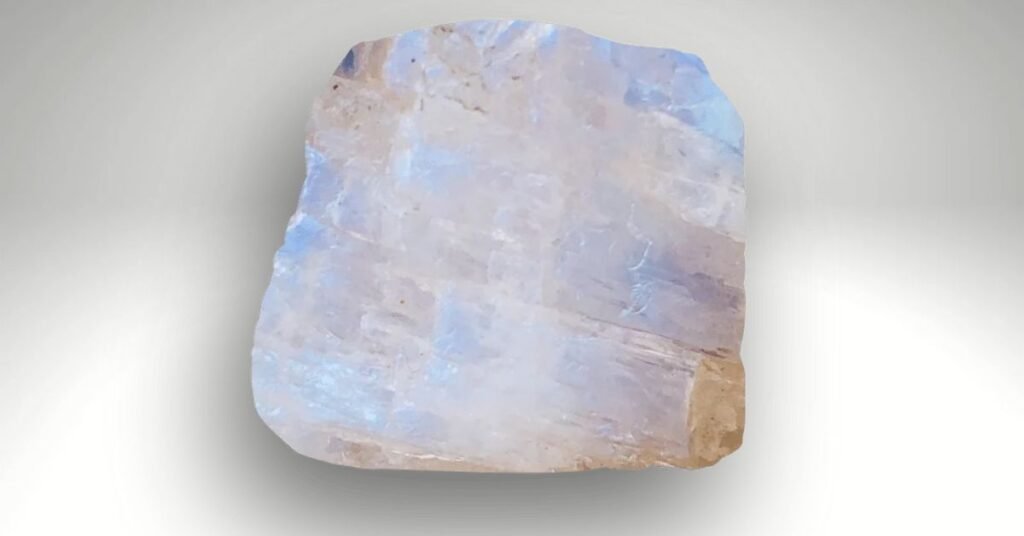
GIA notes that feldspars make up more than half of Earth’s rocky crust, so moonstone comes from one of the most ordinary minerals on the planet. What makes it rare is quality: a clear stone with a strong, mobile blue sheen is genuinely hard to find, especially in large sizes. Most fine moonstone has historically come from Sri Lanka, with India also a major source of the white, peach, and gray stones sold today.
A few practical facts are worth knowing. Moonstone measures 6 to 6.5 on the Mohs hardness scale, which makes it softer than quartz (7). It’s one of the birthstones for June, alongside pearl and alexandrite. And it’s usually cut into smooth, domed cabochons, because a rounded surface shows off the moving light far better than flat facets.
Why Does Moonstone Glow?
The glow has a name: adularescence. It’s the soft, billowing light that appears to roll across a moonstone as you tilt it, as if moonlight were floating just under the surface. The term comes from adularia, an old name for moonstone feldspar from the Adula region of the Swiss Alps.
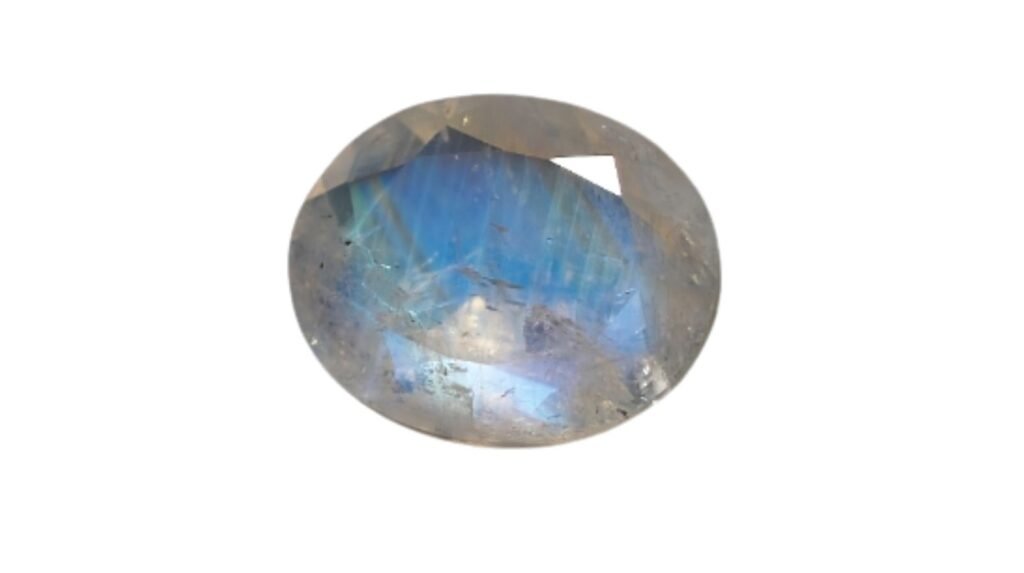
Here’s what’s happening inside the stone. Light enters the moonstone and meets those stacked layers of orthoclase and albite. GIA explains that these layers are around 0.5 microns thick, roughly the size of a wavelength of visible light, so instead of passing straight through, the light scatters. When the layers are especially thin, the scattered light looks blue. When they’re thicker, the glow looks white and milky. That’s why the most prized moonstones have a vivid blue sheen over a nearly transparent body.
Some moonstones also show a second optical effect: a narrow band of light, like a cat’s eye, when the stone is cut just right. Both effects depend on structure, not color, which is a useful reminder when you’re shopping. A stone that is simply white or pearly but shows no moving light isn’t displaying adularescence at all.
A Short History of Moonstone
The lunar connection is ancient. The Romans believed moonstone was formed from solidified rays of moonlight, and the Roman naturalist Pliny wrote that its appearance changed with the phases of the moon, a belief that lasted well past the 16th century, according to the American Gem Society. Both the Greeks and Romans linked the stone to their moon goddesses.
In India, moonstone has long been considered a sacred and auspicious gem, and it has a traditional place in gifts between lovers. Around 1900, Art Nouveau jewelers embraced moonstone for its soft, dreamlike light, and it came back into fashion during the 1960s.
There’s also a distinctly American chapter. In 1970, the year after Apollo 11, Florida’s legislature adopted moonstone as the official state gem to honor the moon landings launched from Kennedy Space Center (Florida Department of State). As the state itself points out, moonstone isn’t found naturally in Florida, and none was found on the moon either. It was chosen purely for what it represents: a giant leap into something new. For a stone associated with new beginnings, that’s a fitting piece of history.
Moonstone Meaning: What Does It Represent Spiritually?
In modern crystal practice, moonstone carries a consistent set of meanings, most of them drawn from its connection to the moon’s rhythm of waxing, waning, and returning.
New beginnings. This is moonstone’s best-known theme. Because the moon renews itself every month, moonstone is associated with fresh starts, letting go of what’s finished, and stepping into the next chapter with an open mind.
Intuition and inner knowing. Moonstone’s soft, inward glow has made it a symbol of intuition: the quiet sense of what’s right that’s easy to miss when life is loud. Many people keep it close during meditation or journaling to support reflection.
Emotional balance. Moonstone is traditionally used to soothe emotional ups and downs and to encourage patience with your own changing moods. Rather than promising to make feelings disappear, its symbolism is closer to acceptance: emotions move in cycles, and that’s normal.
Calm and rest. Its gentle energy makes moonstone a common bedside stone. Our guide on how to use crystals for sleep explains how it fits into a calm evening routine.
Love and tenderness. In many traditions, moonstone is a stone of gentle, nurturing love, and it often appears in our guide to the best crystals for love and relationships.
Safe travel. Moonstone is sometimes called the “traveler’s stone,” and some people carry it on journeys, particularly at night.
Chakra connection. Moonstone is most often linked to the crown and third eye chakras, the energy centers associated with intuition and spiritual awareness, and sometimes to the sacral chakra because of its emotional and creative associations. Our complete guide to chakra balancing explains how these centers relate to one another.
A gentle note on expectations: there’s no scientific evidence that a crystal itself produces intuition or emotional balance. In a well-known experiment, people holding real quartz and people holding glass replicas reported the same sensations (Time). What moonstone reliably offers is a beautiful, tangible reminder of an intention you’ve chosen, and during times of change, a reminder can be exactly what helps.
Why Is Moonstone Called a Stone of New Beginnings?
Most guides stop at the label. It’s more useful to understand why the idea works and how to put it into practice.

Every transition has an awkward middle. You’ve left the old job, relationship, home, or routine, but the new one doesn’t feel like yours yet. Psychologists sometimes describe this as a liminal space, from the Latin limen, meaning threshold. It’s the hallway between two rooms, and it tends to bring restlessness, doubt, and the urge to rush.
That’s where moonstone’s symbolism earns its place. The moon spends part of every month nearly invisible, and it always comes back. A moonstone can serve as a “threshold stone”: an object you deliberately associate with patience during a period of change. Here’s a simple way to use it:
- Name the transition. Write one sentence about what’s ending and one about what you hope is beginning. Keep it honest and specific.
- Choose a home for the stone. Place your moonstone somewhere you’ll see it every day during this period: your nightstand, your desk, or your pocket.
- Pair it with one small action. Each time you notice the stone, take one slow breath and ask, “What’s one small step toward the new chapter today?”
- Mark the ending. When the transition feels complete, maybe after the first month in a new home or the first season in a new role, take a moment to acknowledge how far you’ve come, and then let the stone return to your regular collection.
This works well for moving into a new place, and our guide to crystals for a new home offers more ideas for that transition. It can also help in harder seasons, such as after a loss, alongside the gentler approaches in our guide to crystals for grief and loss.
Is Rainbow Moonstone Real Moonstone?
Not in the strict mineralogical sense. GIA explains that rainbow moonstone is actually a transparent variety of labradorite, a closely related feldspar, rather than orthoclase. Its flashes of blue, purple, and gold come from light reflecting off fine internal layers, similar to classic moonstone but with more color. The trade name is so widely used that you’ll see it everywhere, and it’s still a beautiful natural stone. It’s simply worth knowing what you’re buying.
Here’s how the stones most often sold as “moonstone” compare:
| Type | What it actually is | Typical look | Natural? |
|---|---|---|---|
| White or blue moonstone | Orthoclase feldspar (classic moonstone) | Colorless to milky white with a blue or white glow | Yes |
| Peach moonstone | Orthoclase feldspar | Soft peach to apricot with a gentle sheen | Yes |
| Gray or black moonstone | Orthoclase feldspar | Silvery gray to dark gray with a subtle glow | Yes |
| Rainbow moonstone | Labradorite feldspar | White body with blue and multicolor flashes; often has small black inclusions | Yes |
| Opalite (sometimes sold as “sea opal” or “moonstone”) | Man-made glass | Milky with a blue glow in front and orange tones when backlit; perfectly clear, no inclusions | No |
Two quick tips help when you’re shopping. Natural moonstone almost always shows small imperfections, internal lines, or uneven sheen, so a perfectly flawless, glassy stone with no inclusions deserves a second look. And the tiny black flecks or needles in rainbow moonstone are a sign of a natural stone, not a flaw to avoid.
How to Use Moonstone Every Day
Moonstone doesn’t need elaborate practices. A few simple habits are enough to give it a meaningful place in your life.
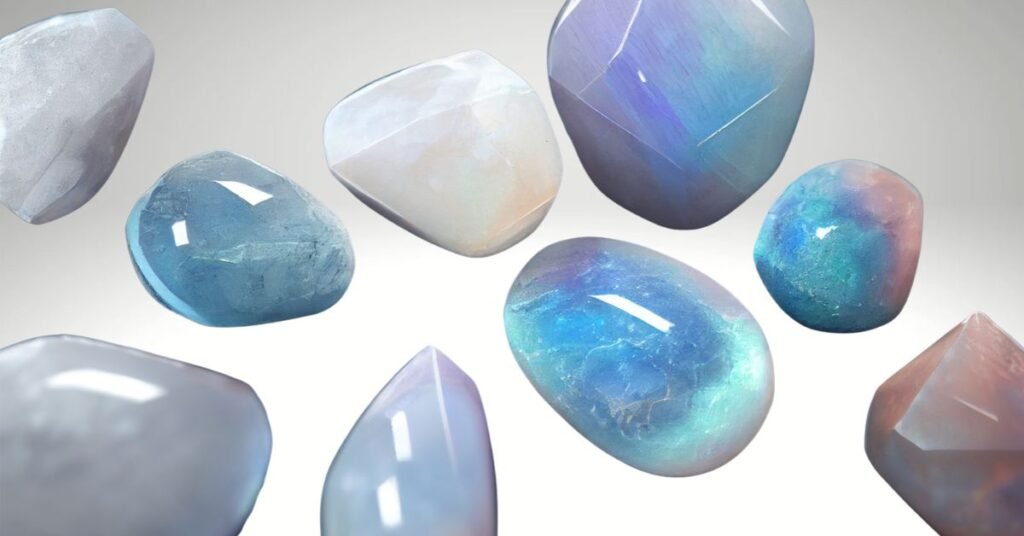
At your bedside. Keep a tumbled stone or palm stone on your nightstand as a cue to slow down before sleep. It pairs naturally with an evening routine like our guided sleep meditation.
During morning reflection. Hold your moonstone for a minute before you start your day and set one gentle intention. Our morning meditation routine is an easy framework to build on.
While journaling. Keep it on your desk while you write about feelings, changes, or decisions you’re weighing. Its symbolism of intuition makes it a good companion for reflective prompts.
In your pocket during a transition. A smooth worry stone or tumbled piece is easy to carry on a first day, a move, or a trip.
Alongside other stones. Moonstone works well in combination with stones whose meanings complement it:
- With clear quartz, the classic “amplifier” stone, to keep an intention in clear focus.
- With citrine when a new beginning also involves new work, study, or financial goals.
- With tiger’s eye when you need courage to take the first step, balancing moonstone’s softness with grounded confidence.
- With rose quartz for new beginnings in love and self-compassion. Our rose quartz guide explains this pairing further.
How Should You Wear Moonstone Jewelry?
Moonstone is lovely to wear, but it needs a little more thought than quartz-family stones like tiger’s eye or citrine. Like all feldspars, it has two directions of cleavage, natural planes of weakness along which a hard knock can split the stone. GIA notes that this is why jewelers often set moonstone in pendants, earrings, and pins rather than rings, which take more bumps.
That doesn’t mean you can’t wear a moonstone ring or bracelet. It just helps to follow a few habits:
- Choose pendants and earrings for everyday wear, since they’re protected from most knocks.
- Take off rings and bracelets before the gym, gardening, cleaning, or moving furniture.
- Look for protective settings such as a bezel, a metal rim that surrounds the stone, if you want a moonstone ring for daily use.
- Put jewelry on last, after lotions and perfumes, to keep the stone’s surface clean and bright.
Many people also enjoy wearing moonstone close to the heart in a pendant during a period of change, where it’s easy to touch as a quiet reminder.
How Do You Cleanse and Care for Moonstone?
Moonstone is easy to care for if you avoid a few common mistakes.
Physical cleaning. According to GIA’s moonstone care guide, warm, soapy water is the only recommended way to clean moonstone. Use a soft brush, rinse, and dry with a lint-free cloth. Ultrasonic and steam cleaners should never be used, and high heat or sudden temperature changes can cause breaks.
Storage. At Mohs 6 to 6.5, moonstone can be scratched by harder stones such as quartz, amethyst, and citrine. Store it in a soft pouch or a separate compartment, not loose in a bowl with other crystals.
Energetic cleansing. For energy work, gentle methods are best. A selenite charging plate is a popular choice: simply rest your moonstone on it for a few hours. Smoke from sage or incense and sound from a singing bowl are also safe options. Avoid soaking moonstone in salt water, since the salt can leave residue in tiny surface flaws and is an unnecessary risk for a softer stone. Our guide on how to cleanse and charge your crystals compares methods stone by stone.
Where to Start
If you’re new to moonstone, choose one piece you’ll actually see or touch every day. Here are three good starting points.
A pendant is the most practical way to wear moonstone, since it’s protected from the knocks that can damage rings. This sterling silver necklace features rainbow moonstone, the labradorite variety, and is designed around the theme of new beginnings, which makes it a thoughtful gift for someone starting a new chapter:

A simple bead bracelet keeps moonstone in view throughout the day. This 8mm stretch bracelet comes in several stones, so make sure moonstone is selected when you order:

For your pocket or nightstand, a thumb worry stone gives your hand something calm and smooth to rest on during a busy or uncertain day:

- Package:1 Set (1 worry stone & 1 Gift Pouch), Size & Weight: Each stone measures about 1.8″ long x 1.5″ wide x 0.3″ thic…
- Hand Carved Worry Stone: Carved in Water Drop Shape, Well Polished to Smooth Front and Back side. Thumb-sized indentatio…
- Pocket & Palm Stone: Light and compact, it slips into a pocket, purse, or pouch. Carry it through the day as a quiet, ta…
The Bottom Line
The moonstone meaning comes down to gentle renewal: the reminder that endings make room for beginnings, that feelings move in cycles, and that intuition often speaks quietly. Its glow comes from layers of feldspar so fine they scatter light like the moon behind a thin cloud, and its history stretches from Roman legend to Florida’s tribute to the moon landing. Choose a natural piece you love, wear it in a way that protects it, keep it close during times of change, and let it remind you that you, like the moon, can always begin again.
Frequently Asked Questions
What does moonstone mean spiritually?
Spiritually, moonstone represents new beginnings, intuition, emotional balance, and calm. Its connection to the moon’s monthly cycle makes it a symbol of renewal, and it’s traditionally linked to the crown, third eye, and sacral chakras.
Is rainbow moonstone real moonstone?
Rainbow moonstone is a natural stone, but mineralogically it’s a transparent variety of labradorite rather than orthoclase, the mineral in classic moonstone. Both are feldspars, and both show a moving glow. The name is a widely accepted trade name.
How can I tell if moonstone is real?
Real moonstone shows a soft glow that moves as you tilt the stone, and it usually has small internal lines or inclusions. Opalite, a man-made glass often sold as moonstone, looks perfectly clear and flawless and shows orange tones when held up to light.
Can moonstone get wet?
Yes. Moonstone can be washed with warm, soapy water and dried with a soft cloth. Avoid long soaks, salt water, ultrasonic cleaners, steam cleaners, and sudden changes in temperature, which can damage the stone.
Can I wear a moonstone ring every day?
You can, but moonstone is softer than quartz and can split along its cleavage planes if it’s knocked hard. A protective bezel setting helps, and it’s best to take the ring off for workouts, cleaning, and heavy tasks.
Which crystals go well with moonstone?
Moonstone pairs well with clear quartz for focus, citrine for new work or study goals, tiger’s eye for courage, rose quartz for love and self-compassion, and selenite for gentle energetic cleansing.
This article is for general educational purposes and reflects traditional and spiritual uses of crystals. It is not a substitute for professional medical or mental health advice. If you are experiencing persistent anxiety, sleep problems, or emotional distress, please consult a licensed healthcare provider.
References
- Gemological Institute of America (GIA). “Moonstone.” https://www.gia.edu/moonstone
- Gemological Institute of America (GIA). “Moonstone Care and Cleaning Guide.” https://www.gia.edu/moonstone-care-cleaning
- American Gem Society. “Moonstone History.” https://www.americangemsociety.org/page/moonstonehistory
- Florida Department of State. “State Gem: Moonstone.” https://dos.fl.gov/florida-facts/florida-state-symbols/state-gem/
- Time. “Do Crystals Work? What Science Says About Healing Crystals.” https://time.com/4969680/do-crystals-work/