

Amethyst is the purple variety of quartz, and it’s probably the first crystal most people ever bring home. The traditional amethyst meaning centers on calm, clarity, and sobriety of mind: for more than two thousand years, people have reached for this stone when they wanted to quiet mental noise, sleep more peacefully, or feel more spiritually grounded. Its name comes from the ancient Greek amethystos, “not intoxicated,” a belief that the stone protected its wearer from drunkenness.
What most guides won’t tell you is where some of that lore actually comes from, what amethyst can and can’t realistically do, and how to make sure the stone you’re buying is genuine. This guide covers all three. You’ll find the real history (including a famous “ancient” myth that turns out to be from the 1500s), an honest look at how amethyst supports calm and sleep, a practical buying checklist, and care instructions that will keep its color from fading on a sunny windowsill.
Table of Contents
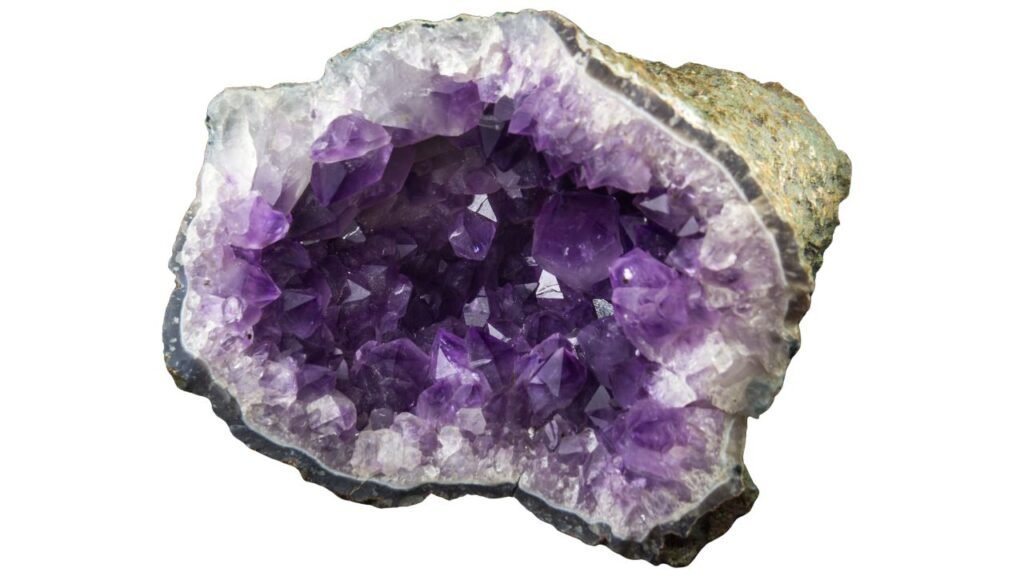
What Is Amethyst?
Amethyst is silicon dioxide, the same mineral as clear quartz, colored purple by traces of iron that have been exposed to natural radiation inside the Earth over long periods of time. That combination creates tiny “color centers” in the crystal structure, and they produce every shade amethyst comes in, from pale lilac to deep royal purple with flashes of red.
On the Mohs scale it measures 7, according to the Gemological Institute of America. That makes it hard enough for everyday jewelry and safe to hold, carry, and rinse, though not indestructible. It’s the birthstone for February and the traditional gift for the sixth and seventeenth wedding anniversaries.
Most of the amethyst you’ll see today comes from Brazil and Uruguay, where it forms inside large volcanic geodes, some tall enough to stand in. Zambia is another major source, known for deep, saturated color. A useful bit of context: until large Brazilian deposits were discovered in the nineteenth century, GIA notes that amethyst was priced alongside ruby and emerald. Its reputation as a “precious” stone is old. Its affordability is fairly recent.
Amethyst Meaning and Symbolism: What Does It Represent?
Across cultures and centuries, amethyst has carried a remarkably consistent set of meanings:
Clarity and sobriety. The oldest association, rooted in its Greek name. Ancient drinkers sometimes used amethyst cups or wore the stone as an amulet against intoxication, and over time the idea broadened from “not drunk” to “clear-headed.”
Spiritual devotion. Amethyst has a long ecclesiastical history. Bishops in several Christian traditions wear episcopal rings set with amethyst, a nod to the Apostles being described as “not drunk” at Pentecost. The stone became a symbol of a sober, devoted mind.
Calm and peace. In modern crystal practice, amethyst is the stone most often recommended for stress, overthinking, and restless sleep. Its cool purple tones do much of the work here: soft violet is a color most people experience as restful.
Intuition and the higher chakras. In chakra traditions, amethyst is linked to the third eye (intuition) and the crown (spiritual connection). If chakra work is part of your practice, our complete guide to chakra balancing explains how those energy centers fit together.
Is the Bacchus and Amethyst Myth Really Ancient?
Almost every amethyst article repeats the same story: the god Bacchus, angry and drunk, sends tigers after a maiden named Amethyst; the goddess Diana turns her into white quartz to save her; and a remorseful Bacchus pours wine over the stone, staining it purple.
It’s a lovely tale. It’s also not ancient. No Greek or Roman source records it. The story was written by the French Renaissance poet Rémy Belleau in a 1576 collection of poems about precious stones, Les Amours et nouveaux eschanges des pierres precieuses. Belleau borrowed familiar classical themes (a maiden fleeing a god, a merciful transformation), which is why the myth feels authentically Greek.
The underlying belief, though, is genuinely old. The Greek name itself proves that amethyst was associated with sobriety long before Belleau picked up his pen, and a late-antique Greek poet, Nonnus, describes Dionysus receiving an amethyst meant to keep his mind clear. So the meaning is ancient; the famous story behind it is about 450 years old. Knowing the difference doesn’t take anything away from the stone. If anything, it shows how powerful the idea of amethyst as a guardian of a clear mind has been, strong enough that a poet felt it deserved an origin story.
What Are the Benefits of Amethyst?
It’s worth being clear about what we mean by “benefits.” There is no scientific evidence that amethyst emits a frequency that changes your brain chemistry, and crystal practice is never a substitute for medical or mental health care. In a 2001 experiment presented by psychologist Christopher French of Goldsmiths, University of London, people who meditated holding real quartz reported the same sensations as people holding glass replicas, as Time reported. What predicted their experience was expectation, not the crystal.
That doesn’t make the practice meaningless. It tells us where the value actually lives: in the ritual, the attention, and the intention a stone helps you hold. Research on rituals shows that deliberate, repeated actions can genuinely reduce distress; one series of studies published in the Journal of Experimental Psychology found that performing rituals helped people cope with loss (Norton & Gino, PubMed). Amethyst works best when you treat it as an anchor for practices that already have real benefits.
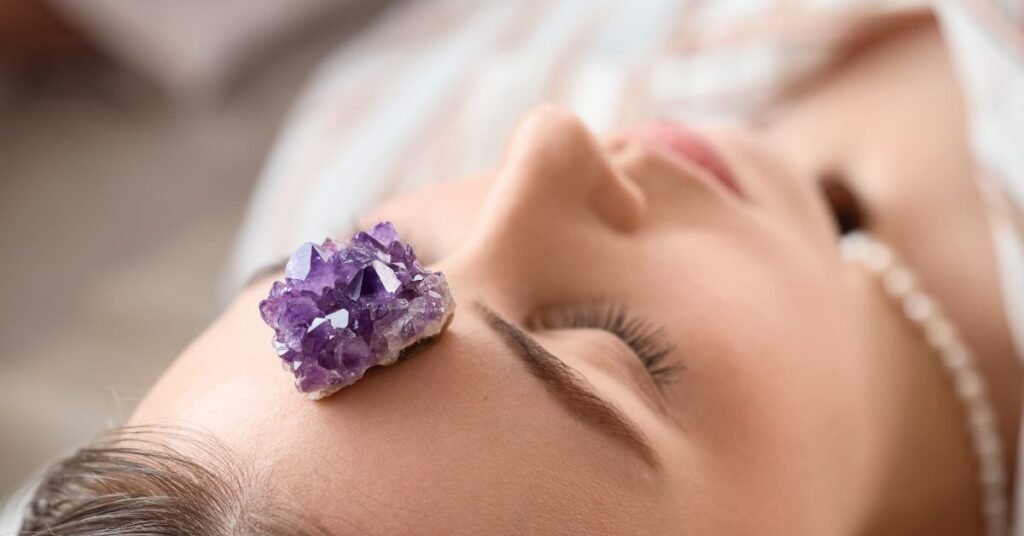
With that framing, here is where amethyst earns its place.
Calm for an Overthinking Mind
Amethyst’s most celebrated quality is its association with calm. Holding a smooth tumbled stone during a stressful moment gives your hands a task and your attention a single point of focus, which can interrupt a spiral of anxious thoughts long enough for slower breathing to take over. If anxiety is your main reason for exploring crystals, our honest guide to crystals for anxiety compares amethyst with lepidolite and other calming stones.
A Bedtime Cue for Better Sleep
Amethyst is the classic bedroom crystal. Its value here is as part of a consistent wind-down routine, which the Sleep Foundation identifies as one of the most effective habits for falling asleep more easily. A stone you hold for a few slow breaths each night becomes a signal that the day is over. For placement ideas and stone pairings, see our full guide on how to use crystals for sleep.
Focus Without the Anxious Edge
Amethyst is a particularly good fit for a specific kind of distraction: the worried kind, where your attention keeps drifting toward problems instead of the task in front of you. A small piece on your desk works as a visual reminder to come back. Our guide to the best crystals for focus explains when amethyst is the right choice and when an energizing stone like citrine is better.
A Companion for Meditation and Spiritual Practice
Because of its long link with devotion and intuition, amethyst is one of the most popular meditation stones. Holding it, or placing a cluster in front of you, gives the practice a tangible starting point. If you’re building a meditation practice, our guide to the best crystals for meditation shows how amethyst pairs with clear quartz and selenite.
Support During Hard Emotional Seasons
Many people keep amethyst close during periods of grief or transition, when sleep is disrupted and the mind won’t settle. Its gentle, soothing reputation makes it a natural choice; our guide to crystals for grief and loss covers how to use it alongside other comforting stones.
How Do You Use Amethyst in Everyday Life?
The simplest ways to use amethyst are also the most effective, because they turn the stone into a habit rather than a decoration.
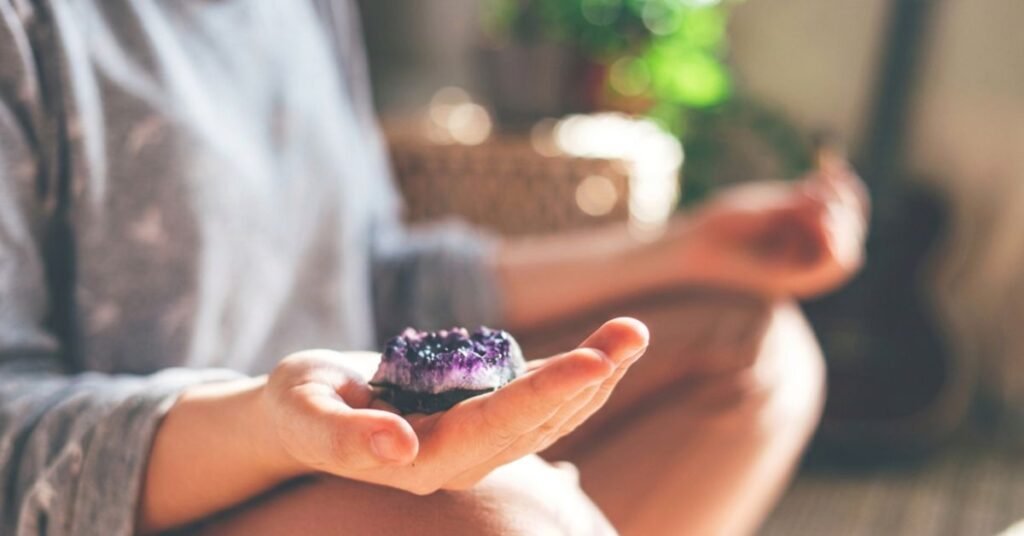
On your nightstand. Place a tumbled stone or small cluster within reach. Before sleep, hold it for five slow breaths and set an intention to let the day go. Some light sleepers find that a large piece right beside the pillow feels too stimulating; if that’s you, move it to the dresser.
In your pocket. A palm stone or tumbled piece is easy to carry and easy to reach for during a tense meeting, a commute, or a difficult conversation.
On your desk. A small cluster or tower works as a visual cue to pause, breathe, and return to the task. It’s also a beautiful object, and there’s nothing wrong with enjoying that.
In meditation. Hold a stone in your non-dominant hand, or place it in front of you as a focal point. Begin each session by noticing its weight and temperature; that small moment of attention is already practice.
As jewelry. A bracelet or pendant keeps the stone with you as a quiet reminder of whatever intention you’ve attached to it. Our guide to choosing healing crystal bracelets explains what to look for in quality and fit.
In a crystal grid. Amethyst is a common center stone for grids focused on peace or spiritual growth. Our crystal grid layouts guide walks through simple designs.
Which Shape of Amethyst Should You Choose?
The shape you buy should follow how you plan to use it. Here’s a quick comparison:
| Shape | Best for | Keep in mind |
|---|---|---|
| Tumbled stone | Carrying, holding during meditation, bedtime ritual | Most affordable; easy to lose in a bag |
| Palm stone | Tactile calming, anxious moments | Smooth, flat shape fits the hand naturally |
| Cluster | Nightstand, desk, shared spaces | Points can chip; dust gently with a soft brush |
| Geode or cathedral | Statement piece for a living room | Heavy; keep out of direct sun to protect the color |
| Tower or point | Desk focal point, crystal grids | Mostly decorative; check the tip for damage |
| Jewelry | All-day reminder of an intention | Remove before cleaning products and hot water |
If you’re unsure, start with a tumbled stone. It’s inexpensive, versatile, and tells you quickly whether amethyst resonates with you before you invest in a larger piece. For a deeper look at each form, see our guide to crystal shapes and what each is for.
How Can You Tell If Amethyst Is Real?
Because amethyst is so popular, imitations are common, especially colored glass. Natural amethyst also competes with lab-grown amethyst, which is chemically identical quartz grown in a laboratory. Lab-grown stones aren’t “fake,” but you deserve to know what you’re buying. A few practical checks help:
Look for color zoning. Natural amethyst rarely has perfectly even color. Hold it up to the light and you’ll often see bands or patches where the purple is deeper or paler. Perfectly uniform, intense purple at a low price is a warning sign.
Check for bubbles. Round air bubbles trapped inside are typical of glass. Natural amethyst can contain inclusions, but they look like tiny veils, fractures, or crystals, not perfect spheres.
Feel the temperature. Quartz feels cool to the touch and warms slowly in your hand. Glass and resin tend to feel closer to room temperature from the start.
Be wary of unnatural colors. Amethyst can be heated or irradiated to change its shade. Much of the citrine sold today is actually heat-treated amethyst, often recognizable by a burnt-orange color concentrated at the tips of a cluster. Unusually electric purple shades in raw clusters may have been enhanced.
Consider the price and the seller. A large, vivid geode for very little money is almost never what it claims. Buy from sellers who state the stone’s origin and whether it has been treated. For jewelry or significant purchases, only a gem lab can reliably separate natural from lab-grown amethyst.
How Do You Cleanse and Care for Amethyst?
Amethyst is easy to care for, with one important exception: sunlight. Prolonged direct sun can fade its purple color over time, so a sunny windowsill is the worst place to display it, and “charging” amethyst in the sun is a habit worth dropping.
Physical cleaning. Rinse it under lukewarm water with a drop of mild soap and dry it with a soft cloth. Avoid harsh chemicals and sudden temperature changes, which can crack stones with internal fractures. Clusters collect dust; a soft makeup brush works well.
Energetic cleansing. In crystal tradition, amethyst is cleansed with moonlight, sound from a singing bowl, or the smoke of sage or palo santo. Monthly is a reasonable baseline, more often if you use the stone daily. Our step-by-step guide on how to cleanse and charge your crystals covers every method and which stones need extra care.
Storage. Keep tumbled stones in a pouch or separate compartment so harder stones don’t scratch them, and keep displays out of direct sunlight.
How Does Amethyst Compare With Other Calming Crystals?
Amethyst isn’t the only stone associated with calm, and the right choice depends on what kind of calm you’re looking for.
| Crystal | Its focus | Choose it if… |
|---|---|---|
| Amethyst | Mental calm, sleep, spiritual clarity | Your stress shows up as overthinking or restless nights |
| Rose quartz | Emotional warmth, self-compassion | You’re being hard on yourself or healing emotionally (our rose quartz guide) |
| Lepidolite | Steadying emotional ups and downs | Your anxiety comes in waves |
| Black tourmaline | Grounding and protection | You feel scattered or drained by other people (our black tourmaline guide) |
| Selenite | Clearing a space | You want to reset the feel of a room |
Many people combine two: amethyst and rose quartz on the nightstand is one of the most popular pairings for restful, gentle evenings. If you’re building your first collection, our list of 7 essential crystals for beginners is a good place to start.
Where to Start
If you’re buying your first amethyst, a few simple pieces cover nearly every use described above.
A set of tumbled amethyst stones is the most versatile starting point: one for the nightstand, one for your pocket, one for your desk.

- Natural Amethyst (Fur Origin: Brazil)
- Size: Approx. 35-50mm. Weight: 1/2 Pound. Quantity: Between 5-6 Pieces
- Sourced from Brazil crystal mine.

- [Crystals and healing stones ]: 10pcs Natural crystals and healing stones.Due to the nature of gemstones, carvings may s…
- [Healing Enger]:The versatility of this kind of mini wand and the multiplicity of its uses make it a very important wand…
- [Amethyst Function]:This purple stone is said to be incredibly protective, healing, and purifying. It’s claimed it can h…
A small natural cluster (look for visible color zoning) makes a beautiful bedside or desk piece. If you prefer something you can wear, an amethyst bead bracelet with natural stones keeps your intention with you all day. And if your goal is better sleep, a combined amethyst and rose quartz set is a gentle, well-matched pair for a bedtime ritual.


- – This is a 100% NATURAL URUGUAYAN AMETHYST known worldwide for having the Deepest Purple Colors and High Shear Crystals…
- – EACH STONE IS UNIQUE IN SIZE, SHAPE & COLOR. The Amethyst you will receive will NOT be the same as those pictured on t…
- – Precisely INSPECTED & Packaged with CARE in the USA


- What You Get: 1pcs handmade decorative car pendant, equipped with amethyst and rose quartz to purify the surrounding ene…
- Amethyst: It is an excellent all-purpose stone, it is birthstone for February. Dream Amethyst is one of the best stones …
- Rose quartz: It is called as love stone that opens heart chakra. Adds positive love energy to relationships, helps clear…
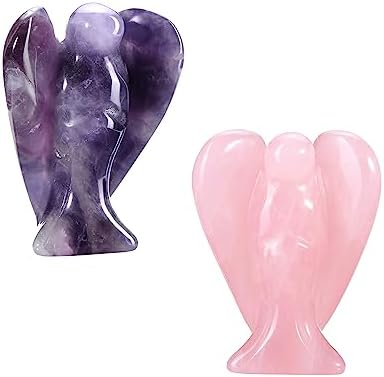
- Pocket Guardian Angel–Carry the beautiful carved crystal angel in your pocket,hold or keep by your bedside at night to …
- Healing Angel Figurines–Angels have reiki healing benefits and properties that aid wellbeing and can be combined with w…
- Crystal Angel – Amethyst can develop intelligence, calm mood, improve intuition, help think, focus on reading power, inc…
The Bottom Line
The amethyst meaning has stayed remarkably steady for more than two millennia: a stone for a clear, calm, devoted mind. Its most famous origin story is a Renaissance poem rather than an ancient myth, and its benefits come from the rituals it anchors rather than from any measurable energy. None of that diminishes it. A beautiful stone that reminds you to slow down, breathe, and return to what matters is doing exactly what people have always valued it for. Choose a genuine piece, keep it out of the sun, and give it a real place in your day.
Frequently Asked Questions
What does amethyst mean spiritually?
Spiritually, amethyst represents calm, clarity, and connection to intuition. In chakra traditions it is linked to the third eye and crown chakras, and it has long been associated with a sober, devoted mind, which is why bishops have traditionally worn amethyst rings.
Where should I put amethyst in my home?
The bedroom is the most popular spot: on a nightstand or dresser as part of a bedtime routine. Amethyst also works well on a desk as a focus cue or in a meditation corner. Avoid sunny windowsills, since prolonged sunlight can fade its color.
Can amethyst go in water?
Yes. Amethyst is quartz with a hardness of 7, so a quick rinse in lukewarm water is safe. Avoid long soaks, harsh chemicals, and sudden temperature changes, especially for clusters or stones with visible internal fractures.
How can I tell if my amethyst is real?
Look for uneven color zoning, a cool feel that warms slowly in your hand, and inclusions that look like veils or tiny fractures rather than round bubbles. Perfectly uniform color at a very low price often indicates glass. Only a gem lab can reliably separate natural from lab-grown amethyst.
Who should wear amethyst?
Anyone drawn to it. Amethyst is the February birthstone and is especially popular with people who want support for calm, sleep, or meditation. There are no traditional restrictions on who can wear or use it.
Does amethyst help with anxiety?
There’s no scientific evidence that amethyst itself treats anxiety. It can be a helpful tool within calming practices, as a tactile anchor for slow breathing or a cue in a bedtime routine. For persistent anxiety, it should complement, never replace, support from a qualified professional.
This article is for general educational purposes and reflects traditional and spiritual uses of crystals. It is not a substitute for professional medical or mental health advice. If you are experiencing persistent anxiety, sleep problems, or emotional distress, please consult a licensed healthcare provider.
References
- Gemological Institute of America (GIA). “Amethyst.” https://www.gia.edu/amethyst
- Belleau, Rémy. Les Amours et nouveaux eschanges des pierres precieuses. Paris, 1576. Bibliothèque nationale de France record: https://data.bnf.fr/16507674/remi_belleau_les_amours_et_nouveaux_echanges_des_pierres_precieuses/
- Time. “Do Crystals Work? What Science Says About Healing Crystals.” https://time.com/4969680/do-crystals-work/
- Norton, M. I., & Gino, F. “Rituals alleviate grieving for loved ones, lovers, and lotteries.” Journal of Experimental Psychology: General, 2014. PubMed. https://pubmed.ncbi.nlm.nih.gov/23398180/
- Sleep Foundation. “Bedtime Routines for Adults.” https://www.sleepfoundation.org/sleep-hygiene/bedtime-routine-for-adults
2 thoughts on “Amethyst Meaning: Properties, Uses, and How to Tell If It’s Real”