

Mindfulness exercises for anxiety are short practices that train you to notice what’s happening in your body and mind, right now, without judging it or trying to push it away. Mindfulness is the skill of paying attention to the present moment on purpose, with curiosity rather than criticism. It won’t make anxiety disappear, and it isn’t meant to. What it does is change your relationship with anxious thoughts and sensations, so they stop running the show.
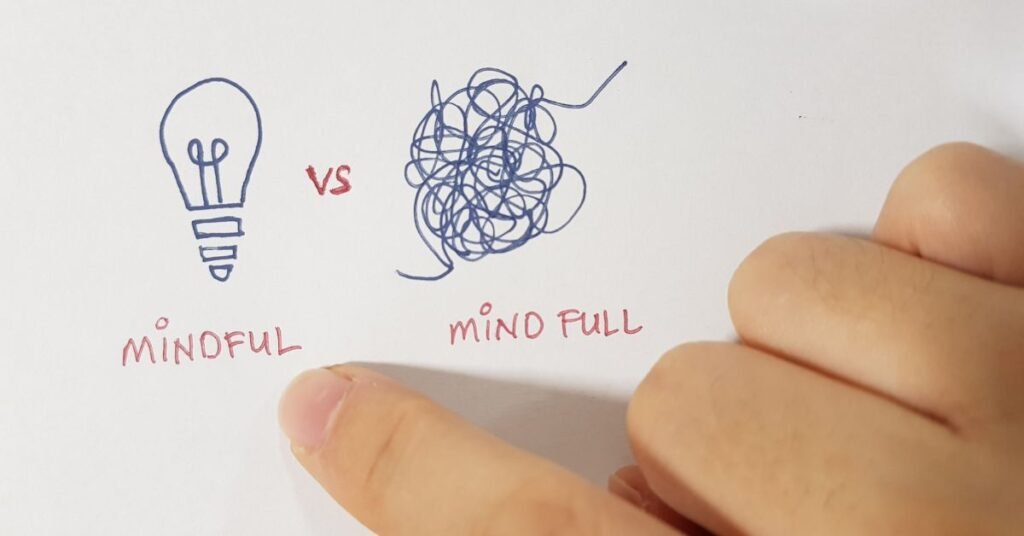
The problem with most lists of anxiety exercises is that they treat every anxious moment the same. A racing heart before a presentation, a 2 a.m. worry spiral, and a low hum of dread that lasts all week call for different tools. This guide explains what the research actually shows, then sorts nine techniques by the moment you’re in, so you know which one to reach for.
Table of Contents
Does Mindfulness Really Help With Anxiety?
Yes, and the evidence has grown stronger in recent years. The most striking study was published in JAMA Psychiatry in 2023. Researchers led by Elizabeth Hoge at Georgetown University randomly assigned 276 adults with diagnosed anxiety disorders to either an eight-week Mindfulness-Based Stress Reduction (MBSR) course or escitalopram, a first-line anti-anxiety medication. After eight weeks, anxiety had dropped by almost exactly the same amount in both groups, and the mindfulness program was judged “noninferior” to the medication. Side effects were far less common in the mindfulness group: 15% reported at least one, compared with 79% of those taking the medication (Hoge et al., JAMA Psychiatry, 2023).
Two details matter. First, MBSR is a structured program with weekly classes, daily home practice, and a retreat day, not a single breathing exercise. Second, the study compared two treatments; it doesn’t mean anyone should stop medication on their own. What it does show is that regular mindfulness practice is a genuine, evidence-based option for anxiety, not just a nice extra.
Which Mindfulness Exercise Should You Use Right Now?
| What you’re feeling | Try this first | Why it fits |
|---|---|---|
| Panic or a racing heart right now | Cyclic sighing (double inhale, long exhale) | Works on the body fastest; slows breathing within a few breaths |
| Feeling detached, foggy, or “not here” | 5-4-3-2-1 grounding | Pulls attention back to your senses and surroundings |
| A thought you can’t stop replaying | Noting and labeling | Naming a thought or feeling creates distance from it |
| A wave of fear, shame, or sadness | RAIN | A step-by-step way to meet a strong emotion without being swept away |
| Worries about the future that keep multiplying | Leaves on a stream | Lets thoughts pass instead of chasing each one |
| Tension in your shoulders, jaw, or stomach | Body scan | Finds and softens where anxiety lives in the body |
| Restlessness, can’t sit still | Mindful walking | Gives anxious energy somewhere to go |
| Harsh self-talk (“What’s wrong with me?”) | Self-compassion break | Replaces criticism with kindness, which lowers threat |
| A low level of anxiety most days | A daily 10-minute practice | Builds the long-term resilience the research is based on |
Mindfulness Exercises for Anxiety in the Moment
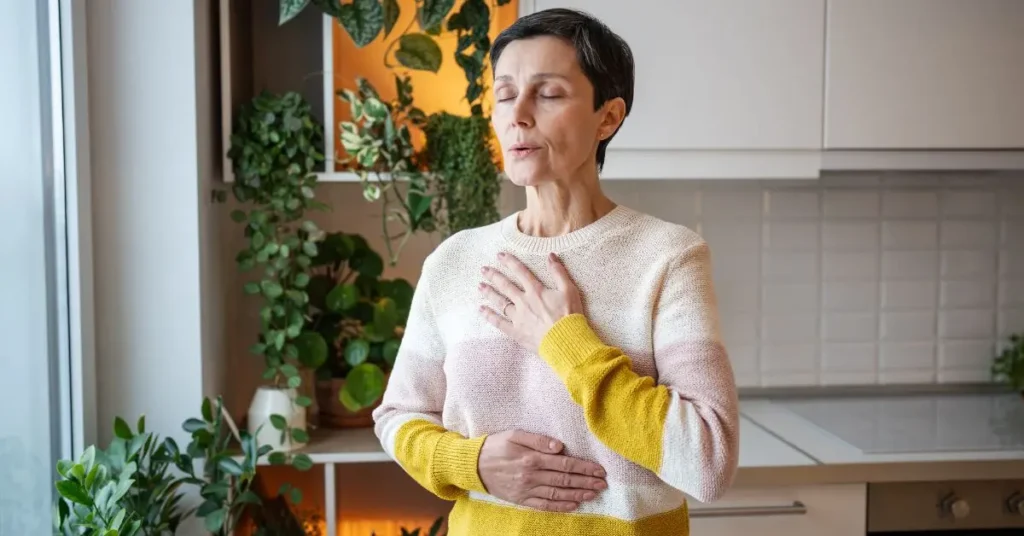
1. Cyclic Sighing: The Fastest Way to Calm Your Body
Cyclic sighing is a breathing pattern in which you inhale through your nose, take a second short “top-up” inhale, and then exhale slowly and fully through your mouth. It mimics the natural sigh your body uses to reset.
In a 2023 Stanford study, adults practiced one of four techniques for five minutes a day for a month: cyclic sighing, box breathing, rapid breathing with breath holds, or mindfulness meditation. All four reduced anxiety. Cyclic sighing produced the largest improvement in daily mood and the biggest drop in breathing rate, a sign of a calmer nervous system (Balban et al., Cell Reports Medicine, 2023). The study was small, but the practice is simple and low-risk.
How to do it: Breathe in through your nose until your lungs are nearly full. Take one more short sip of air through your nose. Then breathe out slowly through your mouth until your lungs feel empty. Repeat for one to five minutes. The long exhale is the key; let it take at least twice as long as the inhale.
2. The 5-4-3-2-1 Grounding Technique
The 5-4-3-2-1 technique is a sensory grounding exercise that brings your attention out of anxious thoughts and into your surroundings. It’s especially helpful when anxiety makes you feel unreal, spacey, or detached.
How to do it: Slowly name five things you can see, four things you can feel (your feet on the floor, the fabric of your shirt), three things you can hear, two things you can smell, and one thing you can taste. Say them out loud if you can. Take your time with each one; the slower you go, the better it works.
To be honest about the evidence, 5-4-3-2-1 is widely taught by therapists but hasn’t been tested on its own in clinical trials. Its value comes from the same principle that underlies all mindfulness: anchoring attention in the present.
3. Feet on the Floor
When you can’t step away, such as in a meeting or on a crowded train, press your feet firmly into the floor and notice the pressure, temperature, and texture beneath them. Feel the weight of your body in the chair. This takes ten seconds, no one can see you doing it, and it gives your attention a solid, physical anchor. Our guide on how to ground yourself explores more grounding practices.
Mindfulness Exercises for Anxious Thoughts and Worry
4. Noting and Labeling: “Name It to Tame It”
Noting is the practice of silently naming what you’re experiencing: “worry,” “planning,” “fear,” “tightness.” It sounds almost too simple, but it has a solid basis in brain research. In a UCLA brain-imaging study, simply putting feelings into words reduced activity in the amygdala, the brain’s alarm center, while increasing activity in a region involved in regulating emotion (Lieberman et al., Psychological Science, 2007).
How to do it: When you notice anxiety, pause and label it in a calm, neutral inner voice: “There’s worry.” “That’s a what-if thought.” “Tightness in the chest.” You’re not arguing with the thought or trying to solve it. You’re simply noticing it the way you’d notice weather.

5. RAIN for Difficult Emotions
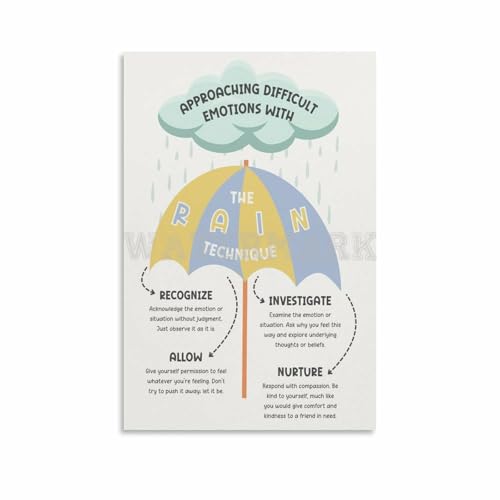
RAIN is a four-step mindfulness practice for meeting strong emotions. It was developed by meditation teacher Michele McDonald and popularized by psychologist Tara Brach. The letters stand for:
- Recognize what’s happening (“I’m feeling panic”).
- Allow it to be there, without trying to fix it right away.
- Investigate with kindness: Where do I feel this in my body? What does this part of me need?
- Nurture yourself with a gesture of care, such as a hand on your heart or a kind phrase.
RAIN takes three to ten minutes and works well for emotions that feel too big to simply breathe through.
6. Leaves on a Stream
This visualization comes from Acceptance and Commitment Therapy (ACT), a mindfulness-based therapy. It’s ideal for “what if” spirals, where one worry leads to another and another.
How to do it: Close your eyes and imagine sitting beside a gentle stream with leaves floating past. Each time a thought appears, place it on a leaf and watch it drift away. If a thought comes back, that’s fine; put it on another leaf. You’re not trying to empty your mind, just practicing letting thoughts move rather than grabbing onto each one.
Mindfulness Exercises for Body Tension
7. Body Scan
A body scan is a slow sweep of attention from your toes to the top of your head, noticing sensations without trying to change them. Anxiety often hides in the body as a clenched jaw, raised shoulders, or a knotted stomach, and a body scan helps you find and soften those places. It’s also one of the core practices taught in MBSR. Our body scan meditation script walks you through a complete session, and our somatic healing exercises offer more body-based approaches.
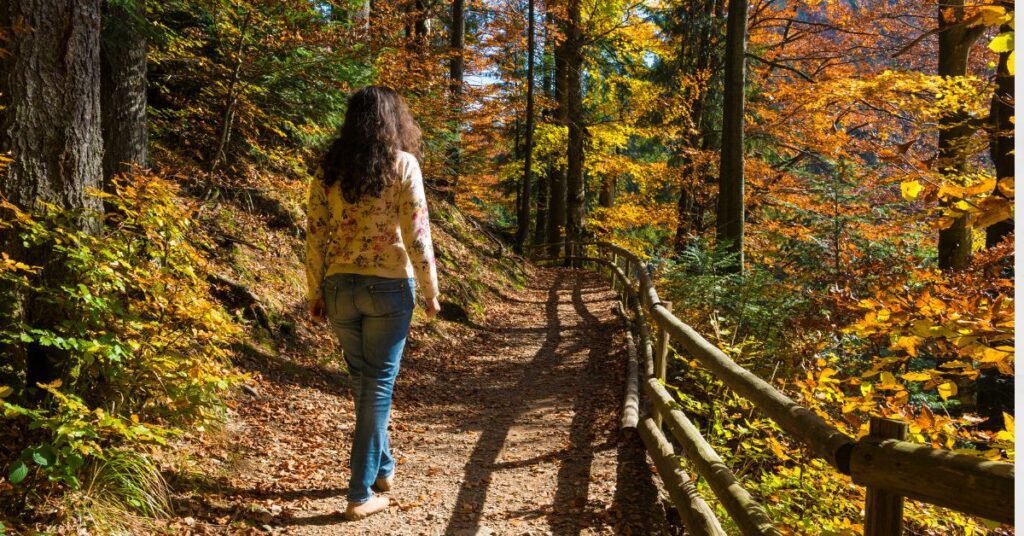
8. Mindful Walking
When anxiety makes it impossible to sit still, move. Mindful walking means walking slowly and paying attention to each step: the lift of the heel, the shift of weight, the contact of the foot with the ground. It gives restless energy somewhere to go while still training attention. Our walking meditation guide explains how to practice indoors or outside.
9. The Self-Compassion Break
Anxiety often comes with a harsh inner critic: “Why can’t I handle this?” A self-compassion break, a practice developed by psychologist Kristin Neff, interrupts that pattern.
How to do it: Place a hand on your heart and say three things to yourself, silently or out loud. First, “This is a moment of suffering” (mindfulness). Second, “Anxiety is part of being human; I’m not alone in this” (common humanity). Third, “May I be kind to myself right now” (self-kindness). It feels awkward at first. Most people find that it gets easier, and more comforting, with practice.
How Do You Build a Daily Mindfulness Practice for Anxiety?
The in-the-moment exercises above are helpful, but the research on anxiety comes from regular practice, not occasional rescue. The goal is to build the skill on calm days so it’s there when you need it.
A simple 10-minute routine works well for most beginners:
- Two minutes of cyclic sighing to settle your body.
- Five minutes of breath awareness or a short body scan. When your mind wanders, which it will, notice where it went, label it, and gently come back.
- Three minutes of noting or a self-compassion break, depending on what came up.
Practice at the same time each day, such as right after your morning coffee. If you’d like more structure, our guide to starting a daily meditation practice and our morning meditation routine can help. For a deeper look at the basics, see what mindfulness is. Some people also find that a breathing trainer or a smooth worry stone gives their hands and breath something to focus on.

Can Mindfulness Make Anxiety Worse?
Sometimes, yes, and it’s worth knowing before you start. A Brown University study of people taking mindfulness-based programs found that 58% reported at least one unpleasant meditation-related experience, and 6% had effects that lasted more than a month, a rate similar to other psychological treatments (Britton et al., Clinical Psychological Science, 2021). Common experiences include increased anxiety, unwanted memories surfacing, or a feeling of detachment.
For most people, these experiences are mild and pass. A few simple adjustments help:
- Keep your eyes open and practices short (two to five minutes) if closing your eyes makes you feel worse.
- Choose outward anchors like sounds or your feet on the floor instead of your breath, which can feel triggering for some anxious people.
- Use movement-based practices such as mindful walking if sitting still is uncomfortable.
- Stop and ground yourself if you feel detached or overwhelmed. Feeling “unreal” is a sign to pause, not to push through.
When Should You Seek Professional Help?
Mindfulness is a valuable tool, but it isn’t a substitute for professional care when anxiety is persistent or severe. Consider talking to a doctor or licensed therapist if anxiety interferes with your work, relationships, or sleep; if you’re having panic attacks; if you avoid places or situations because of fear; or if you’ve been feeling this way for several weeks. Therapies such as cognitive behavioral therapy (CBT) and medication are effective, and many therapists integrate mindfulness into their work.
If you are in crisis or having thoughts of harming yourself, call or text 988 to reach the 988 Suicide & Crisis Lifeline in the United States.
Recommended Products
None of these are necessary for mindfulness, which needs nothing but your attention. But some people find that a physical cue makes it easier to practice consistently. A breathing light can guide the pace of your inhale and exhale:

- 3 BREATHING EXERCISES: Whether you’re looking to relax, focus, or sleep, our device offers three effective breathing tec…
- Everyday Use for All Ages – This versatile device isn’t just for relaxation; its cute design makes it a great addition t…
- Perfect Calm Corner Companion – Create a peaceful and supportive environment in school calm corners. Breathing Pal helps…
A book on the RAIN practice offers a deeper, guided introduction:
- NOTE: All poster prints may vary slightly from what you see on your screen due to the resolution and colour profile of y…
- HIGH QUALITY: The posters is made shortly after purchase. It is not stored in the warehouse because its color will be un…
- DECORATION: TOP MODERN! Really eye-catching! Ideal for all modern graphic & photographic designs. Your wall / room gets …
A worry stone gives anxious hands a calm, tactile focus:

- 【Worry Stones】: Natural crystals and healing stones.Due to the nature of gemstones, carvings may slightly vary in size, …
- 【Use Instructions】:Simply hold the stone’s indentation against your thumb, place your fingers of the same hand over the …
- 【Advantages of Worry Stones】: Its smooth surface creates a pleasant sensation on the skin of the thumb during rubbing, a…
A short daily gratitude practice can complement mindfulness; our morning gratitude journal prompts offer ideas to get started:

- The Ultimate Upgrade to Your Gratitude Practice! Unlike traditional gratitude journals with fixed daily prompts, our gra…
- Transform Your Mindset & Embrace Lasting Happiness – Scientifically designed prompts in this gratitude journal with gift…
- Beginner-Friendly & Effortless to Use – Undated for Ultimate Flexibility. No pressure, no deadlines. Simply open today’s…
And for creating a calm space to practice, a diffuser and a comfortable cushion can help:



The Bottom Line
Mindfulness exercises for anxiety work best when you match the technique to the moment: cyclic sighing or grounding when anxiety hits your body, noting, RAIN, or leaves on a stream when your thoughts are spinning, and a body scan or mindful walking when tension builds. The strongest evidence, including a 2023 trial showing an eight-week mindfulness program performed as well as a first-line medication, comes from regular practice. Start with ten minutes a day, be gentle with yourself when your mind wanders, and reach out for professional support if anxiety is getting in the way of your life. For more ways to calm your nervous system, explore our guide to breathwork for beginners.
Frequently Asked Questions
What is the best mindfulness exercise for anxiety?
It depends on the moment. For a racing heart or panic, cyclic sighing, a double inhale followed by a long exhale, calms the body quickly. For spiraling thoughts, noting and labeling or the RAIN technique work well. For long-term relief, a regular daily practice of about 10 minutes is most effective.
How long does it take for mindfulness to help anxiety?
Some exercises, like cyclic sighing or grounding, can ease anxiety within minutes. Longer-term benefits usually build over several weeks of regular practice. In a 2023 clinical trial, an eight-week mindfulness program reduced anxiety as much as a first-line medication.
Is mindfulness as effective as medication for anxiety?
A 2023 randomized trial in JAMA Psychiatry found that an eight-week Mindfulness-Based Stress Reduction program was as effective as the medication escitalopram for adults with anxiety disorders. However, you should never stop or change medication without talking to your doctor.
What is the 5-4-3-2-1 technique?
It’s a grounding exercise in which you name five things you can see, four you can feel, three you can hear, two you can smell, and one you can taste. It helps bring your attention back to the present when anxiety makes you feel detached or overwhelmed.
Can mindfulness make anxiety worse?
Occasionally. Some people feel more anxious or detached during meditation, especially with eyes closed or long sessions. Keeping practices short, keeping your eyes open, focusing on sounds or your feet instead of your breath, and stopping to ground yourself if you feel overwhelmed can help.
What is the RAIN meditation technique?
RAIN stands for Recognize, Allow, Investigate, and Nurture. It’s a four-step mindfulness practice for meeting difficult emotions with kindness, developed by Michele McDonald and popularized by psychologist Tara Brach.
This article is for general educational purposes and is not a substitute for professional medical or mental health advice. If you are experiencing persistent or severe anxiety, please consult a licensed healthcare provider. If you are in crisis, call or text 988 in the United States.
References
- Hoge, E. A., Bui, E., Mete, M., Dutton, M. A., Baker, A. W., & Simon, N. M. “Mindfulness-Based Stress Reduction vs Escitalopram for the Treatment of Adults With Anxiety Disorders: A Randomized Clinical Trial.” JAMA Psychiatry, 80(1), 2023. https://jamanetwork.com/journals/jamapsychiatry/fullarticle/2798510
- Balban, M. Y., Neri, E., Kogon, M. M., et al. “Brief Structured Respiration Practices Enhance Mood and Reduce Physiological Arousal.” Cell Reports Medicine, 4(1), 2023. https://pmc.ncbi.nlm.nih.gov/articles/PMC9873947/
- Lieberman, M. D., Eisenberger, N. I., Crockett, M. J., Tom, S. M., Pfeifer, J. H., & Way, B. M. “Putting Feelings Into Words: Affect Labeling Disrupts Amygdala Activity in Response to Affective Stimuli.” Psychological Science, 18(5), 2007. https://pubmed.ncbi.nlm.nih.gov/17576282/
- Britton, W. B., Lindahl, J. R., Cooper, D. J., Canby, N. K., & Palitsky, R. “Defining and Measuring Meditation-Related Adverse Effects in Mindfulness-Based Programs.” Clinical Psychological Science, 2021. https://www.brown.edu/news/2021-05-18/adverse-effects
1 thought on “Mindfulness Exercises for Anxiety: 9 Techniques Matched to What You’re Feeling”