

Black tourmaline is an opaque black crystal known in mineralogy as schorl, and it’s the stone people reach for first when they want to feel protected. The idea of black tourmaline protection centers on boundaries: a sense of being grounded, steady, and less affected by stress, difficult people, or a heavy atmosphere. It’s the classic stone for the front door, the work bag, and the pocket of anyone who leaves crowded rooms feeling drained.

This guide explains what black tourmaline actually is, where its protective reputation may come from (there’s a fascinating bit of real physics involved), how to use it in practical rituals, and how to tell genuine schorl from look-alikes. It also addresses the most common claim made about this stone, that it shields you from electromagnetic fields, and why that one doesn’t hold up.
What Is Black Tourmaline?
Black tourmaline is the iron-rich member of the tourmaline family, a group of complex boron silicate minerals. Its mineral name is schorl, and it’s by far the most common tourmaline on Earth: schorl makes up roughly 95 percent of all natural tourmaline. It forms mainly in granite and granite pegmatites, which is why it often appears embedded in white quartz or feldspar.
You can recognize it by its shape. Black tourmaline grows as long, column-like crystals with fine parallel grooves (striations) running along their length, and a cross-section that’s usually rounded-triangular rather than square or hexagonal. It measures 7 to 7.5 on the Mohs scale, slightly harder than quartz, but it’s brittle: raw rods snap across their length more easily than you’d expect.
The name has two layers of history. “Tourmaline” comes from the Sinhalese word tōramalli, used in Sri Lanka for colorful gemstones. “Schorl” is older in Europe: it traces to a village in Saxony, Germany, today called Zschorlau, where black tourmaline turned up alongside tin ore in mines that were active before 1400. The first written description, under the spelling “schürl,” dates to 1562. You’ll often read that black tourmaline was “discovered” in 1400; more accurately, that’s roughly when its European name took root. The mineral itself is, of course, far older than any of us.
What Does Black Tourmaline Mean?
In crystal tradition, black tourmaline carries a consistent set of meanings:
Protection. Its core association. Black tourmaline is described as an energetic shield that keeps you steady when the environment around you isn’t.
Grounding. It’s linked to the root chakra, the energy center associated with safety and stability. People use it when they feel scattered, anxious, or “up in their heads.” Our complete guide to chakra balancing explains how the root chakra fits into the wider system.
Boundaries. For sensitive people and empaths, black tourmaline symbolizes the right to decide what you take on from others. Our guide to the best crystals for empaths shows how it pairs with selenite and smoky quartz for exactly this purpose.
Transmutation. Practitioners often describe it as turning heavy, negative energy into something neutral rather than simply blocking it.
Where Does the Idea of Black Tourmaline Protection Come From?
Here’s where the stone gets genuinely interesting. Tourmaline is both pyroelectric and piezoelectric: when a crystal is heated or squeezed, it develops a small electrical charge across its length. That’s real, measurable physics, and it’s why tourmaline has practical uses in pressure sensors.
Long before anyone understood the science, people noticed the effect. A warmed tourmaline crystal would attract light particles like hot ash and then push them away again, which earned it the old nickname “Ceylonese magnet.” It’s easy to see how a stone that visibly pulled debris toward itself could earn a reputation for “drawing in” and holding unwanted things.
To be clear, that small static charge doesn’t absorb emotions or intentions, and it disappears as soon as the crystal’s temperature stabilizes. But it’s a lovely example of how much of crystal lore begins with something people actually observed.
Can Black Tourmaline Protect You From EMF?
No. This is the most widespread claim about black tourmaline, and it’s the one most worth correcting.
You’ll often see black tourmaline sold for placement next to Wi-Fi routers, laptops, or phones to “absorb” or “neutralize” electromagnetic fields. Physically, a stone can only block radiation that happens to strike it directly, the same as any other solid object of that size. It can’t pull radio waves out of the air around it or create a protective field around your body. When AAP FactCheck examined a nearly identical claim about shungite pendants, physicists described it as false, and an expert from Australia’s radiation protection agency noted that there was no reliable evidence such products provide any health benefit beyond possibly easing anxiety (AAP FactCheck). The same reasoning applies to tourmaline. Its piezoelectric property doesn’t change this; generating a tiny charge under pressure is not the same as shielding.
If a stone near your desk helps you take breaks from screens, that’s a real benefit. Just let it be a reminder, not a shield.
What Are the Real Benefits of Black Tourmaline?
There’s no scientific evidence that black tourmaline changes your energy or protects you from other people’s moods, and crystal practice is never a substitute for professional mental health care. When crystals have been tested directly, people holding real quartz and people holding glass replicas reported the same sensations, as Time reported. What shaped the experience was expectation.
That points to where the value lives: in the rituals a stone anchors. Research on ritual behavior shows that deliberate, repeated actions can genuinely help people cope with distress and restore a sense of control (Norton & Gino, PubMed). Black tourmaline is especially well suited to rituals of boundaries and grounding, because its weight, texture, and dark color make it feel solid in the hand.
A Physical Anchor for Boundaries
Holding a stone before a tense meeting or a difficult visit gives you a moment to decide, deliberately, what you will and won’t take on. That pause is the protective part. For more strategies, see our guide on how to protect yourself from negative energy.
Grounding During Anxious Moments
Pressing a heavy, textured stone into your palm draws attention back into your body, which can interrupt a spiral of anxious thought long enough to slow your breathing. Our guides to grounding yourself spiritually and crystals for anxiety go deeper into both practices.
A Threshold Ritual for Your Home
Placing black tourmaline by the front door turns arriving home into a small ritual: you pass the stone, and you leave the day outside. Our pillar guide to crystals for home protection walks through room-by-room placement in detail.
How Do You Use Black Tourmaline for Protection?
At the front door. Place a raw chunk or tumbled stone near the entrance, on a shelf or console, as a visual cue to set down the day. Many people also place a small piece at each corner of a room or home; it’s a meaningful way to mark your space as your own.
In your pocket or bag. A tumbled stone is easy to carry and easy to reach for before a commute, a crowded event, or a stressful appointment.
As jewelry. A bracelet keeps the stone in contact with you all day. Our guide to choosing healing crystal bracelets explains what to look for in quality and fit.
Before difficult conversations. Hold your stone for three slow breaths, set one clear boundary in your mind, and put it back in your pocket. Simple, repeatable, and surprisingly steadying.
During space clearing. Black tourmaline is often paired with sage or sound when refreshing the feel of a room. Our guides to sage smudging for beginners and energy cleansing for your space cover both practices.
In a new home. Many people make black tourmaline part of a moving-in ritual. Our guide to crystals for a new home shows how to combine it with rose quartz and citrine.
In a crystal grid. It’s a classic choice for the outer points of a protection grid. Our crystal grid layouts guide walks through simple designs.
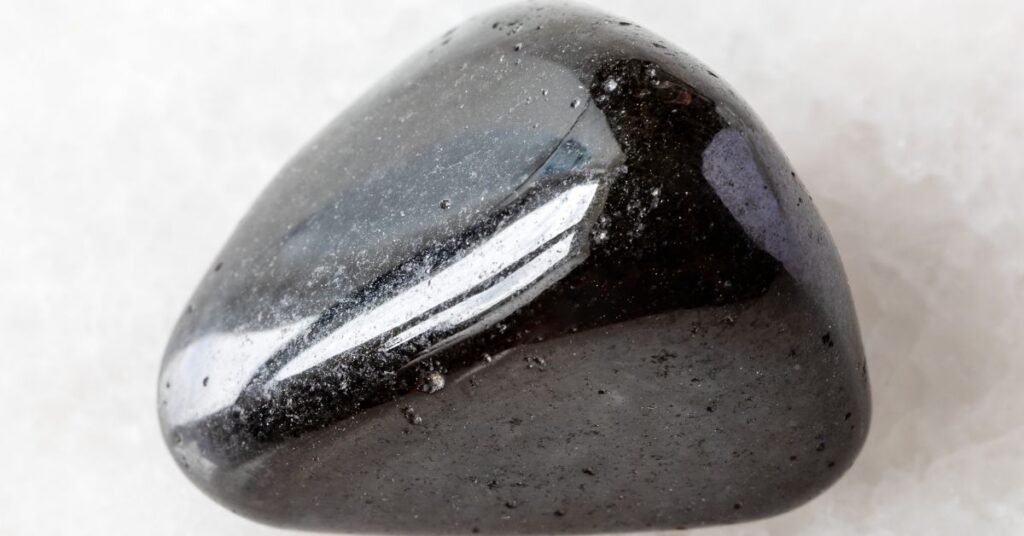
Which Shape of Black Tourmaline Should You Choose?
| Shape | Best for | Keep in mind |
|---|---|---|
| Raw rod or chunk | Front door, shelves, room corners | Brittle; can snap or shed splinters |
| Tumbled stone | Pocket, bag, nightstand, rituals | Smooth and durable; easiest to start with |
| Tourmaline in quartz | Display, gifts | Striking contrast; heavier and pricier |
| Bracelet | All-day wear | Choose natural beads over dyed stones |
| Pendant | Wearing near the heart | Check the setting is sturdy |
| Tower | Desk or altar | Mostly decorative; check edges for chips |
If you’re new to it, start with tumbled stones. They’re inexpensive, sturdy, and versatile. For a broader look at what each crystal form is for, see our guide to crystal shapes.
How Can You Tell If Black Tourmaline Is Real?
Genuine black tourmaline is plentiful and affordable, but other black materials are sometimes sold in its place. These checks help:
Look for striations. Raw black tourmaline almost always shows fine, parallel grooves running along the length of the crystal. Smooth, glossy surfaces with no lines suggest something else.
Check the cross-section. Broken ends of a raw rod are usually rounded-triangular. Most look-alikes don’t share that shape.
Compare the shine. Black tourmaline has a glassy-to-dull luster and is fully opaque. Black obsidian is volcanic glass, very shiny, and breaks with smooth, curved, shell-like surfaces. Hematite has a metallic, silver-gray sheen and feels noticeably heavy for its size.
Be wary of uniform beads. Perfectly identical, jet-black, glossy beads at a very low price are often dyed stone or glass. Natural tourmaline beads usually show slight variation and tiny surface pits.
Ask about the source. Reputable sellers will tell you where the stone came from and whether it has been treated or stabilized.
How Do You Cleanse and Care for Black Tourmaline?
Physical care. Raw black tourmaline is brittle, so handle rods gently and keep them away from edges where they could fall. A soft, dry brush removes dust; tumbled stones and beads can be rinsed briefly in lukewarm water and dried right away. Avoid soaking raw pieces, since water can work into existing cracks.
Sunlight. Unlike amethyst, black tourmaline won’t fade in the sun, so a sunny windowsill is fine.
Energetic cleansing. Because it’s associated with absorbing heavy energy, many practitioners cleanse black tourmaline more often than other stones: with smoke from sage or palo santo, sound from a singing bowl, or by resting it on selenite. Our step-by-step guide on how to cleanse and charge your crystals covers every method.
How Does Black Tourmaline Compare With Other Protection Stones?
| Crystal | Its focus | Choose it if… |
|---|---|---|
| Black tourmaline | Boundaries and grounding | You leave people or places feeling drained |
| Black obsidian | Honest self-reflection | You’re doing deep inner work and want a “mirror” stone |
| Smoky quartz | Gentle grounding, release | You want protection with a softer, lighter feel |
| Hematite | Focus and steadiness | You feel scattered and need to come back to your body |
| Selenite | Clearing a space | You want to reset the feel of a room |
Black tourmaline pairs well with a softer stone. Many people keep it with rose quartz for protection without closing off, or with amethyst for calm, protected sleep.
Products Worth Considering
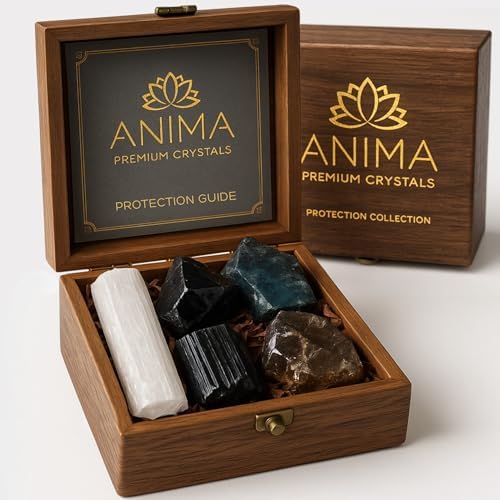
If you’re choosing your first black tourmaline, these cover the most common ways to use it: tumbled stones for carrying, a larger raw piece or hanging set for the front door, and wearable options for all-day support.

- 💎【PRODUCT SIZE】 :- The Black Tourmaline natural tumble stones, weight is 1 LB. The natural Tumbled Stones with various s…
- 💎【BENEFITS OF BLACK TOURMALINE】 :- Black Tourmaline will cleanse, purify, and transform dense energy into a lighter vibr…
- 💎【HAND-POLISHED STONE】 :- People usually used it to wish for increase good luck, wealth and fortune. Use for home decor …




The Bottom Line
Black tourmaline protection is best understood as a practice of boundaries and grounding, not as an invisible force field. The stone has a genuinely remarkable physical property, a small electrical charge when heated or pressed, which may help explain its long reputation for “drawing in” negativity, but it can’t absorb emotions or block the signals from your router. What it can do is give your hands something solid to hold while you decide what you’ll carry and what you’ll leave at the door. Used that way, it’s one of the most practical stones you can own.

Frequently Asked Questions
What is black tourmaline good for?
In crystal practice, black tourmaline is used for protection, grounding, and setting emotional boundaries. It works best as a physical anchor for rituals, such as pausing before a stressful conversation or marking the threshold of your home.
Where should I put black tourmaline in my home?
The most popular spot is near the front door. Many people also place pieces in the corners of a room, on a desk, or by the bed. Choose places where you’ll see it often enough for it to work as a reminder.
Does black tourmaline really block EMF?
No. A stone can only block radiation that strikes it directly, like any solid object of the same size. It cannot neutralize electromagnetic fields from phones, Wi-Fi, or other devices, or create a protective field around your body.
Can black tourmaline go in water?
Tumbled stones and beads can be rinsed briefly in lukewarm water and dried right away. Avoid soaking raw rods, which are brittle and may have cracks that water can widen.
How do I know if my black tourmaline is real?
Look for fine parallel striations along the crystal, a rounded-triangular cross-section, and an opaque, non-metallic luster. Very glossy stones with smooth curved breaks are usually obsidian, and heavy metallic-gray stones are usually hematite.
Can I wear black tourmaline every day?
Yes. There are no traditional restrictions on daily wear. Many people wear a black tourmaline bracelet or pendant as a constant reminder of their boundaries and cleanse it more often than other stones.
This article is for general educational purposes and reflects traditional and spiritual uses of crystals. It is not a substitute for professional medical or mental health advice. If you are experiencing persistent anxiety, stress, or emotional distress, please consult a licensed healthcare provider.
References
- “Tourmaline.” Wikipedia. https://en.wikipedia.org/wiki/Tourmaline
- AAP FactCheck. “Pendant ‘protection from radiation’ claims sink like a stone.” August 2021. https://www.aap.com.au/pendant-protection-from-radiation-claims-sink-like-a-stone/
- Time. “Do Crystals Work? What Science Says About Healing Crystals.” https://time.com/4969680/do-crystals-work/
- Norton, M. I., & Gino, F. “Rituals alleviate grieving for loved ones, lovers, and lotteries.” Journal of Experimental Psychology: General, 2014. PubMed. https://pubmed.ncbi.nlm.nih.gov/23398180/
2 thoughts on “Black Tourmaline Protection: Meaning, Uses, and What It Can’t Do”