

Some nights, sleep just won’t come. The room is dark, your body is tired, but your mind keeps running through tomorrow’s schedule, last week’s argument, the email you forgot to send. You lie there waiting for something to shift, and nothing does.
This is one of the most common experiences in modern life. According to the American Academy of Sleep Medicine, roughly 30 to 35 percent of American adults experience some form of insomnia symptoms — and anyone who has stared at the ceiling at 2 a.m. knows how quickly poor sleep unravels everything else. Patience, focus, the ability to handle ordinary stress with any grace at all: they all depend on rest.
Crystal healing isn’t a cure for sleep disorders. It won’t replace a doctor, fix sleep apnea, or resolve the underlying anxiety that may be keeping you up. What it can do is give you something sleep science actually values: a consistent, calming bedtime ritual. Repeated nightly cues help the nervous system recognize that it’s time to downshift. Crystals, held with intention and placed thoughtfully, can become part of that cue.
This guide walks through how to use crystals for sleep — which stones to choose, where to put them, how to build a ritual that actually sticks, and which products are worth starting with.
Table of Contents

What’s Really Happening When Crystals Support Sleep
Crystal healing is grounded in the idea that minerals carry distinct energetic frequencies that interact with the body’s own energy field. It’s a practice with deep roots — ancient Egyptians used lapis lazuli and amethyst for protection and calm; Ayurvedic traditions have long associated moonstone with emotional soothing; many Indigenous cultures incorporated stone-based rituals into their healing practices for centuries.
Modern science hasn’t confirmed that crystals emit measurable healing frequencies. That’s worth being honest about. What research does support, however, is that intentional bedtime rituals — handling a calming object, setting an intention, practicing slow breathing — genuinely help reduce pre-sleep anxiety and improve sleep onset. A meta-analysis published in the Journal of Psychosomatic Research found that mindfulness meditation significantly improved sleep parameters in patients with insomnia across multiple randomized controlled trials, with researchers noting that consistent practice reduced both insomnia symptoms and nighttime cognitive arousal. You can review that study on PubMed.
Whether the crystal itself carries energetic properties or whether the ritual around it is doing most of the work is, in some ways, beside the point. People who use crystals as part of their wind-down routine consistently report sleeping with more ease. This guide takes that seriously.
The 5 Best Crystals for Sleep
Not every crystal belongs in a bedroom. Carnelian, tiger’s eye, citrine, and red jasper all carry activating, energizing qualities that can make settling down harder, not easier. The stones below were chosen for the opposite reason — they calm, ground, and emotionally stabilize.
1. Amethyst
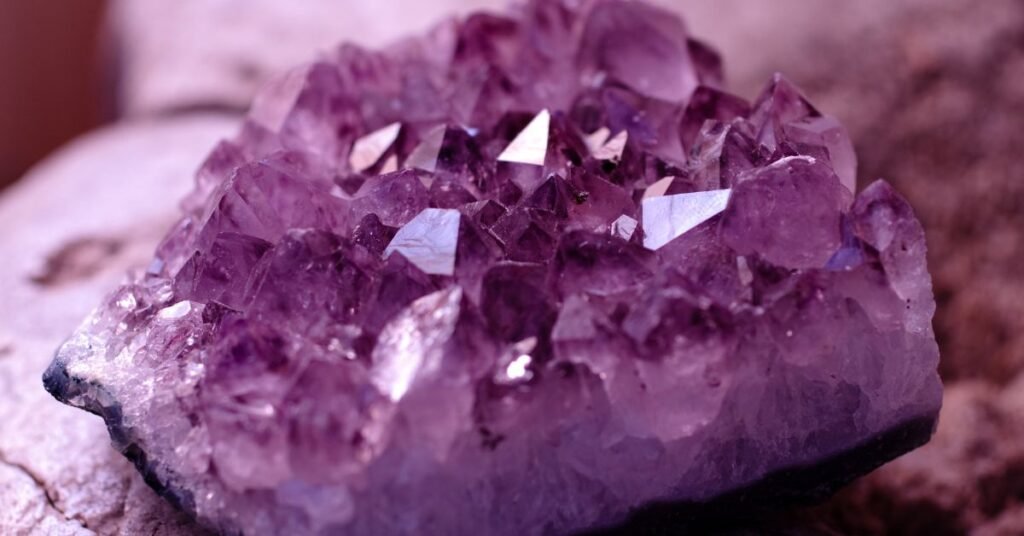
Ask almost any crystal practitioner which stone they’d reach for first when someone can’t sleep, and amethyst is what they’ll name. Its deep violet color is connected to the third eye and crown chakras, and its energy has a quieting, clarifying quality that’s hard to replicate with other stones.
What amethyst does particularly well is break the loop. The mental replay — the to-do list, the conversation you keep re-running, the vague worry that has no target but refuses to leave — tends to soften in its presence. It doesn’t dull the mind so much as give it somewhere to land.
For a deeper look at this stone’s history and full range of properties, our complete amethyst guide covers everything worth knowing.
Placement: A small tumbled piece under the pillow is the classic choice. The nightstand works just as well. Light sleepers sometimes find amethyst too activating at close range — if that’s you, try moving it to the dresser. It still reaches you from there.
2. Lepidolite
Lepidolite is lavender-gray, often with a slight shimmer, and it contains natural lithium in its mineral structure. Lithium is used in mood-stabilizing medication, though in trace amounts here — enough, many practitioners believe, to give lepidolite a distinctly calming effect on emotional overwhelm and anxiety.
Where amethyst works primarily on the mind, lepidolite tends to settle the body. The tight shoulders, the jaw that won’t unclench, the restlessness that makes it impossible to find a comfortable position — lepidolite addresses those things. It has an almost sedating quality, soft and releasing rather than sharp.
Placement: Hold it in your palm during your pre-sleep wind-down. When you’re ready to lie down, slip it into your pillowcase or set it on the nightstand.
3. Howlite
White with gray veining, howlite has one particularly focused gift: quieting mental chatter. If racing thoughts are your main obstacle to sleep, this is worth keeping close. People often describe it as slowing the internal noise without shutting the mind down entirely — more like turning the volume down than hitting mute.
It also has a reputation for building patience. That matters more than it sounds. One of the crueler features of insomnia is the frustration that comes from not sleeping, which then makes sleep even harder to reach. Howlite has a way of softening that edge.
Placement: Under the pillow or held during pre-sleep breathwork. Its texture is smooth and pleasant to grip, which makes it a good stone for tactile grounding practices.
4. Selenite
Selenite operates differently than the other stones here. Rather than working directly on your mind or body, it works on the space around you — clearing accumulated stress from the room, dissolving heavy or stagnant energy, and leaving a sense of lightness that’s easier to sleep inside.
Its name comes from Selene, the Greek goddess of the moon, and there’s something apt about that. It has a cool, clear quality — the energetic equivalent of opening a window. It’s also one of the few crystals that’s considered self-cleansing, which means you don’t need to recharge it the way you would amethyst or howlite. Convenient, and genuinely useful for a bedroom staple.
One practical note: selenite is water-soluble. Never soak it or leave it anywhere damp. Moonlight or smoke cleansing works perfectly well.
Placement: Windowsill, nightstand, or under the bed. A selenite wand swept slowly along the body before lying down is a simple ritual that many people find genuinely settling.
5. Moonstone
Moonstone has a soft luminosity — a glow that seems to shift slightly with the light — and an energy that matches it. It’s connected to lunar cycles and emotional intuition, and it’s especially helpful when sleep is being disrupted by emotional processing rather than mental stress. Grief, transition, hormonal shifts, the kind of sensitivity that makes everything feel louder — moonstone steadies those waters.
It also supports dreamwork. People who want more vivid or meaningful dreams, or who are curious about working with their subconscious through sleep, often place moonstone in their sleep space specifically for that purpose.
Placement: Nightstand or briefly held in meditation before sleep. If you find that it amplifies dream intensity past the point of comfort, move it a bit further away rather than removing it entirely.
Placement Guide: Where to Put Your Crystals
Placement shapes the experience significantly, and it’s worth thinking through before you just set something on the nightstand and hope for the best.
Under the pillow is best reserved for smooth, tumbled stones — amethyst, howlite, or a small piece of lepidolite. Raw crystals with points or rough edges don’t belong there, for obvious practical reasons. If you try pillow placement and wake feeling more alert than when you went to bed, that’s useful information. Some people are genuinely more sensitive to close-range crystal energy. The nightstand is a perfectly good alternative.
On the nightstand is the most accessible option and works for almost any stone. The crystal stays within your energetic field throughout the night, close enough to be present without being physically intrusive. If you have a larger piece — an amethyst cluster, a selenite tower — this is the natural home for it.
Under the bed suits selenite wands and grounding stones like black tourmaline especially well. Many practitioners place tourmaline at each corner of the mattress to create a kind of protective perimeter around the sleep space. Worth trying if nighttime anxiety or a general sense of unease tends to disturb your rest.
In the room’s corners works for stones you want to act on the overall environment rather than your personal field. Four small pieces of black tourmaline, one in each corner, is one of the most commonly recommended protective arrangements in crystal healing.
For more on creating a sleep-supportive bedroom from the ground up, both our Feng Shui bedroom guide and Zen bedroom ideas offer approaches that pair naturally with crystal work.
Building a Nightly Crystal Ritual
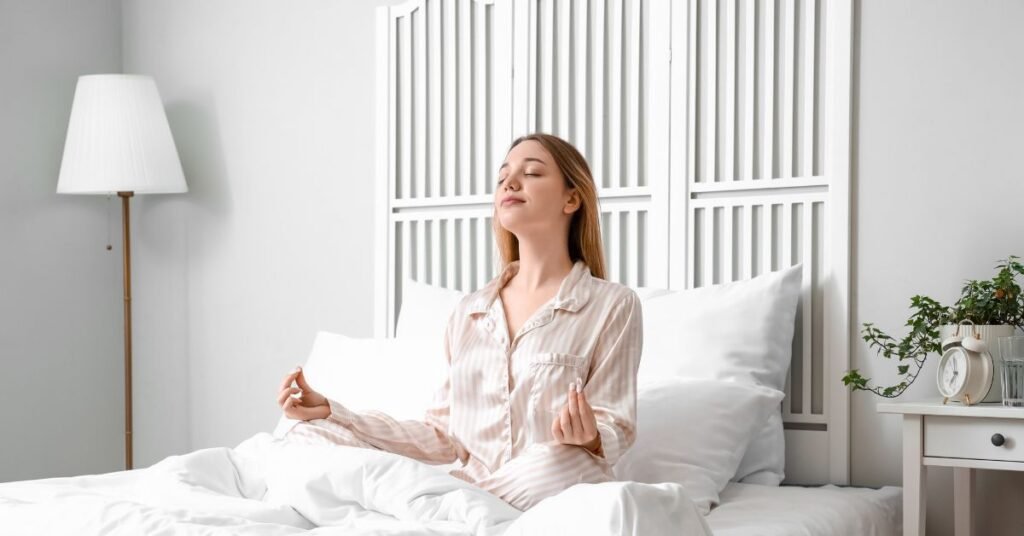
A crystal sitting on a nightstand is still a beautiful object. But it does much more when it’s part of a deliberate sequence — something your nervous system learns to associate with sleep the way it associates darkness with melatonin production.
The following ritual is simple. Adjust it to fit your evenings.
About an hour before bed: Start dimming the lights in your home. Pick up your sleep crystal for a moment and just hold it. No elaborate intention-setting yet — this is just the beginning of the transition, a physical acknowledgment that the active part of the day is winding down.
Fifteen to twenty minutes before bed: Sit quietly, stone in both hands, eyes closed. Breathe in for four counts, out for six. The longer exhale is the key — it activates the parasympathetic nervous system, the part of the body responsible for rest and digestion. After a few rounds, set your intention. It doesn’t need to be wordy or spiritual. “I’m ready to sleep” works. So does “I’m letting the day go.” Whatever feels true.
As you settle in: Place the crystal where you’ve chosen to keep it. If you have a selenite wand, run it slowly from your head to your feet before lying down, releasing whatever tension is left in your body.
If your mind still won’t quiet after all that, pairing the crystal work with a short guided meditation often closes the gap. Our guided sleep meditation was built specifically for this transition.
Crystal Combinations Worth Trying
Individual stones are effective. But certain pairings complement each other in ways that address more than one dimension of sleeplessness at once.
Amethyst + Howlite is the go-to for an overactive mind. Amethyst settles the spiritual and intuitive centers; howlite slows the mental loop. Together they cover both the emotional and cognitive sides of restlessness — useful if your thoughts tend to spiral rather than simply race.
Lepidolite + Selenite works well after hard days. Lepidolite releases what you’re carrying in your body; selenite clears the room around you. The combination creates a kind of double clearing — internal and environmental.
Amethyst + Moonstone suits people drawn to dreamwork or deeper subconscious exploration. Amethyst under the pillow, moonstone on the nightstand. It’s a more spiritually oriented pairing, less focused on quieting the mind and more on what the sleeping mind might offer.
If you want to understand how crystals interact more broadly, our guide to crystals for meditation covers the underlying principles — most of them apply directly to sleep work as well.
Recommended Products to Get Started
Finding quality sleep crystals doesn’t require visiting a specialty shop. The three sets below are available on Amazon US, reasonably priced, and well-suited to the practice described in this guide.
4 Sleep Aid Crystals Set — Amethyst, Moonstone, Lepidolite, Howlite
Four of the most effective sleep stones in one set, each selected for its calming or grounding properties. An information card is included explaining what each crystal is and how to work with it — genuinely useful if you’re starting from scratch. The four-stone format also makes it easy to experiment: try one stone at a time over several nights before combining them, so you can learn what your body responds to most.
Best for: Anyone new to sleep crystals who wants to explore multiple options before committing to a particular stone.

- Handmade Unique Gifts for Woman and Men from Highest Quality Natural Indian Crystal Stones
- Natural Calm – Regain Energy with Restful Sleep, Exhaustion, Tension, and Stress Relief
- Crystal Clarity – Eco Resin and Healing Crystals set together
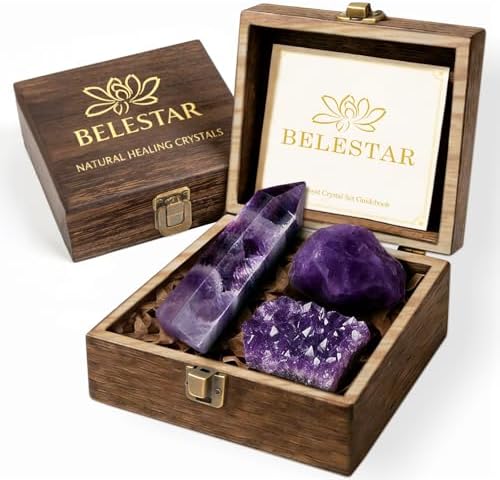
Anima Premium Amethyst Crystal Set — Geode, Tower, and Raw Crystal
Three forms of amethyst in a single wooden gift box: a tower, a raw crystal, and a small geode. Each form has a slightly different energetic quality — the tower focuses and directs intention, the raw crystal preserves the stone’s natural unprocessed energy, the geode radiates outward into the room. Ethically sourced from Brazil, with documentation included.
It’s also genuinely beautiful. If you want your sleep space to feel sacred as well as functional, this set earns its place on a nightstand.
Best for: Those who already know they connect with amethyst and want a more complete, considered experience with it — or anyone looking for a meaningful gift.
- Promotes Peaceful Sleep & Calm – This amethyst set helps reduce stress, clear mental fog, and enhance intuition, making …
- Large Raw Natural Crystals – Each crystal measures 1.4-1.6 inches (longest side) with a 3.15-inch Selenite bar, featurin…
- Beginner-Friendly Meditation Kit – Includes an 18-page detailed guidebook with chakra basics, stone properties and step-…
Amazing Gemstone Sleep Manifestation Set — 6 Crystals
A broader six-stone raw collection: amethyst, smoky quartz, shungite, vesuvianite, serpentine, and rose quartz. The scope extends beyond sleep specifically into stress relief, emotional balance, and general energetic wellbeing — useful if you want a versatile starting collection rather than stones focused narrowly on one purpose. Comes in a velvet pouch with a certificate of authenticity.
Best for: Those building a broader crystal practice, or anyone interested in smoky quartz and rose quartz alongside the classic sleep stones.
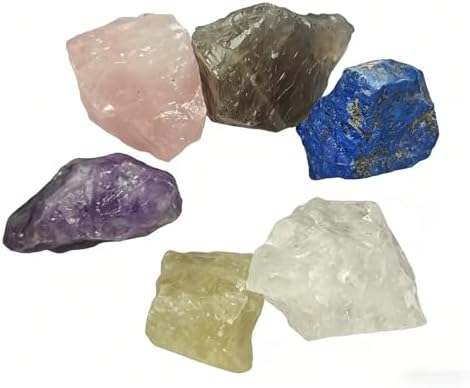
- 🧘 POWERFUL ENERGY CRYSTAL SET – Includes 6 hand-selected natural raw healing stones (each 1.2-2 inches): Amethyst, Rose …
- 💜 ANXIETY RELIEF & EMOTIONAL HEALING – These authentic natural rough stones, are specially selected for their soothing a…
- ✨ PERFECT FOR BEGINNERS & SELF-CARE ENTHUSIASTS – Each genuine raw crystal (1.2-2 inches) maintains its natural unpolish…
How to Care for Sleep Crystals
Crystals used nightly are in continuous contact with your energy field, and they benefit from regular cleansing. Monthly is usually enough; during particularly stressful stretches, every two weeks is reasonable.
The most reliable methods are moonlight (a windowsill overnight, ideally around the full moon), sage or palo santo smoke (pass the stone through slowly with the intention of releasing what it’s absorbed), and sound (a singing bowl struck nearby). All three work. Choose whichever fits your routine.
Two exceptions worth knowing: lepidolite and selenite should never be left in water. Both can be damaged by prolonged moisture. The other sleep crystals mentioned here tolerate a brief rinse, though energetic cleansing methods work equally well for all of them.
Our crystal cleansing and charging guide covers every method in detail, including less common options like rice cleansing and sound bowls.
A Realistic Note on What Crystals Can and Can’t Do
Crystals work best as part of a broader approach to sleep hygiene, not as a standalone fix. The CDC reports that roughly 14.5 percent of American adults have trouble falling asleep most days — and for many of them, the underlying causes are behavioral and environmental as much as anything else. A consistent sleep and wake time (even on weekends), a cool and genuinely dark room, no screens in the hour before bed, and no caffeine after early afternoon all make a real difference, and crystals don’t replace them.
If sleep difficulties persist despite consistent effort, a healthcare provider can help identify what else might be happening. Conditions like sleep apnea, restless leg syndrome, and clinical insomnia have effective treatments that go beyond lifestyle changes. The American Academy of Sleep Medicine is a good starting point for understanding when professional evaluation is warranted.
That said — for the very common experience of a mind that won’t stop and a body that holds tension into the night, crystals offer something real. A reason to slow down. A ritual that marks the boundary between the day and sleep. A small, beautiful object that holds your intention for rest. That’s not nothing. For many people, it’s exactly what’s been missing.
FAQ
Which crystal is best for sleep?
Amethyst is the most widely recommended starting point — it’s effective for quieting an overactive mind and has a long track record in sleep-focused crystal work. That said, lepidolite is often a better fit for people whose sleep difficulties are driven more by physical tension or emotional overwhelm than by racing thoughts. When in doubt, the four-stone set above lets you test both.
Where should I put crystals for sleep?
Under the pillow (smooth tumbled stones only), on the nightstand, or under the bed are the most common placements. Selenite and black tourmaline are often placed under the mattress or in the corners of the room to work on the broader sleep environment rather than just your personal energy field.
Can I sleep with crystals under my pillow?
Yes, as long as you use small, smooth, tumbled stones rather than raw or pointed pieces. If you wake feeling more alert than when you went to bed, move the stone to the nightstand instead — some people simply respond more strongly to close-range crystal energy than others.
How do I know if crystals are working?
The effects tend to be gradual rather than immediate. After a week or two of consistent use, many people notice they fall asleep more easily, wake less often, or feel less anxious as they settle in. The ritual itself contributes meaningfully to these effects — don’t underestimate the value of any practice that reliably signals your nervous system it’s time to rest.
How often should I cleanse my sleep crystals?
Monthly works well for most people. During stressful periods, every two weeks keeps the stones functioning well. Moonlight, sage smoke, and sound are all effective methods.
Are there crystals I should avoid in the bedroom?
Yes. Carnelian, tiger’s eye, citrine, red jasper, and garnet all carry energizing properties that can interfere with sleep. Keep these in other areas of your home — they’re excellent for focus and motivation, just not at bedtime.
Disclaimer: Crystal healing is a complementary wellness practice and is not intended to diagnose, treat, cure, or prevent any medical condition. If you are experiencing persistent sleep difficulties, please consult a qualified healthcare provider.