

In the modern spiritual landscape—where meditation, consciousness studies, and metaphysical philosophy often overlap—few works have developed a following as persistent as The Law of One, also known as The Ra Material. It’s frequently described by readers as a “spiritual blueprint” that tries to answer big questions about identity, evolution of consciousness, free will, polarity (service), and the nature of reality.
At the same time, it remains controversial because its origin is presented as channeled communication, a category that doesn’t fit conventional standards of verification. A grounded way to approach it is to treat the text as a philosophical/spiritual system: evaluate it by its coherence, ethical implications, and practical usefulness—without surrendering critical thinking.
This guide is written for a North American audience and focuses on reliable primary sources (the original books and official publication listings) plus practical reading options.
Table of Contents

What is The Law of One?
The Law of One is a series of 106 Q&A “sessions”—presented as dialogues between questioner Don Elkins and an entity identifying as “Ra,” speaking through Carla Rueckert—organized and published by L/L Research.
A well-known summary statement quoted from the sessions describes the central thesis: all things are one, and the deepest reality is unity expressed as “love/light.”
Where did it come from?
From the primary text itself (Book I), the material is framed as transcripts from tape recordings of an experiment in “tuned trance telepathy.” The introduction attributes the group’s research timeline as beginning in 1962, with a major change in results in 1981, and describes the work as the presentation of “experimental data” for readers to evaluate independently.
This origin story matters because it shapes how you read the book responsibly:
- It is not an academic publication.
- It is presented as channeled communication (a spiritual/paranormal category).
- The authors themselves encourage readers to reach their own conclusions.
How the books are structured (sessions and editions)
There are two “main ways” readers encounter the material:
- The original “Law of One / Ra Material” books (the classic multi-book series).
- The Ra Contact: Teaching the Law of One (a newer, consolidated presentation that includes all 106 sessions in two volumes on Amazon).


A major practical point: the material is session-based, meaning you can read it like a reference library—by theme and question—rather than forcing a cover-to-cover marathon.
The core teachings (in plain English)
Even when readers disagree about the source, many find the framework internally consistent. Here are the most important pillars, stated without jargon overload:
1) Unity (Oneness)
The foundational claim is that reality is ultimately one unified existence. Individual identity and separation are portrayed as temporary perspectives useful for growth.
2) Free will and responsibility
The material repeatedly treats evolution as choice-driven: you are not “saved” by information; you grow through how you live—your intent, integrity, and consistent orientation.
3) Love/light as a spiritual shorthand
You will see “love/light” language used as a way to speak about the Creator and the fabric of reality. Whether you interpret that literally or symbolically, it’s the book’s signature spiritual vocabulary.
4) Polarity (service-to-others vs. service-to-self)
One of the most practical elements is the “polarity” model:
- Service-to-others: compassion, cooperation, honesty, humility, care.
- Service-to-self: control, manipulation, domination, self-exaltation.
Many readers treat this less as moral theater and more as a mirror: “Is this choice expanding connection—or reinforcing separation?”
5) Densities (stages of consciousness)
The Law of One describes consciousness evolving through densities (think “levels” or “grades” of development). This idea is central to its cosmology and is frequently used to interpret spiritual maturation and collective change. The Law of One+1
A grounded way to use it (even if you’re skeptical) is to read densities as a developmental map:
- from survival and identity,
- to empathy and relational maturity,
- to wisdom, integration, and service.
Energy centers and inner work (a practical lens)
The text repeatedly discusses “energy centers” and balancing work (conceptually similar to chakra models). Many readers translate this into modern practice as:
- meditation and nervous-system regulation,
- shadow work and emotional integration,
- daily ethical alignment (what you practice becomes your consciousness).
If your site audience values self-care and spiritual growth, this is where the Law of One becomes less “cosmic” and more personal.

Controversies and how to read with discernment
A responsible article should acknowledge what critics point out:
- Non-verifiability: channeling claims can’t be validated like standard historical or scientific claims. (Treat extraordinary claims cautiously.)
- Cosmology overload: the material includes big cosmic narratives; some readers take them literally, others treat them as symbolic scaffolding.
- Authority risk: any “revealed” text can tempt people into outsourcing judgment.
A strong reading posture:
- Hold the material as hypothesis, not gospel.
- Track outcomes: Does it make you more grounded, ethical, compassionate?
- Keep autonomy: If something doesn’t resonate or harms wellbeing, leave it behind.
How to start reading (three beginner paths)
Path A: “I want the easiest entry”
Start with a beginner-friendly orientation book, then step into the Q&A sessions once the vocabulary feels familiar. One popular option is Living the Law of One 101: The Choice.

Path B: “I want the cleanest ‘complete’ presentation”
Read The Ra Contact: Teaching the Law of One Volume 1, then Volume 2 (two-volume set on Amazon).

Path C: “I want the original methodology + context”
Start with Book I (The Ra Material) and read the introduction carefully before diving into the sessions. It explains the group’s stated method and framing.
![The Ra Material(The Law of One , No 1) [Illustrated] Publisher: D...](https://m.media-amazon.com/images/I/41VjCFW7FHL.jpg)
Pro tip for consistency: do 20 minutes/day and summarize each session in 3 bullets:
- core idea
- what challenged you
- one practical takeaway
Where to read for free vs. which editions to buy
Many readers begin online to test fit, then switch to print for deep study. The website lawofone.info provides a structured interface (sessions, categories, glossary) and states it is republishing with permission from L/L Research. The Law of One
For buying, the choice is usually about experience:
- Print: better immersion, annotation, fewer distractions.
- Kindle/ebook: portable, searchable.
- Audiobook: easiest for momentum, paired with text for reference.
Product review: The Ra Material: Law of One – 40th-Anniversary Boxed Set
If you want a “flagship” physical edition, the 40th-Anniversary Boxed Set is positioned as a premium collector/study set that includes all five books in hardcover, totaling about 1,000 pages in English, published by REDFeather (publication date listed as December 8, 2020).
Who it’s best for
- Readers who already know they’ll study long-term
- People who annotate heavily and want a durable set
- Anyone building a serious spiritual library (instead of a casual “try it” purchase)
Pros
- Complete multi-book set in one purchase (hardcover durability) Amazon
- Aesthetically “giftable” and library-worthy
- Ideal for deep reading without screen fatigue
Cons (practical, not ideological)
- Larger/heavier footprint (less travel-friendly)
- Higher upfront cost than trying an ebook or free online reading (prices vary)
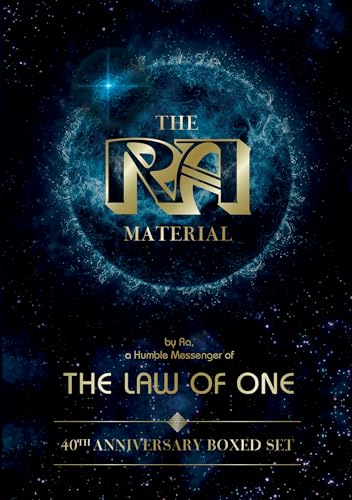
Best use strategy: If you’re unsure, start with a free online reading workflow first; if you keep
Enjoyed this content? Read more on our website.