

In the middle of the modern era—an age shaped by world wars, scientific revolutions, and rapidly changing religious landscapes—The Urantia Book emerged as a striking spiritual text that aims to expand how readers think about God, the universe, human history, and the life of Jesus. First published by Urantia Foundation in 1955, it presents itself as a revelatory work and invites readers into a sweeping, multi-layered cosmology—one that tries to harmonize spiritual faith with an enlarged cosmic context.
Whether you are a lifelong Christian curious about the book’s Jesus papers, a spiritual seeker drawn to big-picture cosmology, or simply someone who keeps hearing “Urantia” and wants the facts in plain English—this guide will help you understand what the book is, what it contains, the origin story as presented by Urantia Foundation, the main ideas readers talk about, and the official ways to read, listen, download, or purchase it.
Table of Contents

Quick facts (for first-time readers)
- Publisher: Urantia Foundation (incorporated January 11, 1950; first printing available October 12, 1955). Urantia
- Format: 196 “papers” (chapters) plus a Foreword, organized into four major parts.
- Official online reading: Urantia Foundation provides the official Standard Reference Text online.
- Free downloads: Official free downloads include popular formats like EPUB and PDF, plus other formats; a complete audiobook download is also offered.
- Audio: Urantia Foundation offers a complete, unabridged audio reading (also available on Spotify).
- Copyright note: Urantia Foundation states the 1955 English text copyright expired in January 2006 and is in the public domain, while translations published by the Foundation remain copyrighted.
- Trademark note: Urantia Foundation owns registered trademarks for “Urantia,” “Urantian,” and the Concentric Circles symbol; websites and materials should avoid implying endorsement or affiliation.
What is The Urantia Book?
Urantia Foundation describes The Urantia Book as a work that portrays humanity’s relationship with God, presents “new spiritual truth for modern men and women,” and emphasizes a pathway toward a personal relationship with God. It also frames human destiny as an ongoing spiritual journey in which “living faith” is central to spiritual progress and survival. Urantia
From a reader’s perspective, it is helpful to think of the book as operating on three levels at once:
- A cosmic “big map” of reality (from Paradise at the center to vast superuniverses)
- A narrative history that reframes aspects of planetary and human development
- A detailed account of Jesus’ life and teachings that many readers find more expansive than the Gospel narratives alone
The book is structured as 196 papers, each with a specific focus, and it is typically read either as a long-form journey (cover to cover) or as a reference work that people revisit for specific themes.
What’s inside: the four-part structure (and what each part tries to do)
One reason The Urantia Book feels so “big” is that it is not just one genre. It’s theology, cosmology, philosophy, and narrative history combined.
Urantia Foundation’s official online edition (Standard Reference Text) makes the organization visible: a Foreword followed by four major parts, covering topics from the nature of God to the life of Jesus.
Part I: The Central and Superuniverses
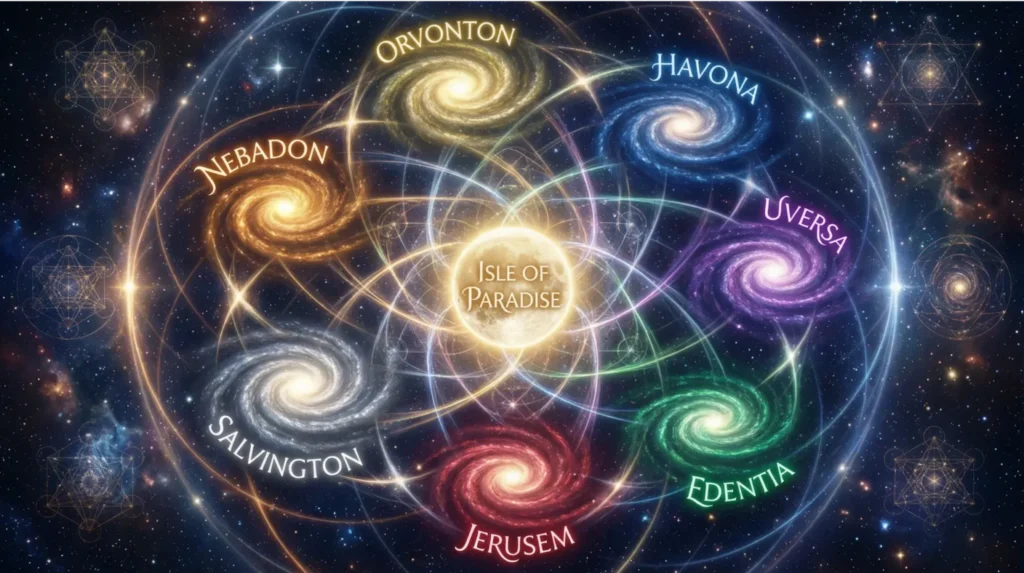
This opening section is the most “cosmic” in scope. It introduces concepts like Paradise, a central universe often referred to as Havona, and multiple superuniverse domains—described as the large-scale structure within which local universes and inhabited worlds exist. Urantia+1
If you enjoy metaphysical architecture—how reality might be organized, how divinity relates to creation, and what “ultimate” reality could mean—Part I is where the book leans heavily into that worldview.
Part II: The Local Universe
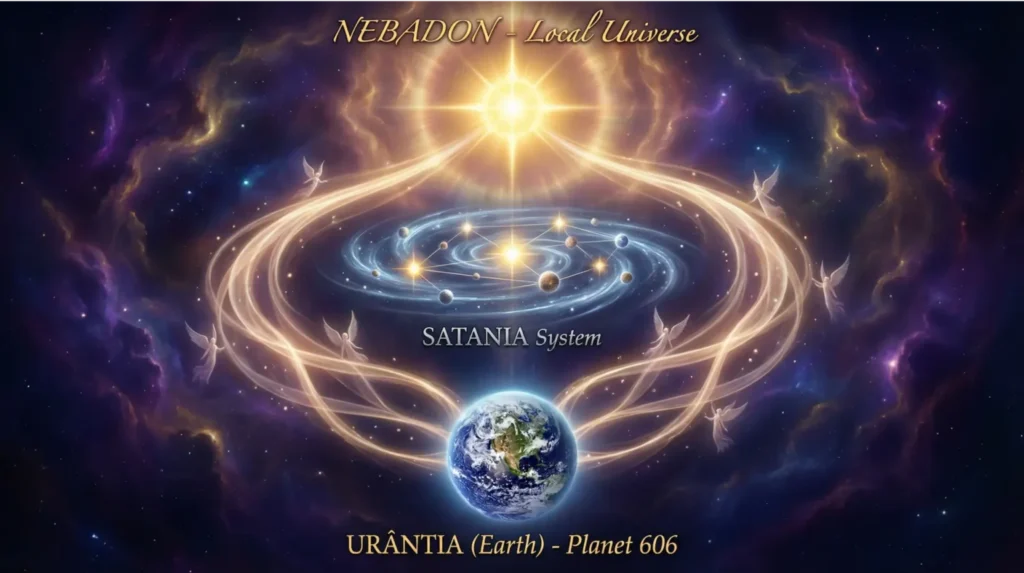
Part II narrows the lens from “everything” to “our region” of the larger cosmic system, introducing the local universe sometimes referred to as Nebadon and placing it within a broader superuniverse context.
This section includes extensive descriptions of celestial administration, orders of beings, and the way spiritual governance is portrayed as operating across worlds and systems. For readers who like structured hierarchies (or who enjoy comparing “cosmic governance” models), Part II is often compelling—though it can be dense.
Part III: The History of Urantia (Earth)
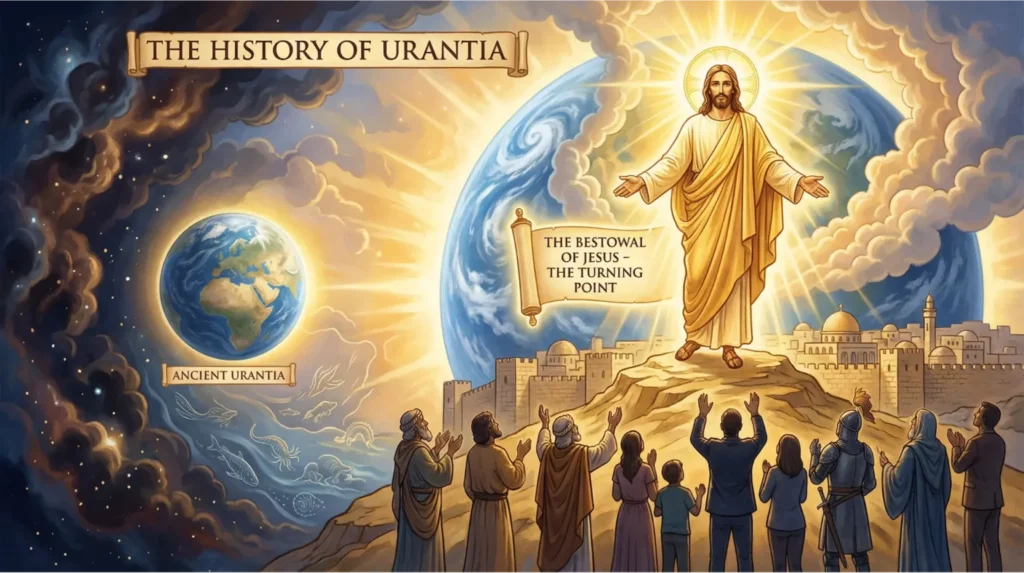
Part III shifts again—this time into a long narrative about planetary development and human history, including the evolution of social institutions, religion, government, and civilization. You can see this emphasis directly in the official “Titles of the Papers,” which include topics such as the origin of Urantia, early life eras, the development of government and the state, and the evolution of marriage and religion.
Readers sometimes describe Part III as a “mythic-history overlay”—a re-interpretation of known human development within the book’s cosmic framework.
Part IV: The Life and Teachings of Jesus
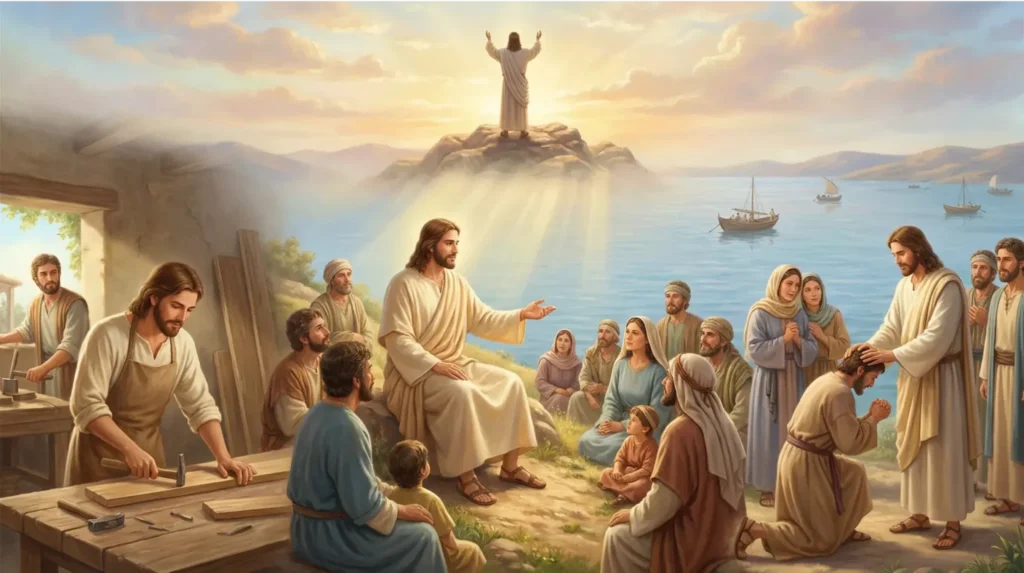
Part IV is often the most read, even by people who do not finish the entire book on a first pass. The official list of papers includes a long sequence focused on Jesus’ life stages—birth, childhood, adolescence, early adulthood, public ministry, and many detailed episodes. Urantia
For many readers, Part IV is the emotional center of the book: it aims to present Jesus not only as a religious figure, but as a fully human personality who reveals the character of God through lived experience.
Key concepts you’ll encounter (a beginner-friendly glossary)
Even people who love the book will tell you: the vocabulary can feel like learning a new map. Here are a few concepts you are likely to see early and often—described here in a neutral, reader-friendly way.
“Urantia”
In the book’s terminology, “Urantia” is used as a name for Earth.
Important note: Urantia Foundation also owns registered trademarks for “Urantia” and related marks in publishing and related contexts, so websites should avoid implying sponsorship or official affiliation.
Paradise and Havona
The text describes Paradise as the still center of creation and refers to a central universe family sometimes called Havona.
The book places our “local universe” within a broader superuniverse framework; for example, it describes Nebadon as belonging to Orvonton (the seventh superuniverse).
Thought Adjuster (also called “Mystery Monitor”)
One of the most distinctive teachings in the book is the concept that God can be personally present within human experience through an indwelling divine presence often called a Thought Adjuster.
“Standard Reference Text” and paragraph numbering
Urantia Foundation provides an official Standard Reference Text online, and it uses a numeric reference system so readers can cite paper/section/paragraph locations consistently across editions and translations.
This matters more than it sounds: it allows study groups and researchers to cite the same passage unambiguously, even when editions or formats differ.
The origin story and publishing history (as presented by Urantia Foundation)
There are two “layers” to the origin story people encounter:
- What can be documented historically (publisher formation, printing, distribution)
- How the papers were received (the revelatory claims and the unusual method described in movement history)
The publisher and first printing
Urantia Foundation states it was incorporated in Illinois on January 11, 1950 to publish and preserve the text, and that the first printing became available on October 12, 1955.
How the papers were said to begin
In Urantia Foundation’s historical account of the movement, the early experience involved a “sleeping subject” through whom communications were reportedly received during nocturnal sessions, eventually leading participants to take the material more seriously and pursue larger questions.
Importantly, even within Urantia Foundation’s own “Who We Are” page, the Foundation notes that details about how the manuscript came to be are limited, while still describing the chain from manuscripts to printing and distribution.
A practical takeaway: the book does not ask you to “prove” its origin story first. Most readers begin by evaluating the text on its internal coherence, spiritual value, and lived impact—while keeping a clear-eyed awareness that the revelatory claims are not the kind of claims that can be validated in a laboratory.
Why people read it: common motivations and “who it’s for”
People come to The Urantia Book for different reasons. These are some of the most common:
You want a “bigger universe” spiritual framework
Some readers resonate with the idea that reality is structured, meaningful, and ultimately oriented toward growth—an “intelligent cosmos” rather than a cold or random one. The official description emphasizes an “endless destiny” for humankind and progressive spiritual evolution.
You’re curious about an expanded portrait of Jesus
Even readers who identify as Christian often approach Part IV with a mix of curiosity and caution, because it is extensive and detailed. The official table of papers shows just how large this section is—covering many phases of Jesus’ life in a structured way.
You prefer personal spiritual experience over institutional dogma
Urantia Foundation explicitly notes that it does not offer interpretations, encouraging individuals to have firsthand experience with the text.
For readers tired of doctrinal “gatekeeping,” that can be appealing.
You want a long-term study text (not a quick inspiration read)
This is not a “finish it in a weekend” book for most people. Many treat it like a multi-year study, revisiting themes across time.
Controversies and critiques (and how to approach them responsibly)
Any work that makes large metaphysical claims will draw scrutiny. The Urantia Book is no exception.
Here are the critiques you will see most often, presented in a balanced way:
- The origin claim is not publicly verifiable.
Even sympathetic readers acknowledge this. The Foundation’s history describes unusual circumstances, but those circumstances do not function as public proof in a modern evidentiary sense. - Some readers dispute parts of its cosmology.
The book uses a complex cosmic framework that many interpret spiritually or philosophically rather than as a scientific model. If you approach it as literal astrophysics, you may feel friction. - Religious readers vary in their response.
Some Christians see it as enriching; others see it as theologically incompatible. If faith tradition matters to you, treat the book as a “dialogue partner” rather than an automatic replacement for existing scripture.
A healthy approach—especially for new readers—is to hold two principles simultaneously:
- Be open enough to learn something real.
- Be grounded enough to keep your discernment engaged.
How to start reading: practical strategies and reading plans
Strategy A: Start with Part IV (the Jesus papers)
This is the most common beginner recommendation because it is narrative-driven and emotionally accessible. The official contents list shows that Part IV is extensive and structured by life stages, making it easier to “enter” than the cosmological papers.
Best for: readers who want meaning, character, and lived spirituality first.
Strategy B: Read the Foreword + early God papers, then pivot
Some readers prefer starting with fundamentals—God, reality, and the overall framework—then moving into Jesus later.
A strong “hybrid start” could be:
- Foreword
- A small set of early papers on God and divine reality
- Then Part IV for narrative depth
- Then Parts I–III as your curiosity pulls you
Strategy C: Use topic-based reading (with the Standard Reference system)
Because the official online edition is standardized and searchable, you can read by theme—God, prayer, destiny, personal growth, cosmology, etc.—and cite passages accurately using the paper/section/paragraph references.
A realistic 30-day starter plan (light but consistent)
If you want momentum without burnout:
- Days 1–3: Foreword + orientation (don’t overthink it)
- Days 4–14: Begin Part IV (1 paper per day, or half-papers)
- Days 15–21: Add one “big map” paper from Part I every other day
- Days 22–30: Continue Part IV + sample 2–3 papers from Parts II/III to taste the broader scope
The goal is not speed. The goal is familiarity—so the terminology stops feeling foreign.
Where to read, download, listen, or buy (official options)
Option 1: Read online (official Standard Reference Text)
Urantia Foundation provides the official Standard Reference Text online, with the full list of papers and navigable structure.
Option 2: Download free formats (EPUB, PDF, and more)
Urantia Foundation offers free downloads and notes that the most popular formats are EPUB and PDF, alongside other formats and a free audiobook download option. Urantia
Option 3: Listen (complete, unabridged audio)
Urantia Foundation offers a complete, unabridged audio version and indicates it is also available on Spotify.
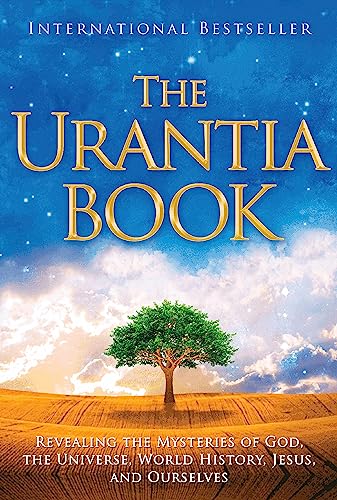
Option 4: Buy a print copy (hardcover/softcover and more)
If you want a distraction-free reading experience, many readers still prefer print—especially for heavy study, margin notes, and long sessions.


Study groups and courses (how to learn with others)
If you suspect you’ll be in this for the long haul, learning with others can be a major upgrade.
- Urantia Foundation’s “Connect With Readers” page points to a study group directory that includes virtual and in-person listings.
- Urantia Foundation also operates an online school (Urantia Book International School / UBIS) with free courses offered in multiple languages and trimesters throughout the year.
FAQ (high-intent SEO section)
Is The Urantia Book a religion?
It is best described as a spiritual and philosophical text that many readers treat as revelatory, rather than as an institutional religion. Urantia Foundation also emphasizes that individuals should engage directly with the text and that the Foundation does not provide interpretive “official doctrine.” Urantia
Do I have to believe everything in it?
No. A mature way to approach the book—especially at first—is as a study text. Evaluate ideas carefully, compare them with your own experience and values, and allow time for reflection.
How long does it take to read?
That depends on your pace and whether you read analytically. Many people treat it as a long-term study (months to years). A sustainable plan beats an intense sprint.
Is there a recommended reading order?
Many new readers start with Part IV because it is narrative and accessible, then move outward to the cosmology and history papers. The official contents list makes this modular approach easy.
Does it contradict the Bible?
Sometimes it offers interpretations and narrative expansions that differ from traditional Christian readings. How you interpret that depends on your theology and your willingness to engage alternative perspectives.
Where can I read it for free?
Urantia Foundation provides the official text online and also offers free downloads (including EPUB and PDF)
Is the English text really public domain?
Urantia Foundation states that the international copyright for the 1955 English text expired in January 2006 and that the English text is in the public domain; it also distinguishes this from translations and from trademark rights.
Where can I find an official audiobook?
Urantia Foundation provides a complete, unabridged audio reading and notes additional availability (including Spotify).
Are there study groups or courses?
Yes. Urantia Foundation points readers to a study group directory and also offers free online courses through UB
Closing thoughts
The Urantia Book is not a casual read—it is a “wide universe” book. But for readers who are drawn to spiritual depth, cosmic scale, and a long-form exploration of God, destiny, and the life of Jesus, it can become a lifelong companion text.
If you are curious, the best next step is simple: read a small portion consistently, ideally using the official online Standard Reference Text and reference system, and let your understanding grow organically over time.
Enjoyed this content? Read more on our website.